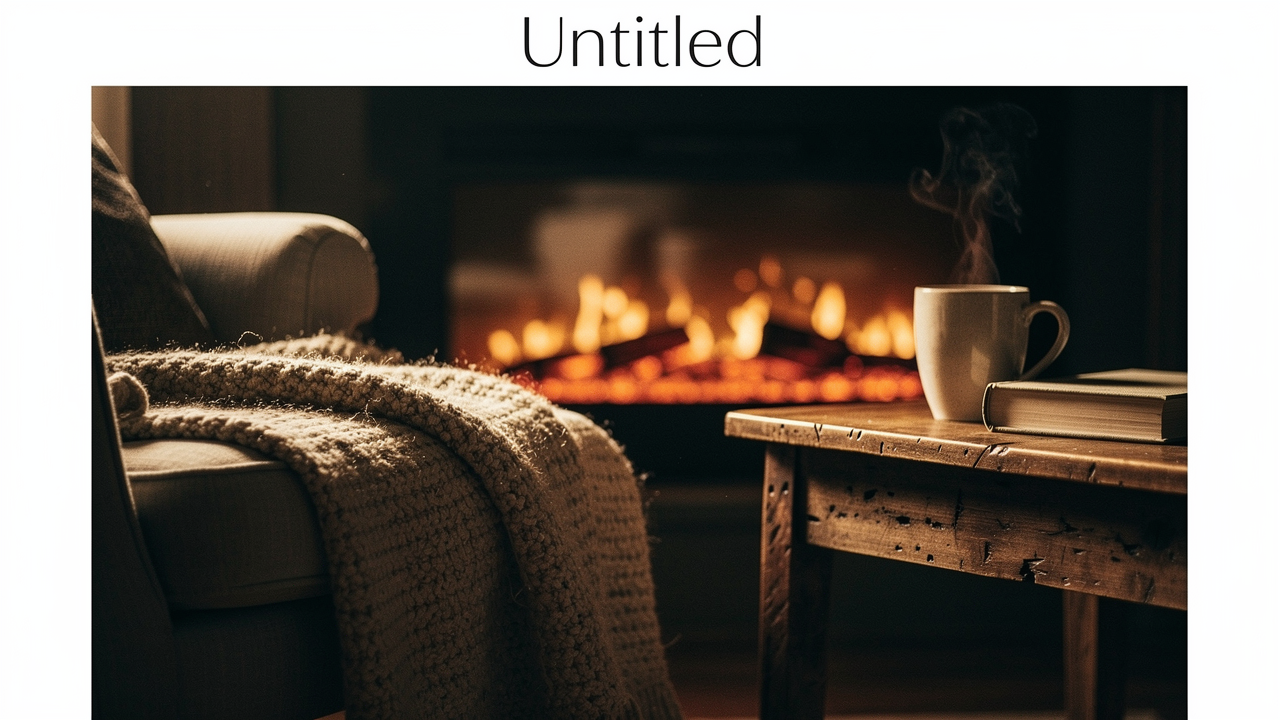
I remember the exact moment it hit me. It was a Tuesday evening in late November, and a rare Austin cold front had turned my breezy apartment into something that felt more like a sterile storage unit than a sanctuary. My thermostat said 72 degrees, but my body—and my brain—said “cold.”
I call this “soul discomfort.” It’s that restless feeling you get when your environment is functionally fine but emotionally empty. I was sitting on my sofa with a cup of herbal tea, staring at a blank, white wall where a “heart” should be. We’ve all been there, right? You spend your day optimizing your spreadsheets and your sourdough starter, but when you sit down to reset, your space doesn’t give anything back to you.
As a lifestyle curator, I’m obsessed with “High Lifestyle ROI”—those rare purchases where the improvement in your daily joy far outweighs the hit to your bank account. I didn’t have $5,000 for a structural renovation, but I did have a car and a nearby Home Depot. That’s how I ended up with a $200 electric fireplace that, quite frankly, did more for my mental health than three years of “perfect” interior design.
The Problem: Why Your ‘Warm’ Home Still Feels Cold
Here’s a secret I’ve learned from years of home optimization: being warm isn’t just about the temperature on the wall. You can crank the heater until your skin feels dry, but if your home lacks a focal point of light and movement, it can still feel “cold.”
According to experts at Sealed.com, many of us struggle with physical “cold spots” caused by air leaks and poor insulation in our building envelopes [1]. But beyond the literal drafts, there is a psychological layer to warmth. A 2024 report in Psychology Today notes that “comforting spaces” rely heavily on environmental familiarity and sensory cues to trigger a sense of safety and well-being [2].
When we lack a central “hearth”—a place for the eyes to rest and the mind to drift—we experience a subtle form of environmental stress. For me, that sterile Austin apartment was technically heated, but it lacked the soul-soothing glow that humans have relied on for millennia. I needed an instant ambiance upgrade, but I needed it to be renter-friendly and budget-conscious.
The Search for a Budget Fireplace Solution
I’ll be honest: I was a total skeptic. In my mind, “fake fireplaces” were synonymous with tacky plastic logs and a light effect that looked like a 1990s screensaver. I started my research looking at the “real” stuff. I quickly found that according to Majestic Products, installing a traditional wood-burning or gas fireplace can easily run between $2,000 and $6,000—and that’s if you even have the permit to cut a hole in your roof [3].
As a renter, that was a non-starter. I shifted my focus to electric. What changed my mind was a piece in Wired about the Turbro Suburbs electric fireplace. The reviewer mentioned that even a budget unit could actually lower your blood pressure and promote recovery [4].
I realized I didn’t need a $5,000 masonry masterpiece. I needed a $200 “High Lifestyle ROI” tool that I could plug into a standard outlet. I headed to Home Depot to see if their sub-$200 lineup could actually deliver on that promise without looking like a cheap prop.
Product Deep Dive: The $200 Home Depot Contender
Let me be honest about my journey to the checkout counter: I stood in the heating aisle of the Mueller Home Depot for forty minutes, comparing the flicker patterns of three different boxes. I was terrified of buyer’s remorse. I eventually settled on a freestanding unit from their StyleWell or Turbro collection—specifically a model under that $200 sweet spot that promised supplemental heat for up to 400 square feet.
The unboxing was a dream for any minimalist. At roughly 30 pounds, I could move it myself (portability is key for us apartment dwellers!), and it took exactly four screws to attach the legs. No electricians, no gas lines, just a standard three-prong plug.
Heating Performance vs. Noise Levels
Here’s the thing about budget heaters: they usually sound like a jet engine taking off. I was worried the fan would ruin my morning yoga or the quiet hum of a Sunday reset.
I was pleasantly surprised. The fan is a gentle “white noise” hum—not silent, but certainly not intrusive. In terms of heat, it’s a powerhouse for its size. It uses a standard forced-air system that puts out about 4,700 BTUs. In my 15′ x 20′ living area, it raised the temperature by three degrees in about twenty minutes. It’s the perfect supplemental heat source, allowing me to keep the main thermostat lower while staying perfectly cozy in my “healing corner.”
The Realism Factor: Does it Look ‘Fake’?
This is where the skepticism usually wins. Does it look like a real fire? No, if you’re standing six inches away. But from the comfort of your sofa? The LED technology has come a long way. The “flicker” isn’t a predictable loop anymore; it’s a soft, rhythmic glow that mimics the way light dances off a dying ember.
Most budget units at Home Depot now use refractors and high-efficiency LEDs to create a depth that didn’t exist five years ago. It’s less “screensaver” and more “mood lighting.”
Micro-Verdict: A surprisingly sturdy, quiet, and glowy win for small spaces.
The Ambiance Upgrade: Styling Your $200 Fireplace
You can buy the best tech in the world, but if you just plop it against a bare wall, it’s going to look like an appliance. To get that Architectural Digest look on a Home Depot budget, you have to “anchor” the unit.
Architectural Digest suggests that “mood lighting 101” involves layering your light sources [5]. You want to avoid the big overhead “landlord light” at all costs. I also took a page from Martha Stewart, who advocates for sub-$100 upgrades like textiles and greenery to soften hard edges [6].
The Cozy Curator Loadout
- Essential: A chunky wool throw draped over a nearby chair to add texture.
- Essential: A pair of brass candlesticks or battery-operated pillars to vary the height of the light.
- Essential: A large floor plant (like a Bird of Paradise) to flank the unit and hide the power cord.
- Pro Upgrade: A vintage-style rug placed just under the front feet of the fireplace to define the “hearth zone.”
The ‘Soul’ Test: My Ritual and Results
The real “Lifestyle ROI” didn’t show up on my utility bill; it showed up in my nervous system. Since adding this unit, I’ve started a nightly “fire ritual.” Instead of scrolling on my phone until 11 PM, I turn off the overhead lights, click on the fireplace (often without the heat on, just for the glow), and practice the 5-4-3-2-1 grounding technique [7].
There is something deeply restorative about watching the flicker. It creates a “soft fascination” state—a term psychologists use for environments that allow your brain to recover from the “hard fascination” of screens and city life.
By creating a restorative environment, I’ve found that my Sunday resets actually leave me feeling… well, reset. My “soul discomfort” has been replaced by a genuine sense of home.
Is it Worth It? The Lifestyle ROI Verdict
If you are looking for a primary heat source to warm a 3,000-square-foot house in a blizzard, this isn’t for you. But for the rest of us?
- Best For: Renters who want a focal point, small-apartment dwellers, and anyone whose “cozy” needs an immediate boost.
- The Pros: Under $200, extremely portable, safe for pets/kids (cool-to-the-touch glass), and instant ambiance.
- The Cons: Supplemental heat only; the fan noise might bother the ultra-sensitive.
Bottom line: This is one of the few times where $200 can genuinely buy you a better quality of life. It’s not just a heater; it’s a heart for your home.
Check out the current sub-$200 lineup at
and start your own evening ritual. Your soul will thank you.***
Suggested Disclaimer: This review is based on personal testing and my specific home environment. Electric fireplaces are intended as supplemental heat sources and should never replace your primary heating system or be left unattended for extended periods.
References
- Sealed.com (2024), “How to Stay Warm in a Cold House,” https://sealed.com/resources/how-to-stay-warm-in-cold-house/
- Psychology Today (2024), “Comforting Spaces: What Makes Us Feel at Home,” https://www.psychologytoday.com/us/blog/live-long-and-prosper/202405/comforting-spaces-what-makes-us-feel-at-home-in-the-world
- Majestic Products (2025), “Wood Burning Fireplace Installation Costs,” https://www.majesticproducts.com/fireplaces/wood
- Wired (2025), “The Turbro Suburbs Fireplace: A Rave Review,” https://www.wired.com/story/turbro-suburbs-fireplace-rave-2025/
- Architectural Digest (2024), “Mood Lighting 101,” https://www.architecturaldigest.com/story/mood-lighting-101
- Martha Stewart (2024), “Easy Home Upgrades Under $100,” https://www.marthastewart.com/easy-home-upgrades-under-100-11863577
- PsychCentral (2024), “How to Deal with Emotional Pain and Grounding,” https://psychcentral.com/blog/how-to-deal-with-emotional-pain