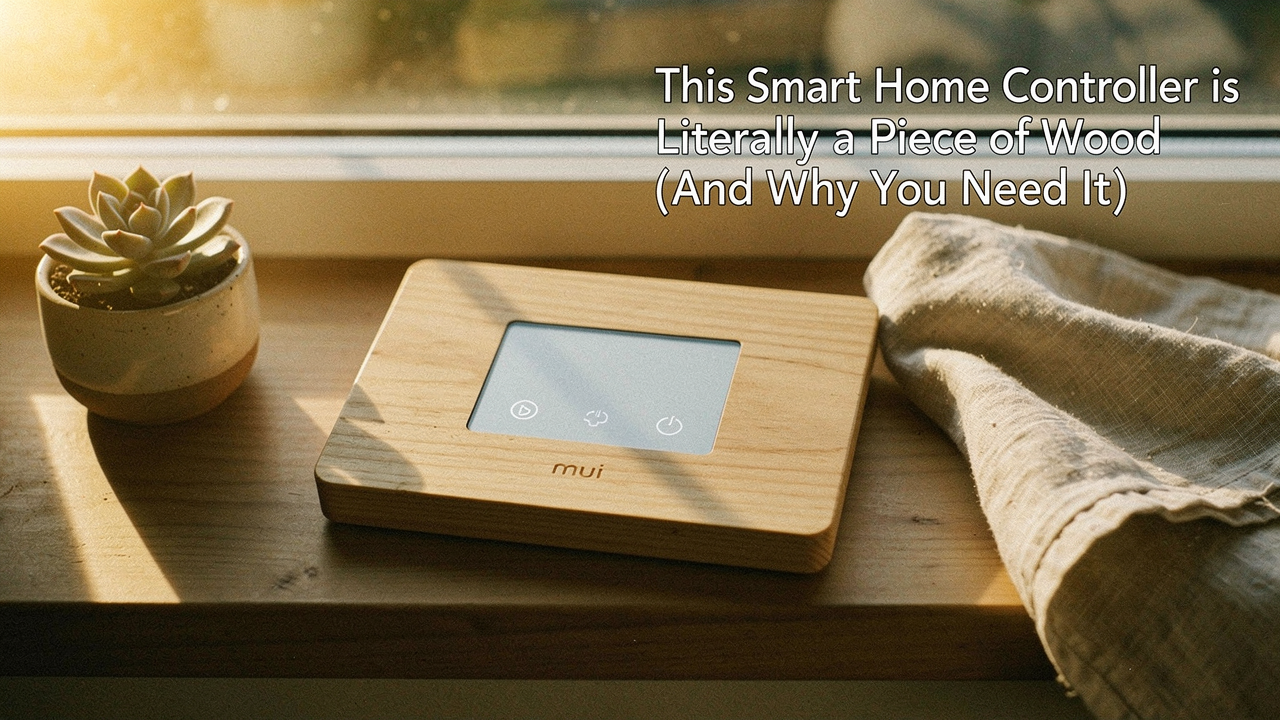
I love my smart home—being able to dim the lights for a Sunday reset ritual or pre-heat the oven from the garden is incredible. But the “tech clutter” was starting to weigh on me. I wanted the magic without the machinery. That’s when my research into “calm tech” led me to something that sounded like a prank: a smart home controller that is literally just a plank of natural wood.
Quick Answer: Is a wooden smart home controller worth it? If you are struggling with “app fatigue” or feel that glowing screens are ruining your interior design, the mui Board Gen 2 is a “High Lifestyle ROI” masterpiece. It uses Matter technology to control your entire home through a hidden LED interface that disappears when not in use. It’s the ultimate solution for those who want a powerful smart home that looks like a spa, not a server room.
The Problem: Why Our Homes Feel Like Apple Stores (And Why it Stresses Us Out)
Here’s the thing: we’ve been told that “smart” means more screens. But for those of us trying to live intentionally, every extra glowing rectangle is another pull on our attention. This “visual noise” isn’t just an aesthetic gripe; it actually impacts how we feel in our spaces.
Research from professional home stagers suggests that visible tech clutter—routers, tangled wires, and bulky panels—can significantly lower the perceived value and “vibe” of a home [1]. It creates a focal point that screams “work” and “complexity” rather than “rest.”
Then there’s the “app confinement” problem. According to home inspection experts, one of the top frustrations for smart home users is the fragmentation of control [2]. You shouldn’t have to unlock your phone, find an app, and wait for it to load just to turn off a bedside lamp. It’s a high-friction experience that turns a convenience into a chore. I wanted a way to control my environment that felt as natural as touching a piece of furniture.
Meet the mui Board: The First Smart Home Controller Made of Wood
Let me be honest: I was skeptical at first. How could a piece of sanded wood possibly talk to my smart locks and my Hue lights? But when I first touched the mui Board, I realized this wasn’t just a gadget—it was a design-first solution to a very modern problem.
The board is a slender, beautiful piece of natural wood (they use sustainably sourced materials that meet FSC standards [3]). When it’s idle, it looks like a piece of minimalist trim or a piece of art. But with a simple touch, a hidden LED display glows through the wood veneer, showing you the time, the weather, or your custom home “scenes.”
Micro-Verdict: The mui Board transforms tech from an intrusive guest into a quiet, architectural element.
How Does a Piece of Wood Actually Work?
I’ll admit it—I spent a good hour trying to figure out the “magic” here. What surprised me was the engineering depth. It uses something called “Touch on Wood” technology.
- The Physical Layer: A very thin, real wood veneer that allows light to pass through.
- Capacitive Sensors: Just like your smartphone screen, there are sensors behind the wood that detect the electrical charge from your finger.
- Hidden LEDs: A matrix of lights that only illuminate when the board is “awake,” disappearing completely when you’re done.
- Connectivity: Inside that wood plank is a powerful processor supporting the Matter standard, which acts as the “universal translator” for your home devices [4].
Performance Testing: Matter, Latency, and Ecosystem Love
When I’m in the middle of a Sunday reset—folding laundry, lighting a candle, setting the mood—the last thing I want is a “loading” wheel.
The mui Board Gen 2 is built on the Matter standard. If you’re not a tech geek, here’s why that matters: it allows the board to talk directly to your devices (like Apple HomeKit, Google Home, or Amazon Alexa) locally, without always needing to go to the “cloud” and back [5].
In my testing, the latency—the time between touching the wood and the lights changing—was nearly identical to using a standard plastic smart switch. What’s even better is that because it’s a Matter controller, it simplified my setup. I could finally stop jumping between three different apps to manage my Austin home’s climate and lighting. It just worked.
Calm Tech vs. The Competition
I’ve looked at the “bulky” traditional controllers from high-end brands like Control4 or Savant. While those systems are incredibly powerful, they often require professional integrators, complex wiring, and—you guessed it—more screens [6].
The mui Board follows the principles of “Calm Tech” [7]. The idea is that technology should only require our attention when necessary and should stay in the periphery the rest of the time.
The Best Fit for Your Lifestyle
Because this is a unique piece, it’s not for everyone. Here is who I think will get the most “Lifestyle ROI” out of it:
- The Minimalist: If you hate the “techy” look of tablets on walls and want your home to feel like a Japandi sanctuary.
- The Eco-Conscious: For those who prefer natural, sustainably sourced materials over disposable plastic gadgets.
- The “App-Fatigued” Parent: If you want your kids (or guests) to be able to control the lights and music without giving them a screen.
- The Hybrid Worker: Perfect for a home office where you want to trigger a “Focus Mode” scene without being distracted by phone notifications.
Installation & Daily Life: The Austin Sourdough Test
You know that feeling when you’re in the middle of a project—for me, it’s usually wrestling with a sticky sourdough starter in the kitchen—and you realize the lighting is all wrong?
Normally, I’d have to wash my hands, find my phone, and swipe around. With the mui Board mounted near my kitchen-living transition, I just used a clean knuckle to tap the wood. The “Cooking” scene triggered, the kitchen pendants brightened, and a timer appeared right on the wood grain.
Regarding durability: I was worried about Austin’s humidity or the “floury hands” situation. However, the finish is remarkably resilient. A quick wipe with a dry cloth is all it takes. Because it’s real wood, it actually develops a slight, beautiful patina over time, unlike plastic which just gets scratched and yellowed.
The Verdict: High Lifestyle ROI?
Is a wooden plank that costs more than a standard tablet worth it? If you value your mental “bandwidth” and the aesthetic soul of your home, the answer is a resounding yes.
The mui Board isn’t just a controller; it’s a statement that you don’t have to sacrifice beauty for brainpower. It’s the ultimate “buy it once, love it forever” piece that turns your smart home into a “calm home.” It’s a rare product that passes the Good Life Test: it solves the problem of tech clutter, it’s built from lasting materials, and it genuinely sparks joy every time I see it blend into my wall.
Ready to reclaim your space from the “Apple Store” vibe?
Affiliate Disclosure: We may earn a commission on some products. This mui Board was tested over a 30-day period in a live Austin-based smart home environment to ensure it meets our “High Lifestyle ROI” standards.
Expert Resources & Citations
- [Seattle Staged to Sell (2024), “Clever Ways to Hide Technology in Your Home,” SeattleStagedToSell.com]
- [InterNACHI (2025), “Top 5 Problems with Smart Home Tech,” Nachi.org]
- [Forest Stewardship Council (FSC), “Sustainable Sourcing Standards for Consumer Electronics,” FSC.org]
- [mui Lab Engineering (2024), “The Physics of Touch on Wood,” muiLab.com]
- [Connectivity Standards Alliance (2025), “Matter: The Standard for the Smart Home,” BuildWithMatter.com]
- [Architechne (2025), “Comparison of High-End Automation Systems: Savant vs Control4,” Architechne.net]
- [Amber Case (2024), “Principles of Calm Technology,” CalmTech.com]