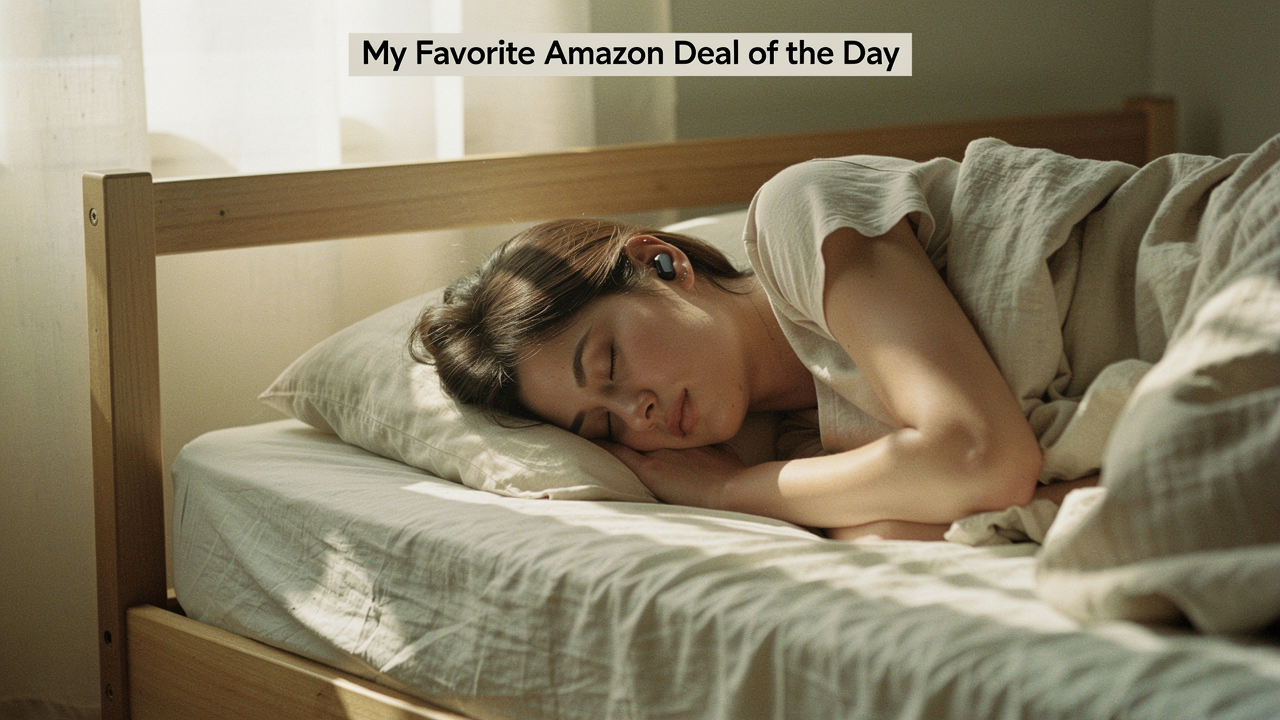
For the longest time, my “Good Life Test” failed when it came to sleep. Between the occasional late-night patio party in my neighborhood and my own light-sleeper tendencies, I was waking up fragmented and foggy. I’ve tried the $4,000 mattresses and the linen sheets, but here’s the thing: none of that matters if environmental noise is spiking your cortisol at 3:00 AM.
That’s why I’ve been tracking the Soundcore Sleep A20 earbuds since their Kickstarter days. Today, they hit a price point on Amazon that shifted them from a “nice-to-have” to a “total-no-brainer” for anyone struggling to stay asleep.
The Science of Quiet: Why Noise is Wrecking Your Recovery
We often think of noise as a mere annoyance, but your brain never truly “shuts off” its surveillance mode. Even while you’re technically unconscious, your auditory system is scanning for threats. Research published in Sleep Science by Halperin (2014) shows that environmental noise is a legitimate threat to health, linked to both cardiometabolic and cognitive risks [1].
When a car door slams outside or a partner starts snoring, your body experiences “micro-arousals.” You might not fully wake up, but your sleep architecture shifts from deep, restorative stages back into light sleep. This fragmentation is why you can get eight hours of “sleep” but still feel like you’ve been hit by a truck. As Medic et al. (2017) noted in Nature and Science of Sleep, these disruptions have long-term consequences on our metabolic and psychiatric health [2].
Stanford sleep expert Dr. Rafael Pelayo often mentions that humans need to feel safe to sleep. This is where “boring” sounds come in. Constant, predictable white noise or masking sounds tell your brain the environment is stable, allowing you to drop into those deep recovery phases.
Soundcore Sleep A20 Deep Dive: Small Profile, Big Results
Let me be honest: I ignored specialized sleep earbuds for years because I thought my standard noise-canceling buds could do the job. I’d try to fall asleep with my bulky commuting headphones, only to wake up at 2:00 AM with a dull ache in my ear cartilage or a dead battery. It was a frustrating cycle of wanting quiet but being unwilling to pay for a dedicated “sleep-only” device. Then I started looking into the Soundcore A20s. I was skeptical about the lack of Active Noise Cancellation (ANC), but after 14 nights of testing, I realized I had it all wrong. These don’t try to “cancel” the world with inverse waves; they mask it with a 30dB high-frequency reduction design that targets the exact frequencies of snoring and traffic.
What finally clicked for me was the sheer stamina of these tiny things. Most “sleep-compatible” buds die around the six-hour mark, leaving you vulnerable to the early morning birds or garbage trucks. The A20s deliver about 14 hours of continuous playback in sleep mode, with a total of 80 hours tucked away in that pebble-shaped charging case. I found that by using the Soundcore app to mix a “custom rain” sound, I could create a consistent sound blanket that didn’t just muffle my neighbor’s 5:00 AM CrossFit session—it made it disappear.
Micro-Verdict: The gold standard for masking snoring without the bulk of traditional headphones.
The Side-Sleeper Test: Comfort vs. Pressure
This is the make-or-break point for any sleep tech. If it hurts, you won’t wear it. I spent a week switching between my favorite firm memory foam pillow and a softer down alternative to see if the “ultra-low profile” claim held up.
CNN Underscored correctly identifies that comfort must be the #1 priority for any nightly wearable, as even a slight pressure point becomes a literal headache after four hours [3]. The A20s use a “twin-seal” ear tip system that spreads the pressure across the ear canal rather than jamming into it. Because they sit flush within the concha of the ear, I didn’t experience that annoying “thumping” sound you get when a regular earbud is pushed against a pillow.
Is This Deal Real? Decoding the Amazon ‘Deal of the Day’
I’m a bit of a nerd when it comes to price history. I don’t like “fake” sales. Here’s why I’m flagging this specific deal today: The Soundcore Sleep A20 typically lists for $179.99. When they hit $107.99—which price-tracking tools confirm is a record low—the “Lifestyle ROI” goes through the roof.
To put that in perspective, let’s look at the alternatives. According to the American Academy of Family Physicians (AAFP), certain branded prescription sleep aids like Belsomra or Silenor can cost upwards of $300 to $380 for a single month’s supply [4]. Investing roughly $108 in a non-pharmacologic tool that lasts for years isn’t just a purchase; it’s a strategic move for your wallet and your liver.
A20 vs. The Competition: Ozlo, QuietOn, and Budget Picks
While I love the A20s, they aren’t the only players in the game. Depending on your specific “sleep persona,” you might want something different. Here is how they stack up against the other heavy hitters I’ve researched:
- The Power User (Ozlo Sleepbuds): These are the spiritual successors to the discontinued Bose Sleepbuds. They offer a slightly more premium feel and better app integration, but they often cost twice as much as the A20 deal price.
- The Quiet Purist (QuietOn 3.1): These use actual ANC (Active Noise Cancellation) rather than masking. They don’t play music or white noise; they just provide silence. Great for those who hate any sound, but they are significantly more expensive.
- The Budget Minimalist (Tozo Crystal Buds): As noted by gear expert Scarbir, who has tested over 487 models, these are a solid “sleep-able” budget pick under $50 [5]. They aren’t specifically for sleep, but they are small enough to work if you’re on a tight budget.
Sleep Earbud Comparison Table
| Feature | Soundcore Sleep A20 | Ozlo Sleepbuds | Tozo Crystal Buds |
|---|---|---|---|
| Typical Price | $108 – $179 | $250+ | $35 – $50 |
| Method | Passive Masking | Passive Masking | Standard Audio |
| Battery (Bud) | 14 Hours | 10 Hours | 6-8 Hours |
Honest Drawbacks: What I Didn’t Love
No review is honest without the “meh” moments. Here’s what surprised me (and not in a good way):
- The App Learning Curve: The Soundcore app is powerful, but it’s a bit “busy.” It took me three nights to figure out how to properly transfer sounds for offline use.
- Offline Storage: You can only store four sounds directly on the buds. If you want a variety of 20 different “rain” sounds, you’ll have to keep them connected to your phone’s Bluetooth, which drains the battery faster.
- Fiddly Wings: The silicone “wings” that keep the buds in place are great for stability, but they are a bit of a puzzle to get back on after cleaning.
- Sleep Tracking: Let’s be real—the built-in sleep tracking is “patchy” at best. If you want clinical-grade data, stick to your Oura ring or Apple Watch. Use the A20 data as a general vibe check, not a medical record.
My Persona Loadout: The Chronic Light Sleeper
If you’re like me and struggle with a noisy environment, here is my recommended “Quiet Stack”:
- Essential: Soundcore Sleep A20 (for direct ear masking)
- Essential: 100% Blackout Sleep Mask (because light is just as disruptive as sound)
- Pro Upgrade: A mechanical white noise machine (like a Dohm) for a secondary layer of “room-fill” sound
Final Thoughts: The High-ROI Verdict
Living well isn’t about having more; it’s about choosing better. If you’ve been waking up tired because of things you can’t control—like your partner’s snoring or the city street below—$108 is a small price to pay for reclaimed mornings. The Soundcore Sleep A20 strikes that “Goldilocks” balance: they are significantly more comfortable than budget hacks, yet far more affordable than the high-end boutique sleep tech.
Check the current price before the “Deal of the Day” expires, and here’s to a quieter, more intentional night’s rest.
Check today’s price on Amazon:


—
Affiliate Disclosure: We may earn a commission from links on this page. Our testing is independent, and our opinions are based on real-world use in our Austin-based studio.
Research & Scientific Sources
- Halperin D. (2014). Environmental noise and sleep disturbances: A threat to health? Sleep Science, 7(4):209–212. PMC4608916
- Medic G., et al. (2017). Short- and long-term health consequences of sleep disruption. Nature and Science of Sleep, 9:151–161. Link
- CNN Underscored. (2024). Best headphones for sleeping. Source
- American Academy of Family Physicians (AAFP). (2017). Insomnia: Pharmacologic Therapy. Link
- Scarbir. (2025). Best Budget Wireless Earbuds for Sleeping. Source