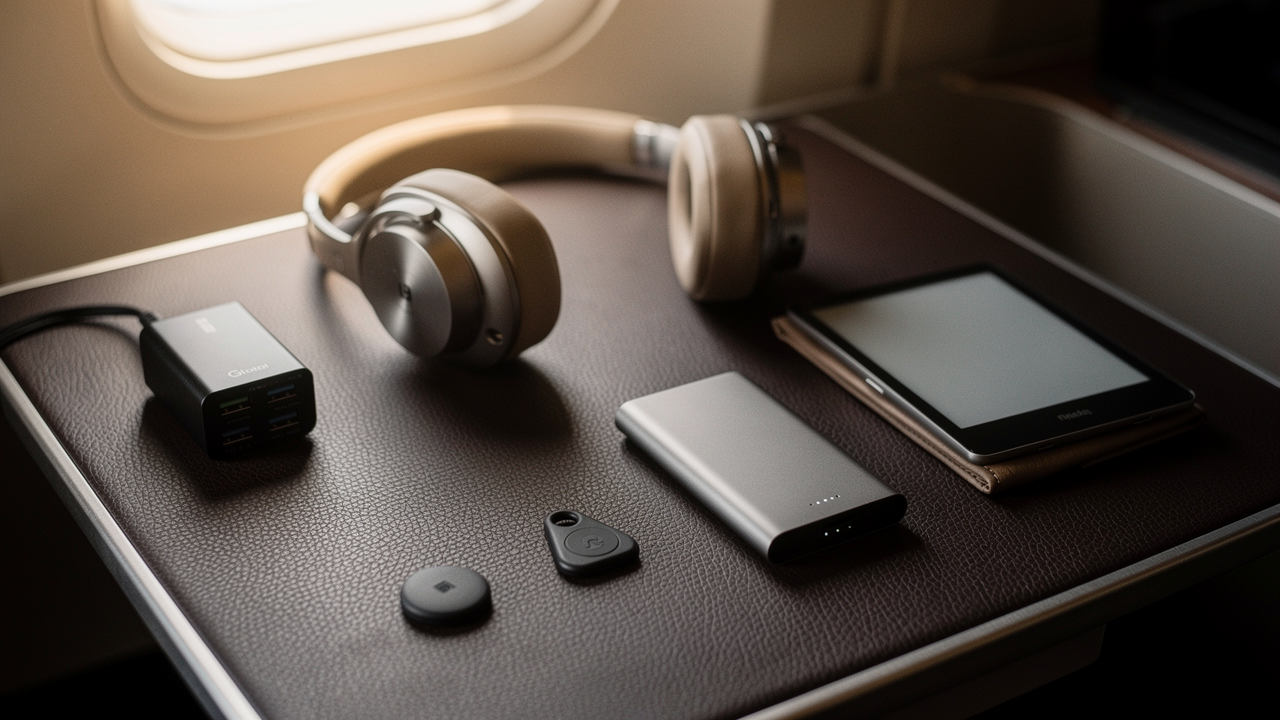
What I’ve learned after a decade of digital wellness coaching and home optimization is that travel isn’t about having everything; it’s about having the right things. I call it High Lifestyle ROI. Every item in your carry-on should earn its keep by solving a real problem, lasting for years, and adding a bit of joy to the friction of travel.
Here’s the thing: most “must-have” travel tech lists are bloated with gimmicks you’ll use once and then lose in the back of a drawer. I’ve spent the last few years ruthlessly editing my own kit down to a “Travel Tech Operating System.” It’s a five-gadget framework designed to handle power, connectivity, and organization without the weight. Let’s get your bag sorted.
The Strategy: Why Your Travel Tech Needs a ‘System’
Before we talk products, we have to talk philosophy. I used to pack reactively—tossing in chargers as I saw them. This led to what researchers identify as “gadget packing stress,” a specific type of decision fatigue that makes you feel like you’ve forgotten something even when your bag is overflowing [8].
Now, I follow the One-Pouch Rule. If it doesn’t fit in my designated tech organizer, it doesn’t come. This forces me to choose versatile gear over single-use items. When I evaluate a piece of travel tech, I look for three things:
- Versatility: Can it charge more than one device? Does it work in multiple countries?
- Reliability: Will it survive a coffee spill or being crammed into a seatback pocket?
- Size-to-Power Ratio: Does it provide enough “juice” or utility to justify its weight in my bag?
As Wirecutter notes in their guide to one-bag travel, the goal is to create a repeatable system so you can spend less time worrying about your battery percentage and more time enjoying the destination [3].
1. The Universal Powerhouse: A Multi-Port GaN Charger
Let me be honest: I used to be the person crawling under airport terminal seats looking for a free outlet, only to realize my bulky laptop brick wouldn’t stay plugged into the loose socket. It was a daily frustration that made every travel day feel like a frantic search for juice. I tried carrying multiple small blocks, but that just meant I needed more outlets than my hotel room had.
What finally clicked for me was switching to Gallium Nitride (GaN) technology. Unlike the old silicon-based chargers we grew up with, GaN chargers are smaller, more efficient, and stay much cooler even when they’re working hard [4]. I found the Tessan Voyager 205, and it completely changed my morning routine. Instead of hunting for four different outlets to charge my phone, watch, Kindle, and laptop, I just need one.
Micro-Verdict: The ultimate space-saver that replaces a bag full of bricks with one sleek, multi-port solution.
Why GaN Wins for Frequent Flyers
If you’re still using the white bricks that came with your devices, you’re carrying dead weight. Here is why I made the switch:
- Efficiency: It charges up to eight devices simultaneously—six USB-C ports, one USB-A, and a pass-through AC outlet [4].
- Global Reach: It’s compatible with outlets in over 200 countries, meaning I don’t need a separate adapter for London or Tokyo.
- Safety: GaN tech generates significantly less heat, which is a major win for the longevity of your expensive devices [4].
Best For: Remote workers who need to power a “full office” from a single hotel desk outlet.
2. The Connectivity Bridge: A Bluetooth Audio Transmitter
You know that feeling when you settle into a long-haul flight, ready to dive into a movie, only to realize your $300 noise-canceling headphones won’t connect to the seatback screen? For years, I either used the itchy, low-quality earbuds the airline gave out or sat there untangling a wired pair I only kept for flights. It felt like a step backward in a wireless world.
I’ll admit it—I was skeptical about adding another tiny gadget to my bag, but the AirFly Pro 2 won me over on a 12-hour flight to Seoul. It’s a tiny transmitter that plugs into the headphone jack and beams the audio directly to your AirPods or Bose headphones. Twelve South users often rave about the “crystal clear” audio, and I have to agree; being able to use my own comfortable, noise-canceling gear for in-flight entertainment makes the cabin noise virtually disappear [12].
Micro-Verdict: The missing link that brings your premium wireless headphones to the in-flight experience.


Best For: Frequent flyers who value high-fidelity sound and want to block out cabin noise during long trips.
3. The ‘Never-Dead’ Insurance: A Slim 10,000mAh Power Bank
I’ll never forget the time my phone died while I was trying to find a hidden Airbnb in the backstreets of Paris. No maps, no translator, no way to call the host. It was a stressful hour of trial and error that could have been avoided with a simple backup. I used to carry those massive, heavy power banks that felt like a brick in my pocket, but I found I rarely used them because they were so cumbersome.
What I found works best is a “Goldilocks” approach: the 10,000mAh slim bank. It’s the perfect balance between weight and capacity. My current favorite is from myCharge because it has the cables built-in (one less thing to lose!). In independent testing, these slim units provided over two full phone charges while still having half their battery left—more than enough to get you through a day of sightseeing and GPS use [9].
Micro-Verdict: Your digital safety net that fits in a pocket without weighing down your day.
Traveler Tip: Per IATA and TSA guidelines, lithium batteries must stay in your carry-on luggage. Never put your power bank in a checked bag—it’s a safety risk and you’ll likely have it confiscated [4].
4. The Piece of Mind: Bluetooth Trackers for Every Bag
The “lost luggage” horror stories of the last few years were my daily reality until I started using trackers. There is a specific kind of helplessness you feel standing at a baggage carousel that isn’t moving, wondering if your suitcase is even in the same country. I tried just “traveling light” with a carry-on, but sometimes checking a bag is unavoidable.
I started tucking an Apple AirTag into the lining of every bag I own—including my “personal item” backpack. What surprised me was how much it reduced my background anxiety. Instead of guessing, I can open the “Find My” app the moment we land and see that my bag is right there on the tarmac. For my friends on Android, the Tile Pro offers similar precision and a rugged build [5].
Micro-Verdict: Real-time visibility that turns luggage-loss anxiety into a manageable data point.
Best For: Anyone checking a bag or traveling with high-value gear like cameras or laptops.
5. The Secondary Life-Line: A Budget-Friendly Backup Phone
Here’s a scenario most people don’t plan for: your primary phone is stolen or shattered while you’re abroad. Because we use our phones for two-factor authentication (2FA) for everything from banking to email, losing that one device can lock you out of your entire digital life [6]. I ignored this risk for years until a friend got stranded in Mexico City without access to her bank account.
Now, I travel with a “Plan B.” I pack a budget-friendly, globally unlocked phone like the Motorola Moto G Power. It’s inexpensive enough that I’m not devastated if it’s lost, but it supports eSIMs and has an incredible three-day battery life [13]. I keep my essential travel apps and a backup of my 2FA codes on it, tucked safely in my hotel safe or a separate pouch in my bag.
Micro-Verdict: A low-cost insurance policy that ensures you’re never truly disconnected or locked out.

Best For: International travelers and digital nomads who can’t afford a single point of failure in their tech stack.
Organization: Taming the ‘Cable Spaghetti’
Even with just five gadgets, your bag can quickly become a disaster zone of tangled wires. This is where “tech packing solutions” move from a luxury to a necessity. I’ve found that using a dedicated organizer doesn’t just look better—it reduces the “gadget packing stress” by giving every cable a “home.”
As Wirecutter highlights, a good organizer should be slim, water-resistant, and easy to grab from your bag mid-flight [8].
Persona Tech Loadouts
Depending on how you travel, your “system” might look a little different. Here are the kits I recommend for different vibes:
- The Minimalist (Carry-on Only): Focus on the GaN charger and the slim power bank. Use a compact tech pouch like the Bellroy Tech Kit to keep things flat.
- The Digital Nomad: Add the backup phone and a foldable laptop stand. Prioritize a larger organizer like the Incase Nylon Accessory Organizer to hold extra dongles.
- The Family Vacationer: Opt for a multi-port charger with at least 4 USB-C ports to handle everyone’s iPads and headphones at once.
Staying Connected: Carrier Roaming vs. Local eSIMs
The final piece of the “Good Life” travel puzzle is staying online without a $500 bill waiting for you at home. Here’s the decision tree I use:
- Short Trips (1-3 days): I usually stick with my carrier’s day pass. AT&T, for example, offers an International Day Pass for about $12/day, which is seamless but adds up fast [10].
- Longer Stays (4+ days): I switch to an eSIM. T-Mobile offers great international data on many plans, but for others, apps like Airalo allow you to buy local data for a fraction of the cost [11].
- Cruises: Be extremely careful. Roaming rates on ships are notoriously high—often around $20/day for very limited data [10]. Always check your carrier’s specific cruise plan before you leave the dock.
Creating a Calm Travel Flow
At the end of the day, travel is about the moments that don’t require a screen—the sunset over Lady Bird Lake, the first bite of a perfect croissant, or the quiet of a mountain trail. But we use our tech to get to those moments safely and efficiently.
By investing in a high-ROI system—the right charger, a reliable backup, and a way to stay organized—you’re not just buying gadgets. You’re buying peace of mind. You’re ensuring that when you land in a new city, your focus is on the adventure ahead, not the “low battery” warning on your screen.
What’s the one tech item you absolutely can’t fly without? Let me know in the comments—I’m always looking to refine the system!
—
Affiliate disclosure: We may earn a commission from links on this page.
Battery safety: Always carry lithium power banks in your carry-on per TSA/IATA guidelines.
References
- NYT Wirecutter. (2025). The Best Travel Guide.
- Travel + Leisure. (2025). Essential Travel Tech Gear for Every Trip.
- Pack Hacker. (2024). Minimalist Tech Guide for One-Bag Travel.
- IATA. (2025). Passenger Essential: Lithium Battery Guidance.
- PCMag. (2025). Apple AirTag vs. Tile: Which Tracker Is Best?
- Electronic Frontier Foundation (EFF). (2024). Digital Security for Travelers.
- CN Traveller. (2025). The Best New Travel Gadgets for Frequent Flyers.
- NYT Wirecutter. (2024). The Best Tech Organizers.
- Travel + Leisure. (2025). Portable Power Bank Testing Results.
- AT&T. (2025). International Day Pass and Cruise Roaming Rates.
- T-Mobile. (2025). International Roaming Plans and Data Passes.
- Twelve South. (2025). AirFly Pro: Bluetooth for In-Flight Entertainment.
- Motorola. (2025). Moto G Power Specifications and Battery Life.