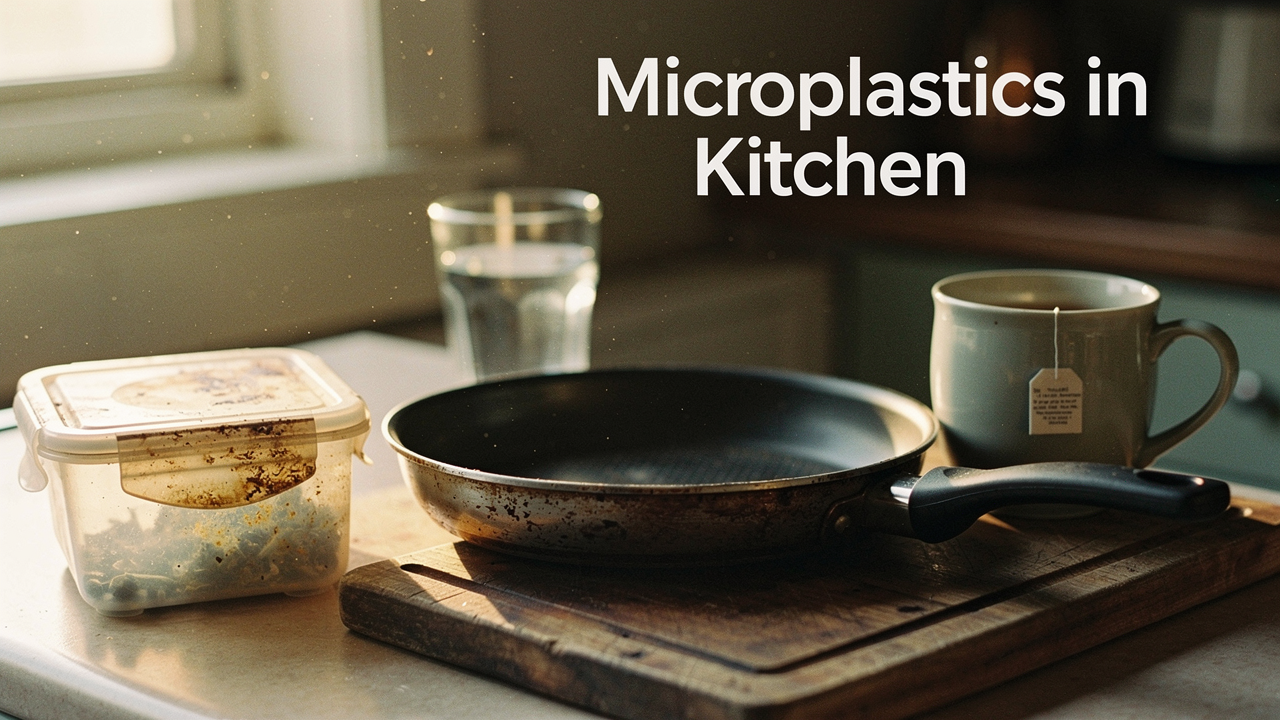
It hit me then: if the plastic was gone from the board, where exactly did it go?
The answer, as I’ve learned through months of research and conversations with environmental toxicologists, is that it likely ended up in my family’s dinner. In my world of “Best Goods for Good Life,” I talk a lot about High Lifestyle ROI—choosing items that genuinely improve our daily flow. But we can’t have a high-quality life if our environment is quietly working against us.
Microplastics aren’t just an “ocean problem.” They are a kitchen problem. But here’s the good news: unlike global industrial policy, you have total control over your kitchen. This isn’t about fear; it’s about optimization.
Quick Summary: The Kitchen Microplastic Audit
If you’re in a rush, here are the 7 biggest culprits shedding plastic into your food and the fastest way to fix it:
- The Culprits: Scratched non-stick pans, plastic cutting boards, synthetic sponges, plastic-lined tea bags, dishwasher pods, electric kettles with plastic internals, and pre-cooked rice.
- The Habit Fix: Stop microwaving in plastic immediately and rinse your rice before cooking (reduces particles by up to 40%).
- The Essential Swap: Trade your plastic board for wood or bamboo and your synthetic sponges for natural cellulose.
The Invisible Guest: Why Kitchen Microplastics Matter
Before we dive into the “what,” we have to talk about the “why.” I’m not a fan of alarmism—life is stressful enough—but the data coming out of the scientific community lately is hard to ignore.
Microplastics are tiny fragments less than 5mm in size, and nanoplastics are even smaller, often able to cross biological barriers in the body. A landmark 2024 study published in the New England Journal of Medicine found a sobering correlation: patients with detectable microplastics in their arterial plaque had a higher risk of heart attack, stroke, and even death [1].
Researchers at UCSF have also confirmed that these particles are now systemic in our bodies, found in everything from blood to human placentas [3]. While we are still learning the exact dose-response relationship, the consensus is moving toward a “precautionary principle.” If we can easily reduce the load of synthetic polymers and their associated chemicals like BPA and PFAS in our personal spaces, why wouldn’t we?
Think of it as a “body reset.” We spend so much time filtering our water and buying organic; it’s time to look at the tools we use to prepare that food.
7 Surprising Items Hiding Microplastics in Your Kitchen
Here is the thing about kitchen contamination: it usually happens through heat or friction. When we apply high temperatures or mechanical force to plastic, it sheds.
1. Scratched Non-Stick Cookware (PTFE)
I used to love my old non-stick omelet pan because nothing ever stuck to it. But here is the reality: many of those coatings are made from Polytetrafluoroethylene (PTFE). A systematic review of kitchen emissions found that even a single deep scratch on a non-stick pan can release thousands to millions of plastic fragments during a single cooking session [2]. If you see flakes or scratches, that pan is no longer “non-stick”—it’s a plastic delivery system.
2. Plastic Cutting Boards
Every time you chop a carrot on a plastic board, the knife creates “plastic snow.” You might not see it, but those micro-grooves are evidence of material being displaced. Research suggests that using a plastic cutting board could result in ingesting several milligrams of plastic per year just from the mechanical friction of food preparation.
3. Synthetic Dish Sponges
Those bright yellow-and-green sponges we all grew up with? They’re usually made of polyester or polyurethane. As they break down through scrubbing, they shed micro-fibers. These fibers either cling to your “clean” dishes or wash down the drain, contributing to the “wastewater footprint” identified by the EPA [4].
4. Plastic-Lined Tea Bags
This was the most heartbreaking discovery for me. Many premium “silky” tea bags are actually made of nylon or PET plastic. When steeped in boiling water, a single tea bag can release billions of microplastic and nanoplastic particles into your cup. I’ve officially switched back to loose-leaf and stainless steel steepers.
5. Dishwasher Pods
Most dishwasher pods are wrapped in Polyvinyl Alcohol (PVA), a water-soluble plastic. While it “dissolves,” it doesn’t always fully biodegrade in the wastewater treatment process. This contributes to the dissolved polymers that eventually find their way back into our water systems.
6. Electric Kettles with Plastic Internals
Heat is the primary catalyst for plastic shedding. If your electric kettle has a plastic window, lid, or filter that stays in contact with boiling water, you’re likely getting a side of polymers with your morning brew. A study on polypropylene cups found that hot liquids at 50°C (well below boiling) significantly accelerated particle release.
7. Pre-Cooked and Processed Rice
Convenience often comes with a hidden cost. Pre-cooked rice—the kind you buy in a plastic pouch—has been found to contain up to 13mg of plastic per serving, compared to much lower levels in bulk rice. The good news? Simply rinsing your dry rice before cooking can reduce the plastic load by 20–40% [2].
The Kitchen Cleanse: A Prioritized 3-Step Swap Plan
When I first started this journey, I felt like I needed to throw everything in the trash and start over. But that’s not sustainable, and it’s certainly not “High ROI.” Instead, I recommend a tiered approach.
Tier 1: The “Zero Cost” Habit Shifts
You don’t need to spend a dime to make your kitchen safer today.
- Stop the Microwave Melt: Never, ever microwave food in plastic containers, even if they say “microwave safe.” Use glass or ceramic instead.
- The Rice Ritual: Rinse your dry rice in a fine-mesh strainer until the water runs clear. It’s better for the texture, and it’s better for your health.
- The Retirement Rule: If a non-stick pan is peeling or a plastic board is heavily scarred, stop using it immediately.
Tier 2: The High-Impact Swaps (Under $50)
If you have a small budget for upgrades, start with the items that touch your food most often.
I’ll be honest—I used to ignore the sponge in my sink. It was just a tool until I realized I was essentially scrubbing my family’s plates with a block of shedding micro-polymers. I started finding those little green fibers in my dish rack, and it felt so counterproductive to “cleaning.” What finally clicked for me was switching to a natural, plant-based alternative that felt just as scrubby but didn’t leave a synthetic trail behind.
Micro-Verdict: A simple, affordable win for keeping plastic fibers out of your drain and off your dinnerware.
Best For: Families who want an eco-friendly sink setup without sacrificing scrubbing power.
Tier 3: The Long-Term Investment
These are the “buy once, cry once” items that will last a lifetime and offer the highest Lifestyle ROI.
Let me be real: transitioning away from my old non-stick set was intimidating. I was worried everything would burn or take hours to clean. But after researching how PTFE fragments can migrate into food, I knew I needed something inert. I invested in high-quality 18/10 stainless steel, and while there was a slight learning curve with heat control, the peace of mind is worth every penny. These pans don’t have a coating to fail; they just perform.
Micro-Verdict: The ultimate “High Lifestyle ROI” upgrade for a truly non-toxic, plastic-free cooking experience.


Best For: Home cooks ready to move away from disposable, coated pans toward heirloom-quality tools.
Decoding Labels: Identifying Safe Materials
When you’re out shopping in Austin or browsing online, don’t let “BPA-Free” labels give you a false sense of security. BPA is often just replaced with BPS or other similar chemicals. To truly audit your kitchen, look for the resin codes (the little numbers in the triangle) on your existing items:
- The “Safer” Choices: Codes #1 (PET), #2 (HDPE), and #5 (PP) are generally considered more stable, but they can still shed if heated or scratched.
- The Red Flags: Avoid #3 (PVC) and #6 (PS/Polystyrene) for food contact. They are notorious for leaching chemicals and shedding fragments.
- The Gold Standard: Look for LFGB-Certified Silicone. The German LFGB standard is much stricter than the FDA, ensuring the silicone is stable and won’t leach “fillers” into your food.
The Health-Conscious Minimalist Loadout
If you’re moving into a new place or doing a total reset, here is the minimalist kit I recommend:
- Essential: Two large wooden or bamboo cutting boards (one for produce, one for bread).
- Essential: A set of glass food storage containers with snap-on lids.
- Essential: One high-quality 10-inch stainless steel or cast iron skillet.
- Pro Upgrade: A glass or stainless steel electric kettle with zero plastic contact points.
Choosing a better life isn’t about perfection. I still have a few plastic lids in my drawer, and I’m sure a microplastic particle or two finds its way into my sourdough every now and then. But by making these seven swaps and shifting our daily habits, we’re taking the power back.
Start with one thing today—maybe it’s rinsing your rice or finally tossing that scratched omelet pan. Your future self (and your kitchen) will thank you.
Suggested Disclaimers:
This guide provides evidence-based suggestions for reducing exposure but does not constitute medical advice. Health outcomes regarding microplastics are an emerging field of study.
Data Sources & Further Reading
- Marfella, R., et al. (2024). Microplastics and Nanoplastics in Atheromatous Plaque. New England Journal of Medicine. https://www.nejm.org/doi/full/10.1056/NEJMoa2309822
- ScienceDirect. (2024). A systematic review of microplastics emissions in kitchens. https://www.sciencedirect.com/science/article/pii/S016041202400326X
- UCSF News. (2024). How to Limit Microplastics Dangers. https://www.ucsf.edu/news/2024/02/427161/how-to-limit-microplastics-dangers
- US EPA. (2021). Emerging Issues in Food Waste Management: Plastic Contamination. https://www.epa.gov/system/files/documents/2021-08/emerging-issues-in-food-waste-management-plastic-contamination.pdf