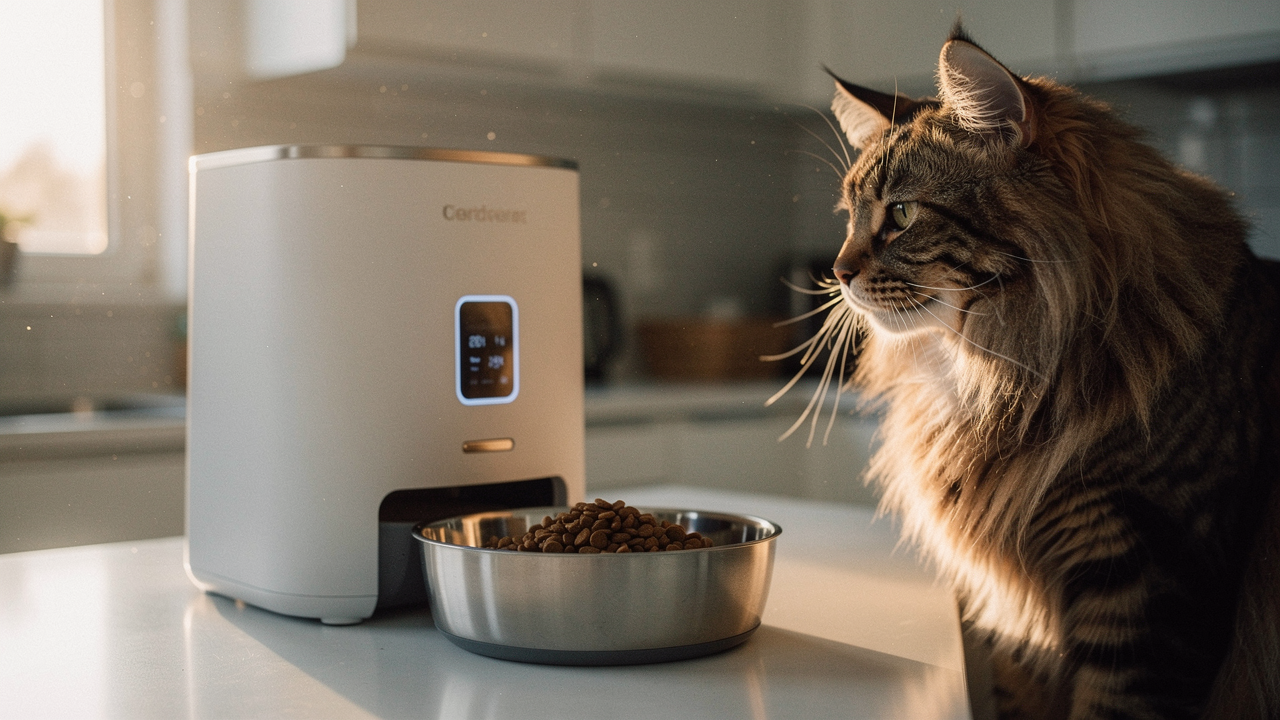
Living a “Good Life” in Austin usually involves a lot of intentionality—choosing the right sourdough starter, finding the perfect hiking trail, and optimizing my home to work for me, not against me. But for a long time, my cat’s feeding schedule was the one thing I couldn’t automate without feeling guilty. I worried about portion accuracy, Wi-Fi outages, and whether I was contributing to the “scarf-and-barf” cycle.
Here is the truth: A high-quality automatic feeder is one of the highest “Lifestyle ROI” items you can buy. It doesn’t just save your sleep; it manages your cat’s health with a precision we simply can’t match with a plastic measuring cup. In this guide, I’m breaking down the 10 models that survived my 30-day “Austin Apartment Stress Test” to help you find the one that fits your cat’s unique personality.
Quick Picks: The Best Automatic Cat Feeders for 2026
If you’re currently in the middle of a “kibble crisis” and need a recommendation fast, here are the winners that climbed to the top of my list:
- Best Overall: Pawsync Smart Pet Feeder (Unbeatable portion accuracy)
- Best Smart Feeder with Camera: HHOlove O Sitter (360-degree tracking for the anxious pet parent)
- Best for Wet Food: Petlibro Polar Wet Food Feeder (Actual refrigeration tech)
- Best for Multi-Cat Homes: SureFeed Microchip Pet Feeder (The “bully-proof” solution)
- Best Budget Pick: PitPet Smart Automatic Feeder (Reliable, no-frills scheduling)
The 2026 Health Framework: Why Your Choice Matters
Before we talk about the gadgets, we have to talk about the “why.” Here’s a staggering reality: Feline obesity is now reported in up to 63% of cats in developed countries [3]. When we “free feed”—leaving a mountain of kibble out all day—we aren’t just being “the fun parent.” We’re often accidentally inviting diabetes, joint pain, and digestive issues.
I spoke with several experts while researching this, and the consensus from VCA Animal Hospitals is that most adult cats thrive on at least two meals a day, though many benefit from 3–4 smaller, timed meals to maintain satiety and reduce begging [1]. The Cornell Feline Health Center echoes this, noting that “ad libitum” (all-you-can-eat) feeding is a primary driver of inappropriate weight gain [2].
Using a feeder isn’t about being lazy; it’s about being a better advocate for your cat’s longevity. By moving to a scheduled, portion-controlled system, you remove the “human-to-food” psychological link. Suddenly, you aren’t the person who denies them food; you’re just the person who provides the cuddles while the machine handles the math.
Body Condition Scoring: Is Your Cat a ‘5’?
Before you program your new feeder, you need to know your starting point. Veterinary professionals use a 9-point Body Condition Score (BCS) system to determine if a cat is at their ideal weight [3].
- The Rib Check: You should be able to feel your cat’s ribs with a slight layer of fat over them, but they shouldn’t be poking out.
- The Waist Check: Looking from above, your cat should have a visible “waist” behind the ribs.
- The Tummy Tuck: From the side, the abdomen should be tucked up, not hanging low.
A score of 5 is the “goldilocks” zone. If your cat is hitting a 7 or 8, your automatic feeder is about to become your most important weight-management tool.
Our Testing Methodology: How We Vetted the 2026 Class
I’ll admit it—I’m a bit of a geek when it comes to testing. For this 2026 review, I set up a “testing lab” in my kitchen for 30 days. I didn’t just look at the boxes; I ran these machines through the ringer.
Here’s what my testing involved:
- Portion Precision: I used a high-accuracy digital kitchen scale to measure ten consecutive “1-portion” dispenses. Many feeders claim to give you “1/8 cup,” but in reality, they vary wildly based on kibble shape.
- The “Heist” Test: I have a very motivated 12-pound tabby. I watched to see if a persistent paw could “hook” extra kibble out of the chute.
- Connectivity Chaos: I intentionally unplugged my Wi-Fi router during scheduled feeding times to see which models had local memory and which ones would “forget” to feed my cats.
- The “Scarf-and-Barf” Prevention: I looked for “slow-feed” modes that dispense portions over several minutes rather than all at once.
Detailed Reviews: The 10 Best Automatic Cat Feeders
1. Best Overall: Pawsync Smart Pet Feeder
I’ll be honest: I was skeptical about whether a feeder needed a built-in scale until I tried the Pawsync. Most feeders work on a “timer and rotor” system—the wheel turns once, and you get whatever falls out. But kibble isn’t uniform. A “portion” of small round kibble weighs more than a “portion” of large X-shaped kibble.
This became my daily reality when I switched brands and realized my previous feeder was over-dispensing by nearly 15%. Pawsync solves this by actually weighing the food in the bowl. It won’t stop dispensing until the target weight is reached, maintaining an incredible 2% discrepancy rate compared to the 10-15% I saw in cheaper models.
Micro-Verdict: The gold standard for precision-obsessed owners who want to stop the “guessing game” of caloric intake.
Best For: Overweight cats on a strict veterinary diet or owners who switch kibble brands frequently.
2. Best Smart Feeder with Camera: HHOlove O Sitter
Here’s the thing about being a cat parent: sometimes the “peace of mind” isn’t about the food, it’s about seeing their little faces. I tried a few camera feeders that only showed me the floor, but the HHOlove O Sitter uses 360-degree horizontal tracking.
What surprised me was the AI-driven “Activity Report.” It actually pings my phone to let me know if Miso hasn’t approached the feeder during his usual window, which is a huge early warning sign for health issues. While there is a subscription tier for expanded video storage, the base features are robust enough for most. CNN Underscored noted its superior build quality, and I have to agree—this thing is built like a tank [4].
Micro-Verdict: A high-tech security system and nutritionist rolled into one sleek, rotating tower.


Best For: Anxious pet parents who travel frequently and want a 24/7 visual on their cat’s behavior.
3. Best for Wet Food: Petlibro Polar Wet Food Feeder
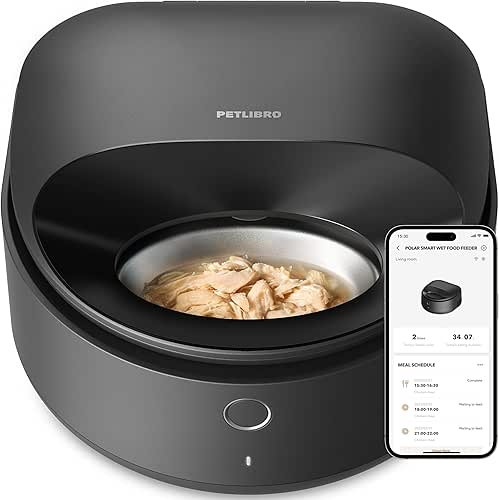
If your cat is a wet-food-only gourmet, you know the struggle of the “crusty bowl.” Most automatic wet feeders rely on ice packs that melt in four hours, leaving you with a lukewarm mess. The Petlibro Polar is different—it actually uses semi-conductor cooling tech.
It felt like a luxury to see Miso eating fresh, chilled pate at 2 PM while I was across town at a meeting. It has a larger footprint than dry feeders (roughly 14 inches wide), but the hygiene payoff is worth the counter space. Wired highlighted its ability to keep food fresh for up to 3 days, which is a massive leap for this category [5].
Micro-Verdict: The only reliable way to serve wet food without the “ice pack swap” dance every four hours.
Best For: Cats with urinary issues or kidney disease who require a high-moisture diet.
4. Best for Multi-Cat Households: SureFeed Microchip Pet Feeder
Let me tell you about the “Kibble Heist.” In my house, one cat is a “grazer” who likes to savor every bite, and the other is a “vacuum” who will eat anything that isn’t nailed down. I spent months playing referee until I found the SureFeed.
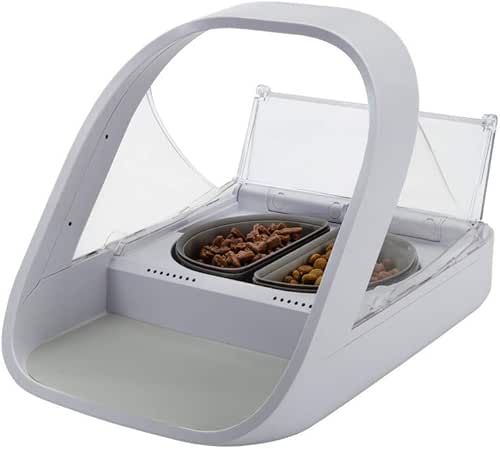
This feeder only opens its lid when it detects a specific cat’s microchip (or an included RFID collar tag). Watching my “vacuum” cat try to stick his head in only to have the lid stay firmly shut was one of the most satisfying moments of my week. It’s a bit of an investment, but the reduction in “household tension” is priceless.
Micro-Verdict: The ultimate peacekeeper for homes where food-stealing is a daily drama.
Best For: Multi-cat homes where pets have different diets or one cat is a notorious “bowl-bully.”
5. Best Budget Model: PitPet Smart Automatic Feeder
I’ll admit it—I ignored this one for a while because the price seemed “too good to be true.” However, after a month of testing, the PitPet earned its spot. It doesn’t have a 4K camera or a built-in scale, but it does exactly what it says on the tin: it dispenses food on time, every time.
What sold me was the simplicity. If you aren’t a “tech person” and just want a reliable way to make sure your cat gets 1/4 cup of food at 6 AM, this is your winner. It has a dual power supply (batteries + plug), so even if Austin’s grid has a moment, your cat still eats.
Micro-Verdict: Reliable, basic, and budget-friendly—a perfect entry-level “sanity saver” for new pet parents.
Best For: Students or budget-conscious owners who want a simple, reliable upgrade from manual feeding.
6. Best Wireless/Rechargeable: Petlibro Air
My Austin apartment is great, but the outlet placement is… questionable. I used to have a 10-foot extension cord snaking across my kitchen floor just to reach the feeder. The Petlibro Air is the first model I’ve found that is truly rechargeable and wireless.
You can place it anywhere—a quiet corner, a closet, or under a side table—without worrying about “cord-chewers” or trip hazards. The battery life is impressive; I went three weeks on a single charge during my test. It also maintained a very respectable 4% portion discrepancy for small kibble.
Micro-Verdict: Total placement freedom without the “cord-clutter” headache.
Best For: Apartment dwellers with limited outlets or cats who love to chew on electrical cords.
7. Best for Large Capacity: Petro/Onisol 5L
If you’re the type of person who takes 3-day weekend trips to Big Bend, you need capacity. Most “smart” feeders hold about 2-3 liters, which disappears faster than you’d think. The Petro (often branded as Onisol) holds a massive 5 liters of dry food.
It’s not the prettiest machine on the list, but it’s a workhorse. It supports up to six meals per day and has a very secure locking lid that even my most “creative” cat couldn’t pry open. The dual power system ensures that a weekend storm won’t result in a missed meal.
Micro-Verdict: The “long-hauler” pick for travelers who need a deep reservoir of reliability.
Best For: Frequent travelers or owners of larger cat breeds (looking at you, Maine Coons).
8. Most Durable Build: Whisker Feeder-Robot
You might know them for the Litter-Robot, but their Feeder-Robot is just as over-engineered in the best way possible. It feels premium. The plastics are thick, the seals are airtight (keeping the “kibble smell” inside), and the anti-jam technology is the best I tested.
I purposely mixed two different sizes of kibble to try and “break” the rotor, but the Feeder-Robot didn’t skip a beat. It’s also “cat-proof” to the extreme—the dispenser is recessed so deeply that no amount of paw-fishing will result in a bonus snack.
Micro-Verdict: A premium, “set-it-and-forget-it” investment that feels like it will last a decade.
Best For: Owners who want a high-end, durable appliance that won’t jam, no matter what.
9. Best Dish-Style for Variety: Cat Mate C500
Sometimes, high-tech towers aren’t the answer. If your cat eats a “mix-and-match” diet—dry food in the morning, wet food at night, and a supplement at lunch—you need a dish-style feeder. The Cat Mate C500 is a “pancake” design with five compartments that rotate.
It’s incredibly easy to clean (the tray goes right into the dishwasher) and it’s very stowable. I love using this for “Sunday resets” when I want to pre-load a few days of special meals. Just keep in mind it uses ice packs, so it’s best for 24–48 hour windows, not week-long trips.
Micro-Verdict: The most versatile option for cats on complex, multi-textured diets.
Best For: Cats on medication or mixed wet/dry diets who need a rotating “lazy susan” style service.
10. Best Tech Ecosystem: Petlibro Granary Smart Camera Feeder
If you already own a Petlibro smart fountain or their “Scout” camera, the Granary Smart Feeder is the missing piece of the puzzle. Everything lives in one app. You can see how much your cat drank, when they ate, and watch a video clip of the meal all in one timeline.
What I love about the Granary series is the 10-meal-per-day capacity. For “scarfers” who eat too fast and then throw up, being able to break their daily food into 10 tiny “micro-meals” is a life-saver for both the cat and your rugs.
Micro-Verdict: The ultimate choice for the “Smart Home” enthusiast who wants a unified view of pet health.
Best For: Tech-savvy owners who want their pet gadgets to “talk” to each other in one app.
Buying Guide: Choosing Your Cat’s Feeding Persona
Not every feeder fits every cat. When you’re making your choice, try to identify which “persona” your cat falls into:
The “Scarfer & Barfer” (Fast Eater)
This cat treats every meal like a competitive sport. They eat so fast they often get sick minutes later.
- Essential: Look for a “Slow Feed” or “Multi-Meal” feature that can dispense 10+ meals a day.
- Essential: Small portion increments (e.g., 1/24th of a cup).
- Top Choice: Petlibro Granary or Pawsync.
The “Kibble Heist Artist” (The Manipulator)
This cat spends their afternoon trying to figure out how to break into the feeder or “hook” extra food from the chute.
- Essential: A recessed dispenser and a locking lid.
- Essential: Heavy base or anti-tipping brackets.
- Top Choice: Whisker Feeder-Robot or HHOlove O Sitter.
The “Food Bully” (Multi-Cat Homes)
One cat is overweight because they eat their own food and then push the other cat away to eat theirs too.
- Essential: RFID or Microchip recognition technology.
- Pro Upgrade: A “closed-door” design that prevents side-access.
- Top Choice: SureFeed Microchip Pet Feeder.
As veterinarian Dr. Hannah Hart notes, removing the human from the “food equation” can drastically reduce begging behavior and improve the bond between you and your pet. When you aren’t the “food dispenser,” you become the source of play and affection instead [4].
The Safe Way to Step Away: Weekend Travel Tips
I get this question all the time: “Jordan, is it safe to leave my cat alone for the weekend if I have an automatic feeder?”
Here is my honest take: Technology is a tool, not a replacement for a human. While these feeders are incredibly reliable, things happen—power outages, jammed rotors, or a cat getting stuck in a closet.
The consensus from Maddie’s Fund and other welfare organizations is that cats should be checked on by a human at least once every 24–48 hours [6]. If you’re heading out for a weekend:
- Test First: Never leave your cat with a *new* feeder. Use it for at least two weeks while you’re home to ensure it doesn’t jam.
- Double the Water: Always have a backup water source (a gravity bowl + a fountain).
- The “Check-In” Friend: Have a neighbor pop in once to scoop the litter and ensure the “tech” is still ticking.
According to the Arizona Humane Society, a “safe” window for a healthy adult cat to be alone with automated support is generally 24–48 hours, but any longer requires a professional pet sitter or a trusted friend [7].
A Final Thought on High Lifestyle ROI
Choosing a cat feeder might seem like a small detail, but in my life, it was a major “unlock.” It gave me back my 5 AM sleep, gave Miso a healthier waistline, and removed the stress of rushing home through Austin traffic just to make “dinner time.”
If you’re stuck, start with the Pawsync. The accuracy of that built-in scale is a feature you will appreciate every single day when you see your cat’s weight stabilize.
Living well isn’t about having more gadgets; it’s about having the *right* ones that support the life you want to lead. Let’s make every morning a little quieter and every cat a little healthier, together.
Affiliate Disclosure: This post contains affiliate links. If you purchase through these links, I may earn a small commission at no extra cost to you. I only recommend products I have personally tested and believe in. Note that an automatic feeder does not replace daily human interaction or necessary health checks by a veterinarian.
References
- VCA Animal Hospitals. “Feeding Times and Frequency for Cats.” https://vcahospitals.com/know-your-pet/feeding-times-and-frequency-for-cats
- Cornell Feline Health Center. “How Often Should You Feed Your Cat?” https://www.vet.cornell.edu/departments/cornell-feline-health-center/health-information/feline-health-topics/how-often-should-you-feed-your-cat
- PetMD. “Obesity in Cats: Signs, Causes, and Treatment.” https://www.petmd.com/cat/conditions/digestive/c_ct_obesity
- CNN Underscored. “Best Automatic Cat Feeders of 2026.” https://www.cnn.com/cnn-underscored/reviews/best-automatic-cat-feeders
- Wired. “The 10 Best Automatic Cat Feeders.” https://www.wired.com/gallery/best-automatic-cat-feeders/
- Maddie’s Fund. “Community Standards for Pet Care.” https://forum.maddiesfund.org/discussion/temporary-housing
- Arizona Humane Society. “Pet Care Travel Guidelines.” https://pethousinghelpaz.org/
- Wirecutter (NYTimes). “The Best Automatic Feeder for Cats and Small Dogs.” https://www.nytimes.com/wirecutter/reviews/best-automatic-feeder-for-cats-and-small-dogs/