=
I’ve been there more times than I care to admit. For years, I thought “high performance” meant pushing through the brain fog with more caffeine, only to collapse into a restless, tossing-and-turning mess at night. What finally changed the game for me wasn’t a fancy supplement or a weighted blanket; it was a simple, ten-minute yoga practice.
Here’s the thing: we often treat sleep like something that just happens to us, but it’s actually something we have to prepare our bodies for. Recent research has completely shifted how we view this preparation. A landmark 2025 network meta-analysis published in BMJ Evidence-Based Medicine found that yoga actually had the highest probability of being the most effective exercise-based intervention for improving total sleep time and sleep efficiency [1].
In this guide, I’m sharing how to use these “High Lifestyle ROI” movements to reclaim your rest, backed by the latest science and a lot of trial and error in my own living room.
The Science of ‘Sleep Yoga’: Why It Works Better Than a Pill
It’s easy to dismiss yoga as just “stretching,” but the physiological shift that happens on the mat is profound. When we practice specific, calming poses, we are essentially hacking our nervous system to move from “Fight or Flight” (sympathetic) into “Rest and Digest” (parasympathetic).
Research suggests two primary reasons why yoga for sleep is so effective:
- Parasympathetic Activation: Slow, mindful movement and deep breathing signal the vagus nerve to lower your heart rate and cortisol levels. A 2020 meta-analysis in BMC Psychiatry confirmed that yoga significantly improves sleep quality and reduces insomnia severity, particularly in women [2].
- The Baroreflex Relaxation: Expert yoga researcher Dr. Roger Cole notes that certain inverted or reclining postures (like getting your legs up the wall) can relax the “baroreflex.” This is the mechanism that stabilizes your blood pressure. When it relaxes, it sends a powerful “it’s safe to sleep” signal to the brain [4].
Unlike a sleeping pill, which can leave you feeling groggy or “hungover” the next morning, yoga helps improve sleep architecture naturally. The 2025 BMJ study showed yoga has an 88.8% probability of being the best intervention for increasing total sleep time [1]. It’s not just about passing out; it’s about staying under and waking up refreshed.
Yoga for Insomnia vs. Restless Sleep: Which Style Do You Need?
I used to think all yoga was created equal. I’d do a vigorous Vinyasa class at 6:00 PM and wonder why I was wired until midnight. For sleep, the style is everything.
If you are struggling with insomnia (the inability to fall asleep), you likely need a practice that addresses “tonic arousal”—that state of being constantly on edge. A 2012 study found that consistent yoga significantly decreased insomnia in postmenopausal women, proving that it works even when hormones are working against you [3].
If your issue is restless sleep (tossing and turning), your focus should be on releasing physical tension in the hips and spine.
Choose your style based on your “Sleep Persona”:
- The “Wired and Tired” (High Anxiety): Go for Yoga Nidra. It’s often called “yogic sleep.” You lie perfectly still while a guided meditation takes you through different layers of awareness. It’s the ultimate “brain dump.”
- The “Stiff and Sore” (Physical Tension): Choose Yin Yoga or Restorative Yoga. These styles use props like pillows and blocks to support the body in long-held poses (3–5 minutes), allowing the fascia to release without effort.
- The “Everyday Optimizer”: A gentle Hatha flow. Simple movements that coordinate breath with motion to burn off the last of the day’s restless energy.
3 Best Bedtime Yoga Routines Tailored to Your Symptoms
I’ve found that one-size-fits-all routines rarely work when you’re staring down a bad night. Instead, pick the routine that matches your current struggle.
Routine 1: The ‘Brain Dump’ (For Racing Thoughts & Anxiety)
This routine is about turning your gaze inward. Forward folds are naturally “introverting” and help quiet the mental chatter.
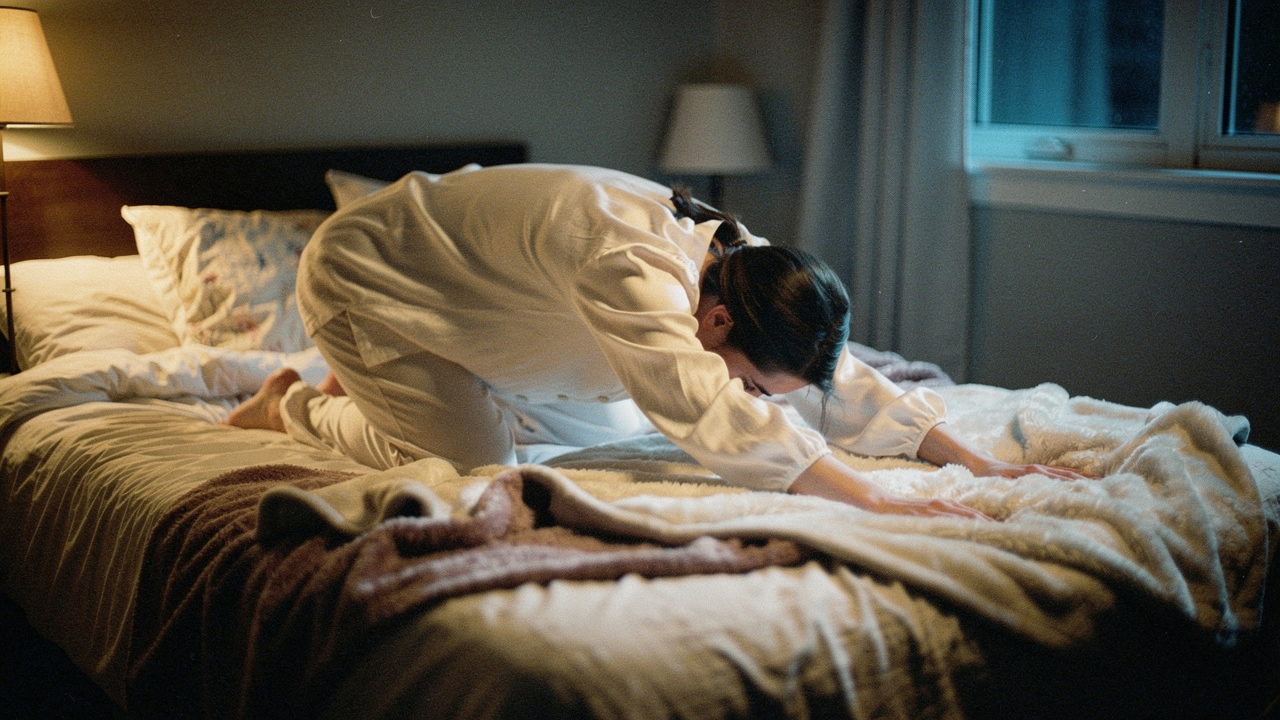
- Child’s Pose (2 mins): Knees wide, big toes touching, forehead on the mat.
- Seated Forward Fold (3 mins): Sit with legs extended, hinge at the hips. Use a pillow on your lap to rest your chest.
- Legs-Up-The-Wall (5 mins): The “High ROI” king of sleep poses.
Routine 2: The ‘Physical Reset’ (For Tossing and Turning)
If you feel like you can’t get comfortable in bed, it’s usually because your hips and lower back are holding onto the day’s stress.
- Cat-Cow (1 min): Gentle spinal waves to wake up the vertebrae.
- Reclined Butterfly (4 mins): Lie on your back, soles of the feet together, knees dropping open.
- Supine Spinal Twist (2 mins per side): Drop your knees to one side while looking to the other.
Routine 3: The ‘Emergency 3 AM’ Mini-Flow
If you wake up in the middle of the night, don’t turn on the lights. Do these right in bed to lower your heart rate.
- Happy Baby: Grab your feet and gently rock side to side.
- Knees-to-Chest: Give yourself a hug to soothe the lower back.
- Savasana with Box Breathing: Inhale for 4, hold for 4, exhale for 4, hold for 4.
The Big Five: Best Yoga Poses for Sleep (And How to Do Them)
If you only have five minutes, these are the heavy hitters. I call these the “High Lifestyle ROI” poses because they offer the maximum relaxation for the minimum effort.
1. Legs-Up-The-Wall (Viparita Karani)
- Best for: Everyone. If you do only one pose, make it this one. It reverses blood flow, soothes tired feet, and triggers that baroreflex we talked about.
- How to: Sit sideways against a wall, then swing your legs up as you lie back. Your body should form an “L” shape. Stay for 5–10 minutes.
2. Reclined Butterfly (Supta Baddha Konasana)
- Best for: Releasing “stored” emotional stress in the hips.
- How to: Lie on your back. Bring the soles of your feet together and let your knees fall out to the sides. If it feels too intense, put pillows under your knees for support.
3. Child’s Pose (Balasana)
- Best for: Feeling safe and grounded. It’s like a reset button for your nervous system.
- How to: Kneel on the floor, sit on your heels, and fold forward until your forehead touches the ground. Reach your arms forward or tuck them back by your sides.
4. Supine Spinal Twist (Supta Matsyendrasana)
- Best for: “Wringing out” the day. It neutralizes the spine and aids digestion (which can often interfere with sleep).
- How to: Lying on your back, draw your right knee to your chest, then drop it across your body to the left. Keep both shoulders glued to the floor. Repeat on the other side.
5. Corpse Pose (Savasana) with Yoga Nidra
- Best for: The final transition into sleep.
- How to: Lie flat on your back, feet as wide as your mat, palms facing up. Don’t just “lie there”—mentally scan your body from toes to head, consciously relaxing every muscle.
Let me be honest: for a long time, I tried to do yoga on my hardwood floors or a thin, slippery mat I’d had since college. I found myself focusing more on my hurting knees or my sliding hands than on my breath. It wasn’t until I invested in a proper, high-grip cork mat that my practice actually became a “refuge.”
A good mat provides that grounding, earthy feel that helps you feel “held” during restorative poses. If you’re slipping around, your nervous system stays on high alert—the exact opposite of what we want for sleep.
Micro-Verdict: A supportive, non-slip surface is the essential foundation that allows your brain to finally stop “gripping” and start letting go.


Protocol & Progression: How to Make it Stick
You don’t need an hour-long practice to see results. In fact, consistency beats intensity every single time when it comes to sleep.
- The Timing: Aim to practice 20–30 minutes before you want to be asleep. This gives your body time to transition through the physiological “cool down.”
- The Environment: Dim the lights, put your phone in another room, and keep the temperature around 65–68°F. The Sleep Foundation notes that a cool room is essential for the body’s natural sleep-wake cycle [5].
- The Progression:
- Week 1: Just 5 minutes. Pick one pose (like Legs-Up-The-Wall) and do it every night.
- Week 2: 10 minutes. Combine three poses.
- Week 4+: 15–20 minutes. A full sequence including Yoga Nidra.
Safety First: When Yoga Isn’t Enough for Sleep Problems
While yoga is a powerful tool, it’s not a panacea. It’s important to recognize when your sleep issues might be signaling something more serious.
According to MedlinePlus, you should consult a doctor if you experience “red flag” symptoms like loud snoring followed by gasping (potential sleep apnea), severe daytime sleepiness that interferes with work, or restless legs that feel like “crawling” sensations [6].
Additionally, be mindful of your physical limits:
- Inversions: Avoid Legs-Up-The-Wall if you have glaucoma or uncontrolled high blood pressure.
- Pregnancy: Modify twists and avoid lying flat on your back after the first trimester without a bolster.
- Mental Health: If your insomnia is tied to severe depression or anxiety, yoga is a wonderful adjunct to therapy, but not a replacement for professional care [7].
Creating a Life That Supports Your Rest
At the end of the day, sleep yoga is about more than just poses; it’s about a commitment to your own well-being. It’s choosing to give yourself ten minutes of peace instead of ten minutes of scrolling. The 2025 BMJ study gives us the scientific “permission” to prioritize this practice—it is, quite literally, the best exercise you can do for your sleep [1].
Start tonight. Just one pose. Pick the one that felt most relatable as you read this, set a timer for five minutes, and let the rest of the world wait. You’ve earned this rest.
Disclaimer: This content is for informational purposes only and not a substitute for professional medical advice, diagnosis, or treatment. Always seek the advice of your physician regarding a medical condition or sleep disorder.
References & Scientific Citations
- BMJ Evidence-Based Medicine (2025). Network meta-analysis on exercise interventions in insomnia patients: Yoga as a primary treatment strategy. Source
- Wang WL, et al. (2020). The effect of yoga on sleep quality and insomnia in women with sleep problems: a systematic review and meta-analysis. BMC Psychiatry. Source
- Afonso RF, et al. (2012). Yoga decreases insomnia in postmenopausal women: a randomized clinical trial. Menopause Journal.
- Yoga Journal. How Yoga Calms the Nervous System: The Role of the Baroreflex.
- Sleep Foundation. Yoga and Sleep: Benefits, Poses, and Tips. Source
- MedlinePlus. Sleep Disorders: Symptoms and Causes. Source
- NAMI. The Link Between Sleep and Mental Health. Source