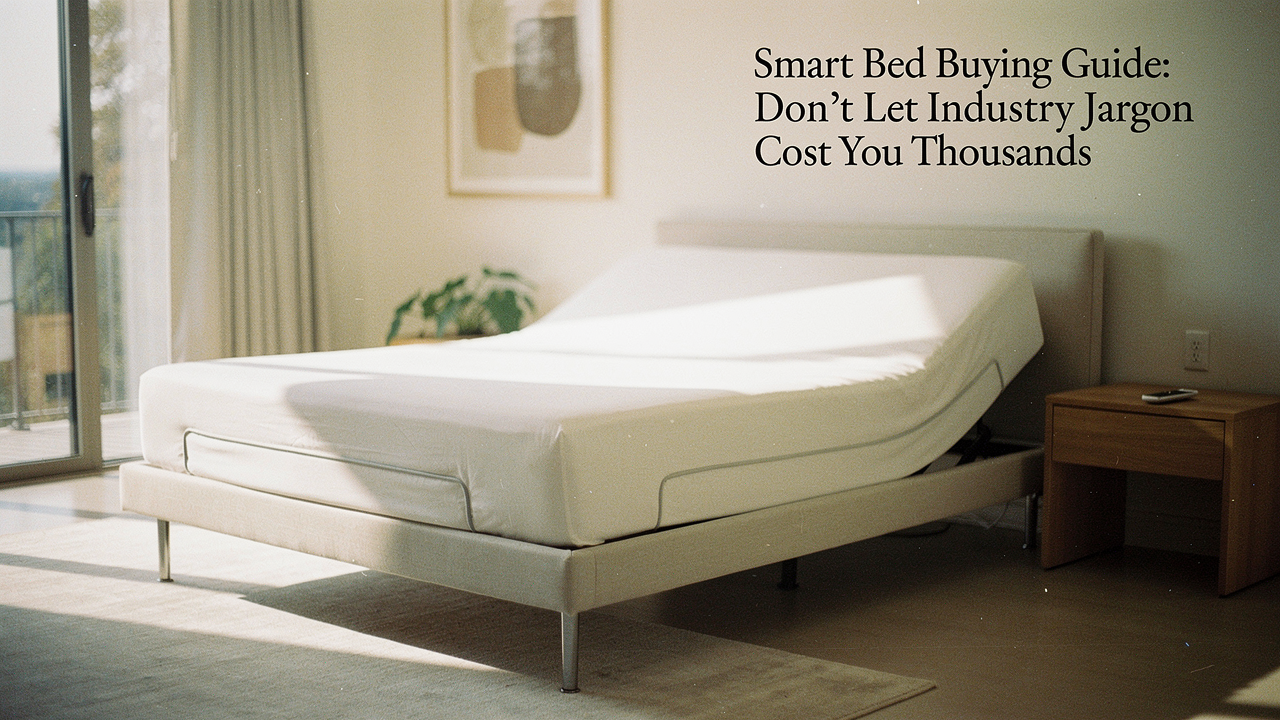
Lately, I’ve been hearing from so many of you who are exhausted—literally and figuratively. You’re tired because you aren’t sleeping well, and you’re exhausted because you’ve started shopping for a “smart bed.” You walk into a showroom or open a website and are immediately hit with sticker shock—sometimes upwards of $10,000—and a mountain of words like “biometric sensors,” “AI-driven algorithms,” and “active response layers.”
Here’s the thing: a smart bed can be a life-changing investment if you’re a hot sleeper or struggle with back pain. But if you don’t know how to translate the marketing fluff into plain English, you’re going to overpay by thousands for tech you’ll never use. Let’s cut through the noise and find what actually works for your life.
The Jargon Trap: Why Smart Bed Specs Are So Confusing
If you feel like you need a PhD in engineering just to buy a mattress, you aren’t alone. The industry often uses terms like “smart bed,” “adjustable mattress,” and “smart base” interchangeably, but they are very different products. According to Wired, this lack of standardized terminology is often a tactic to lead consumers into thinking a single price tag covers everything they need, only to find out at checkout that they need to buy a separate $2,000 base to make the “smart” features actually work [1].
What surprised me during my own research was how much of this is just clever bundling. Sleep Savvy Magazine points out that retailers often package these items together to increase the total “ticket size” of the sale [2]. To avoid the trap, you have to think of a smart bed as an ecosystem:
- The Mattress: This provides the actual support (foam, coils, or air).
- The Smart Base: The motorized frame that moves the bed up and down.
- The Smart Cover/Sensor Layer: The “brain” that tracks your heart rate and temperature.
The Smart Bed Translation Dictionary
Let’s be honest: terms like “SleepIQ” or “Autopilot” sound cool, but what are they actually doing while you’re droozing? When I started looking into the data side of things, I turned to the American Academy of Sleep Medicine (AASM). Their experts note that while metrics like Heart Rate Variability (HRV) and respiratory rate are great for general wellness, they aren’t medical diagnoses [3].
Mechanical Buzzwords (Zoned Support vs. Air Chambers)
“Zoned Support” usually just means the mattress is firmer under your hips and softer under your shoulders. This is a physical construction. “Air Chambers,” however, allow you to change that firmness on the fly using a pump. If you see “Dynamic Adjustability,” the bed is likely using a sensor to tell that pump to add or release air while you sleep.
The ‘AI’ Factor: Autopilot, Concierges, and Algorithms
When a brand mentions “AI,” it sounds like there’s a tiny robot living in your guest room. In reality, this is usually just “if/then” logic. If the sensors detect you are snoring, then the motor raises the head of the bed by five degrees. It’s useful, but don’t let the “AI” label justify a massive price hike.
Smart Bed Features: Essential vs. Marketing Fluff
I’m a big believer in the “Good Life Test.” Does a feature solve a real problem, or is it just a shiny toy? After looking at testing data from the Sleep Foundation, I’ve found that temperature control and adjustable firmness are the two features with the highest ROI for most people [4].
Must-Haves for Problem Sleepers
If you wake up with a stiff lower back every morning, being able to adjust the firmness (often called “Sleep Number setting” or “Comfort Level”) is a game-changer. For my fellow “hot sleepers” who wake up in a sweat, active cooling—where water or air actually flows through the bed—is worth every penny. On the flip side, things like integrated speakers or under-bed “mood lighting” are fun, but they don’t actually improve your sleep quality.
The Total Cost of Ownership (TCO) Reality Check
This is the part most showrooms won’t tell you. You aren’t just paying for the bed; you’re often signing up for a long-term relationship with a software company. Tom’s Guide highlights that some of the most popular smart covers now require a monthly subscription—sometimes around $17 to $20—just to see your own sleep data or use the “Autopilot” features [5].
What finally clicked for me was realizing that electronics have a much shorter lifespan than a traditional mattress. While a high-quality foam mattress might last ten years, the sensors, pumps, and motors in a smart bed are more prone to failure. HouseDigest warns that these electronic components often fail well before the mattress itself, and repair costs can be staggering once the initial warranty expires [6].
Solution Scenarios: Which Smart Bed is Right for You?
Choosing a bed is personal. What works for my Sunday reset might not work for your marathon recovery. Here is how I would break down the choices based on your specific needs.
Scenario 1: The ‘Data Geek’ Couple
You love your wearable trackers and want your bed to be the ultimate health dashboard. You likely care more about temperature and biometrics than physical movement.
I’ll admit, I was skeptical about the idea of a “smart” cover until I spent a summer in Austin with a broken AC. I had tried every “cooling” gel mattress on the market, but they all eventually just soaked up my body heat. I eventually researched the Eight Sleep system and realized that having a “water-cooled” layer that adjusts to my body temperature in real-time was the only thing that actually worked. It’s like having a thermostat for your bed that knows exactly when you’ve hit deep sleep and need to stay cool.
Micro-Verdict: The ultimate solution for hot-sleepers who want high-fidelity sleep data.
- Essential: Active dual-zone cooling and heating
- Essential: Integrated biometric tracking (HRV, Sleep Stages)
- Pro Upgrade: The “Tap-to-Dismiss” smart alarm feature
Scenario 2: The Chronic Back Pain Sufferer
You wake up feeling like you’ve gone ten rounds in a boxing ring. You need physical relief and the ability to change your sleeping position throughout the night.
It’s a frustrating reality when you realize your “luxury” mattress is actually the reason your back hurts. I remember helping a friend research options after her physical therapist recommended “Zero-Gravity” positioning. We looked at everything from basic foam to high-end hybrids, but the Sleep Number i8 stood out because it doesn’t just “guess” your firmness—it lets you change it based on how your back feels that specific day. Being able to raise your feet slightly to take the pressure off your lumbar spine is a massive win for recovery.
Micro-Verdict: Best-in-class for customized spinal support and pressure relief.
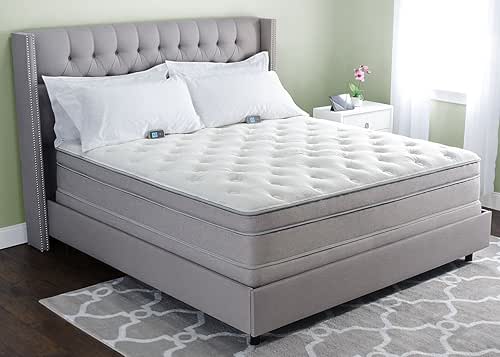

- Essential: Adjustable air chambers for firmness control
- Essential: An adjustable base for “Zero-G” positioning
- Essential: Responsive Air technology that adjusts as you move
Scenario 3: The ‘Smart on a Budget’ DIYer
You want the benefits of a smart bed without the $5,000 price tag. You can achieve high ROI by “building” your own system.
- Essential: A high-quality, non-smart hybrid mattress from a direct-to-consumer brand
- Essential: A universal adjustable base (many are available for under $600)
- Pro Upgrade: A standalone sleep tracker or a smart mattress pad for temperature control
Red Flags: Avoiding Misleading Bed Technology Marketing
Before you tap your credit card, I want you to be on the lookout for a few industry tricks. Jeff Boulter, who famously critiqued the mattress industry as “one big scam,” points out that there are almost no objective measures of “quality” in bedding [7]. Most “proprietary” foams are just standard materials with a fancy name.
Similarly, Texas Mattress Makers often warns consumers about “NASA-grade” or “Miracle” health claims [8]. If a salesperson tells you a bed will “cure” your insomnia or sleep apnea, walk away. A bed is a tool for comfort and optimization, not a medical device.
Jordan’s Shopping Tip: If a bed is “always on sale,” that “sale price” is the actual price. Don’t let a “48-hour only” countdown timer pressure you into a four-figure decision.
Affiliate disclosure: We may earn a commission if you purchase through our links. This helps keep our Austin studio running and the sourdough oven preheated! Medical disclaimer: I am a lifestyle optimization enthusiast, not a doctor. Please consult a sleep specialist for clinical issues like chronic insomnia or sleep apnea.
Expert Sources & Research
- Wired (2023). “Before You Buy a Smart Bed: Understanding the Difference Between Bases and Mattresses.” [wired.com]
- Sleep Savvy Magazine (2022). “Getting Smart About Smartbeds: Retail Strategies and Bundling.” [sleepsavvymagazine.com]
- American Academy of Sleep Medicine (2022). “Talking Sleep Podcast: The Reality of Consumer Sleep Tech.” [aasm.org]
- Sleep Foundation (2026). “Best Smart Mattresses: Lab-Tested Comfort and Tech.” [sleepfoundation.org]
- Tom’s Guide (2024). “What are smart beds and are they worth the money?” [tomsguide.com]
- HouseDigest (2024). “What to consider before getting a smart bed for your home.” [housedigest.com]
- Jeff Boulter (2008). “The Mattress Industry is One Big Scam.” [boulter.com]
- Texas Mattress Makers (2022). “Why You Shouldn’t Invest in a Smart Mattress.” [texasmattressmakers.com]