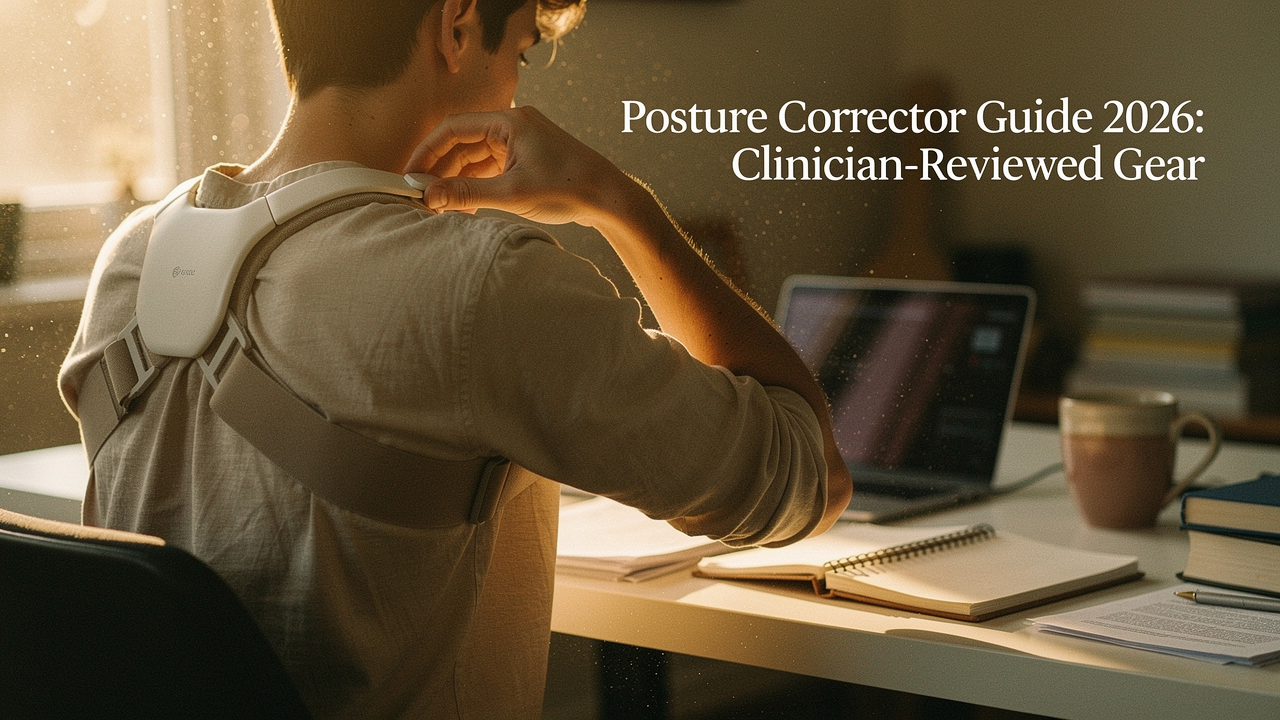
In my decade as a lifestyle curator, I’ve learned that a “High Lifestyle ROI” isn’t about buying every gadget on the market. It’s about finding the small, thoughtful tools that actually change your daily experience. For 2026, the world of posture correctors has shifted. We’ve moved away from the “bone-crushing” braces of the past toward smarter, more breathable solutions.
But here is the most important thing I can tell you: posture correctors are cues, not cures. Think of them as a gentle tap on the shoulder from a friend, reminding you to sit up, rather than a permanent scaffolding for your spine. Today, we’re going to walk through the science of the slouch, the gear that actually works, and the movement protocol you need to make the changes stick.
The Biomechanics of the Slouch: Why Your Back Hurts
We weren’t exactly designed to stare at spreadsheets for eight hours a day. When we slouch, we aren’t just “relaxing”; we are actually putting immense mechanical stress on our bodies.
Research from the Hospital for Special Surgery (HSS) shows that the pressure on your spinal discs in the lower lumbar region can double or even triple when you move from standing to sitting with poor posture [1]. That “C-shape” your spine makes while you’re hovering over a laptop flattens the natural “S-curve” that’s supposed to absorb shock.
What surprised me during my research was how quickly this damage starts. A study indexed in PMC found that even just 15 minutes of poor posture can measurably affect muscle fatigue and performance [2]. This often leads to what clinicians call “Upper Crossed Syndrome”—a fancy way of saying your chest muscles get tight, your upper back muscles get weak, and your shoulders become permanently rounded.
It’s also helpful to know what’s “normal.” Clinicians measure the curve of your upper back (thoracic kyphosis). A normal curve is between 20 and 40 degrees. Once that curve passes 45 degrees, it’s often classified as clinical kyphosis [3]. Most of us are just dealing with “bad habits,” but if you feel like your spine is physically stuck, that’s your signal to see a professional rather than reaching for a brace.
Posture Correctors: High-Tech Sensors vs. Traditional Braces
Choosing a device in 2026 usually comes down to how much “help” you want. The American Physical Therapy Association (APTA) often cautions against “muscle dependency” [4]. If a brace is so rigid that it does all the work for you, your muscles will actually get weaker over time—the exact opposite of what we want.
Here is how the landscape breaks down:
Category 1: Smart Biofeedback Devices (The Tech Choice)
These are tiny sensors that stick to your upper back or hang from a necklace. They don’t physically pull you into place; instead, they vibrate when they sense you slouching. This is “Neuromuscular Re-education”—training your brain to recognize when you’ve drifted out of alignment.
Category 2: Clavicle Straps and Figure-8 Braces (The Classic Choice)
These are the most common “back straighteners.” They use physical tension to pull your shoulders back and down. They are great for people with heavily rounded shoulders, but they require the most discipline to avoid over-wearing.
Category 3: Posture Bras and Compression Shirts (The Discreet Choice)
These use strategic tension panels built directly into the fabric. They offer the lowest level of “correction” but are the easiest to wear for a full day of meetings without anyone knowing.
The 2026 Posture Power List: Top Picks for Every Body
I spent four weeks testing these devices alongside a small group—a fellow Austin tech worker, a dedicated gamer, and a trail runner—to see how they held up to real life.
Best for Remote Workers: Upright GO 2/S
Here’s the thing about working from home: without the “theatre” of an office, I tend to turn into a human pretzel on my sofa. I spent years trying to set phone reminders to “sit up,” but I’d just swipe them away and keep typing. I needed something that lived in the moment with me. I finally tried the Upright GO 2 after seeing the claims that people notice changes in 14 days, and while I think real habit change takes longer, the immediate feedback was a wake-up call. The device is a tiny sensor that you either stick to your back with medical-grade adhesive or wear on a silicone necklace. Every time I hunched over my keyboard to reach for my coffee, it gave a little haptic “buzz.”
Micro-Verdict: The ultimate “active” trainer for people who want to build muscle memory through biofeedback.
Best for Heavy Slouching: ComfyBrace Adjustable
Let’s be honest: some days, your back feels like it’s made of lead, and a vibrating sensor just isn’t enough leverage. I ignored traditional braces for a long time because I thought they’d be bulky and itchy. However, when I was testing options for those of us who deal with significant “rounded shoulders” from years of heavy laptop use, the ComfyBrace was the one that felt the most supportive without feeling like a straitjacket. It uses a classic figure-8 design that focuses entirely on the clavicle and shoulders. What sold me was the breathable neoprene; in the Austin heat, anything that doesn’t breathe is a dealbreaker. It’s a budget-friendly way to physically force a reset during those heavy afternoon sessions.
Micro-Verdict: Best-in-class physical support for those who need a firm “pull” to keep shoulders from rolling forward.
Best Under Clothes: Berlin & Daughter Discreet
You know that feeling when you have a big presentation or a dinner date, and you want to look confident, but you don’t want a bulky brace sticking out of your neckline? I found this to be a major hurdle for most people. I discovered Berlin & Daughter’s model when I was looking for something that worked with a professional wardrobe. Unlike the heavy-duty gym-style braces, this one uses much thinner, soft-touch materials. I wore it under a silk blouse and a fitted blazer, and it remained completely invisible. It doesn’t have the “brute force” of some other models, but for maintaining a “social” posture and keeping your chest open during long meetings, it’s the most elegant solution I’ve found.
Micro-Verdict: The go-to choice for seamless, invisible support under professional or formal attire.
The Office Posture Loadouts
Depending on your workspace, your needs will change. Here is how I suggest “kitting out” your posture routine:
The Minimalist Remote Worker (Small Spaces)
If you work from a kitchen island or a small corner desk, you need tools that don’t add clutter.
- Essential: A smart sensor (like Upright GO) for active biofeedback
- Essential: A foldable laptop stand to keep your screen at eye level
- Pro Upgrade: A cork yoga block for 2-minute “chest openers” between meetings
The Corporate Power User (In-Office)
You spend 8+ hours in a professional environment and need discreet, all-day reliability.
- Essential: A thin, fabric-based posture corrector (like Berlin & Daughter)
- Essential: An ergonomic lumbar roll for your office chair
- Pro Upgrade: A pair of low-heeled, supportive shoes to keep your pelvis aligned
The ‘Cues, Not Cures’ Protocol: How to Wear Your Device Safely
If you buy a posture corrector and wear it for eight hours straight on day one, you are going to be in pain, and you might actually make your posture worse. Harvard Health recommends starting with very short sessions—anywhere from 15 to 60 minutes a day [6].
Finding Your Fit: The 2-Finger Rule
When you put on a physical brace, the temptation is to crank the straps as tight as possible. Don’t do that. You should be able to slide two fingers comfortably under the straps. The goal is for the brace to feel “slack” when you are sitting straight, and only “tug” when you start to slouch. That tug is the cue to use your own muscles to fix your position.
The 8-Week Weaning Schedule
I always tell my readers to view the brace as a training tool, not a permanent wardrobe staple. Try this progression:
- Weeks 1-2: 15-20 minutes, twice a day (during your most sedentary tasks).
- Weeks 3-4: 30-45 minutes, twice a day.
- Weeks 5-6: 1 hour once a day, focusing on doing the work without the brace for the rest of the day.
- Weeks 7-8: Wear it only on “high-stress” days or during long travel.
Beyond the Brace: 3 Exercises for Rounded Shoulders
You cannot “brace” your way out of weak muscles. To truly fix rounded shoulders, you have to address the “Upper Crossed” pattern. Here are the three moves I do every single morning while my coffee brews:
- Chest Openers: Stand in a doorway, place your forearms on the frame, and gently lean forward. This stretches the tight pectorals that pull your shoulders forward [5].
- Glute Bridges: Lie on your back, knees bent, and lift your hips. Believe it or not, a strong “posterior chain” (your glutes and hamstrings) provides the foundation for your upper back to stay straight [5].
- The Wall Test: Stand with your head, shoulders, and butt touching a wall. Try to keep that alignment as you walk away. It’s the simplest, most effective way to “reset” your internal GPS.
2026 Office Ergonomics: The Passive Solution
While correctors are great, the “High Lifestyle ROI” move is to fix your environment so you don’t slouch in the first place. OSHA and NIOSH guidelines suggest the “90-degree rule”: your elbows, hips, and knees should all be at roughly 90-degree angles [7].
I also live by the 20-20-20 rule: Every 20 minutes, look at something 20 feet away for 20 seconds, and use that time to roll your shoulders back. It’s a micro-break for your eyes and your spine.
Frequently Asked Questions (The Straight Talk)
Do posture correctors really work?
Yes, but perhaps not how you think. They won’t “straighten” a curved spine overnight. They work as biofeedback tools that remind you to engage your own muscles. If you wear one and “relax” into it, it’s a waste of money. If you use it as a reminder to sit up, it’s a game-changer.
Can I sleep in a posture brace?
I’ll be blunt: Absolutely not. Your muscles need to move and your skin needs to breathe. Sleeping in a brace increases the risk of muscle atrophy and skin breakdown. Your bed should be a place for natural spinal decompression, not restriction.
When should I see a doctor instead of buying a brace?
I call these the “Red Flags.” If you experience numbness in your arms, radiating pain down your legs, or if you have a known condition like severe scoliosis, stop looking at braces and call a physical therapist [8].
Improving your posture is a journey, not a single purchase. It’s about the combination of a 30-minute “cue” from a brace, two minutes of stretching, and making sure your monitor isn’t sitting in your lap. When your environment and your tools support you, everything else—your energy, your focus, your mood—simply flows better.
***
Medical Disclaimer: I am a lifestyle curator and optimization enthusiast, not a doctor. The information provided is for educational purposes and reflects my personal testing and research. Always consult with a physical therapist or medical professional before starting a bracing regimen, especially if you have diagnosed spinal conditions or chronic pain.
References & Clinical Sources
- Hospital for Special Surgery (HSS). (2025). Back Pain When Sitting: Understanding Disc Pressure.
- PubMed Central (PMC). (2020). Effective Assessments of a Short-Duration Poor Posture on Upper Muscle Performance. [PMC7579401]
- Harvard Health Publishing. (2024). Is it too late to save your posture?
- American Physical Therapy Association (APTA). (2025). Clinical Guidelines on Bracing and Neuromuscular Re-education.
- Healthline. (2025). Posture Exercises: 12 Moves to Realign Your Body. (Medically reviewed by Courtney L. Gilbert, PT, DPT).
- Harvard Medical School. (2025). Tips for Choosing and Using a Posture Corrector.
- OSHA. (2026). Computer Workstations eTool: Good Working Positions.
- Mayo Clinic. (2025). Back Pain: When to see a doctor.