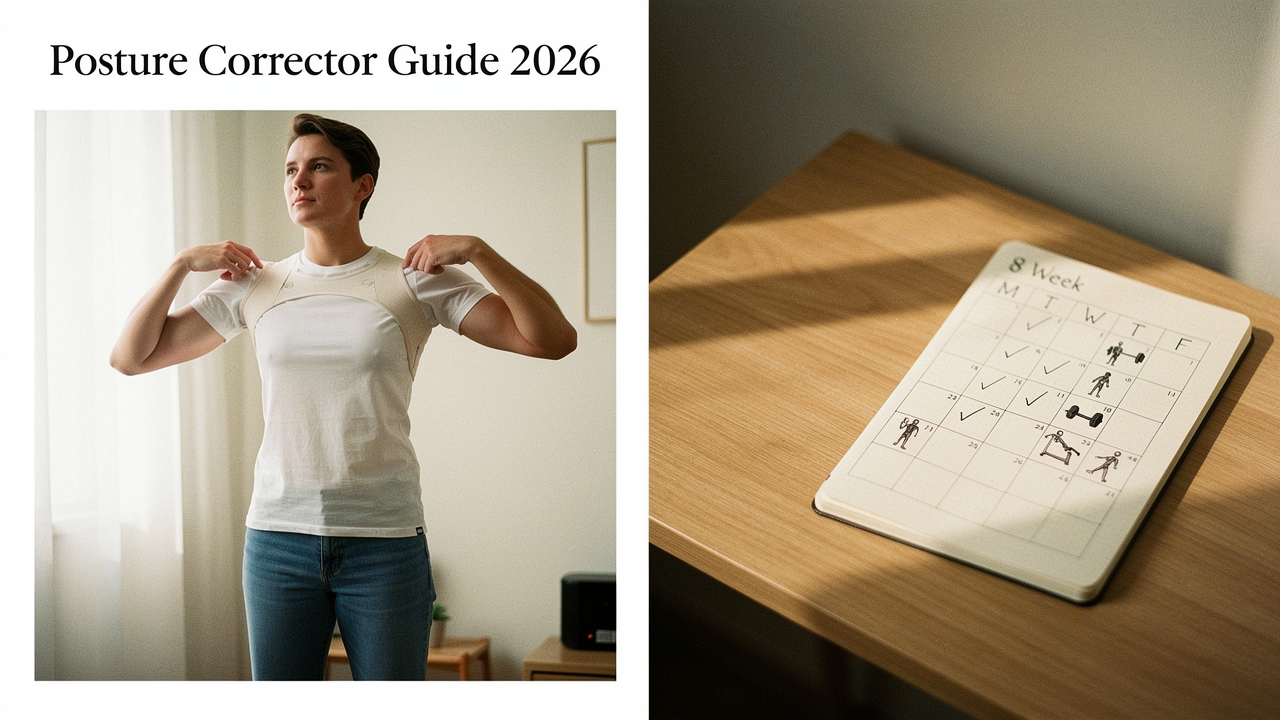
=
As a lifestyle curator, I’m obsessed with “High Lifestyle ROI.” I don’t want more gadgets; I want the right ones that actually improve how I feel. When it comes to posture, the market is flooded with gimmicky Velcro straps that promise an instant fix but often leave you with weakened muscles and a lighter wallet.
In this 2026 guide, we’re moving past the “quick fix” and into a clinician-verified roadmap. We’ll look at why your back is actually hurting, how to test your own alignment at home, and which tools are worth your time. Think of a posture corrector as a bridge, not a crutch. It’s there to remind your body where “home” is until your muscles can hold you there on their own.
Quick Guide: The 2026 Posture Essentials
- Best for All-Day Desk Work: BackEmbrace (Soft, stylish, and discreet under clothes)
- Best Smart Wearable: Upright GO S (Real-time biofeedback for habit formation)
- Best for Active Support: Forme Power Bra (Engineering-meets-apparel for women)
- The Golden Rule: Never wear a brace for more than 2 hours without a movement break.
The Biomechanics of the ‘Modern Slouch’: Why Your Back Hurts
We often think of slouching as a “lazy” habit, but there’s a serious physical toll happening under the surface. Here’s the thing: our bodies weren’t designed to sit in a C-shape for eight hours a day. When we slouch, we’re not just “resting”; we’re fundamentally changing how our spine handles weight.
Research from the Hospital for Special Surgery (HSS) shows that slouched sitting can actually double or even triple the pressure on your lowest lumbar discs compared to standing [1]. It’s like carrying a heavy backpack on your front all day without realizing it. What surprised me during my research was how quickly this happens. A study published in 2020 found that just 15 minutes of slouched sitting is enough to alter your muscle fatigue patterns, making it harder for your body to recover during subsequent physical activity [2].
This creates a vicious cycle. Your chest muscles (pectorals) become tight and shortened, while your upper back muscles (rhomboids and traps) become overstretched and weak. Eventually, your brain starts to think this “rounded” position is normal. That’s why “just sitting up straight” feels so exhausting—your muscles are literally fighting a new, distorted blueprint.
The 3-Minute Self-Assessment: Do You Have Rounded Shoulders?
Before buying a device, you need to know what you’re trying to fix. I’m a big fan of the “Wall Test”—it’s a simple, zero-cost way to see where you stand (literally).
The Wall Test:
Stand with your back against a flat wall. Your heels, calves, glutes, shoulders, and the back of your head should all touch the surface comfortably. If you find your chin tilting up to make your head touch, or if your shoulders feel like they’re miles away from the wall, you likely have forward head posture or rounded shoulders.
For a more clinical measure, I look to the “Melio-Guide” developed by physical therapist Margaret Martin. She suggests the scapula-to-spine measurement: if the distance from the inner edge of your shoulder blade to your spine is greater than roughly three inches, it’s a strong indicator of “upper crossed syndrome” or rounded shoulders [3].
How to Choose a Posture Corrector: The 2026 Selection Framework
Choosing a posture corrector in 2026 is about finding the balance between support and activity. I used to think the stiffest brace was the best, but I was wrong. If a brace does all the work for you, your muscles will eventually “check out,” leading to atrophy.
Here is what I look for based on clinician guidance:
- Material: Look for soft, non-rigid materials. Dr. Amir Vokshoor, a board-certified neurosurgeon, emphasizes that soft correctors are preferable because they act as a “reminder” rather than a rigid cage, keeping your muscles activated [4].
- Adjustability: You should be able to put the device on and adjust the tension yourself. If you need a second person to strap you in, you won’t use it consistently.
- Target Area: Are you struggling with lower back pain (lumbar) or rounded shoulders (thoracic)? Most “posture correctors” focus on the upper back, while “back braces” are for the lower spine.
- Medical Clearance: This is huge. If you have scoliosis or have had spinal surgery, an off-the-shelf brace isn’t for you. You need a prescription orthosis like a Boston brace, fitted by a professional [5].
Top-Rated Posture Correctors for 2026: Jordan’s High-ROI Picks
Best for All-Day Desk Work: BackEmbrace
I’ll be honest: I ignored traditional posture braces for years because they looked like something from a Victorian medical ward. They were bulky, scratchy, and impossible to wear under a silk blouse or a fitted tee. I finally gave in when the “tech-neck” headaches became a daily reality, and that’s when I found this specific design.
What I love about this approach is that it feels like a gentle hug for your shoulders. Instead of forcing you into a rigid position, the soft, premium elastics provide just enough tension to remind you to pull your shoulder blades back and down. I wore it during a three-hour deep-work session at my favorite Austin coffee shop, and for the first time in months, I didn’t leave with that burning sensation between my shoulder blades. It’s discreet enough that nobody knew I was wearing it, even under a light sweater.
Micro-Verdict: The most stylish and effective way to maintain professional alignment without the medical-grade bulk.


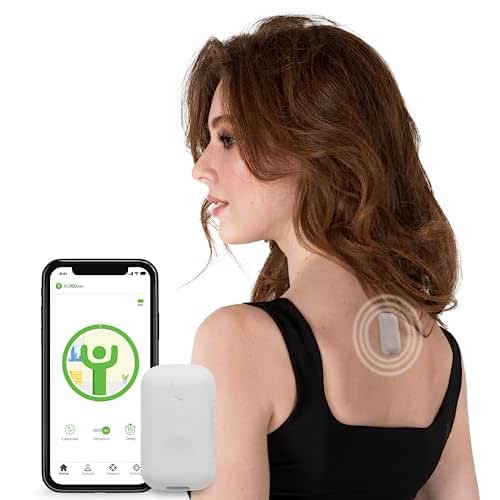
Best Smart Wearable: Upright GO S
Here’s the thing about posture: we usually don’t realize we’re slouching until the pain starts. I call it “mindless melting.” I tried to fix this with phone reminders, but I’d just swipe them away. I needed something that lived in the moment, which led me to the world of biofeedback.
This tiny sensor adheres to your upper back (or hangs from a necklace) and monitors your spinal angle with incredible precision. What finally clicked for me was the “vibration mode.” The second I started to slump toward my monitor, the device gave a gentle, haptic tap on my back. It’s not annoying; it’s more like a digital friend saying, “Hey, sit up.” Over three weeks of use, I found I was slouching less even when I wasn’t wearing the device because I had finally built the cognitive awareness I was missing.
Micro-Verdict: A high-tech “tap on the shoulder” that builds real-time awareness and lasting habits.
Best for Women & Support: Forme Power Bra
If you have a larger bust, you know the struggle is real. The weight alone can pull your shoulders forward, and most posture correctors are designed for a flat-chested silhouette, leading to uncomfortable pinching or digging under the arms. I was skeptical about “posture clothing” at first—it felt a bit like marketing hype.
However, the engineering behind this specific bra changed my mind. It uses high-tension fabric panels that mirror the way a physical therapist might use kinesiology tape to support your muscles. It’s not a brace; it’s a piece of activewear that gently encourages thoracic extension. I’ve started wearing mine for Sunday reset hikes and yoga sessions. It’s the ultimate “High Lifestyle ROI” item because it replaces a regular bra while doing double duty for my spinal health.
Micro-Verdict: Seamlessly integrates posture correction into your daily wardrobe with high-end comfort.

The 8-Week Roadmap: Integrating Devices with Movement
A posture corrector is only one part of the equation. If you wear it for 8 hours a day and never exercise, you’re just masking the problem. My goal for you is to eventually stop needing the device.
The American Physical Therapy Association (APTA) suggests that devices are most effective when paired with a strengthening program [6]. Here is the 8-week framework I recommend for my “Good Life” community:
- Weeks 1-2 (The Awareness Phase): Wear your corrector for 15-30 minutes, twice a day. Use this time to perform your most common tasks (typing, cooking). Notice how it feels to be aligned.
- Weeks 3-4 (The Integration Phase): Increase wear time to 60 minutes during your most “slouch-prone” hours. Add 5 minutes of “Wall Slides” and “Bird-Dogs” to your morning routine to wake up your core.
- Weeks 5-6 (The Strengthening Phase): Maintain wear time but focus heavily on back exercises. Every time you take the device off, try to hold that same tall posture for 10 minutes on your own.
- Weeks 7-8 (The Weaning Phase): Reduce wear time by 15 minutes each day. By the end of week 8, you should only be using the device as a “reset” tool during high-stress days.
Beyond Bracing: Low-Cost Ergonomic Posture Support
You don’t always need to buy a device to fix your space. Sometimes, the best posture support is simply rearranging what you already have. Dr. Weisbein, an orthopedic specialist, notes that movement breaks are often more protective for the spine than trying to maintain a “perfect” static position all day [7].
The Optimized Remote Worker Loadout
If you’re working from a home office or a kitchen table, use this checklist to audit your space:
- Essential: A laptop stand or a stack of sturdy books to bring your screen to eye level. (Your neck should be neutral, not tilted down).
- Essential: An external keyboard and mouse so your elbows can stay at a 90-degree angle while your screen is elevated.
- Essential: A rolled-up towel or a small lumbar pillow placed in the curve of your lower back.
- Pro Upgrade: A “Sit-Stand” converter to allow for postural variety throughout the day.
Let’s Straighten Out Together
At the end of the day, posture isn’t about looking like a soldier or reaching some unattainable standard of “perfection.” It’s about creating a body that supports your life instead of hindering it. When your spine is aligned, your breathing improves, your energy levels stabilize, and that nagging tension at the base of your skull finally starts to dissipate.
Start small. Maybe it’s the BackEmbrace for your morning emails, or maybe it’s just committing to the 3-minute wall test today. Whatever you choose, remember that the goal is a “Good Life”—one where you move with ease and confidence.
Ready to straighten out? Start your 8-week plan with my top pick, the
Medical Disclaimer: This guide is for informational purposes and does not replace professional medical advice. Consult a doctor before starting any bracing or exercise program, especially if you have pre-existing spinal conditions.
Scientific References & Expert Sources
- Hospital for Special Surgery (HSS). (2025). Back Pain When Sitting: Understanding Disc Pressure. HSS Health Library. https://www.hss.edu/health-library/move-better/back-pain-when-sitting
- Jung, S. I., et al. (2020). Effective Assessments of a Short-Duration Poor Posture on Upper Limb Muscle Fatigue. PubMed Central (PMC7579401). https://pmc.ncbi.nlm.nih.gov/articles/PMC7579401/
- Martin, M. (2025). How to Fix Rounded Shoulders: The PT Guide. Melio-Guide. https://melioguide.com/perfect-posture/how-to-fix-rounded-shoulders/
- Vokshoor, A. (2026). The Role of Soft Bracing in Spinal Health. Cited in Healthline Expert Reviews. https://www.healthline.com/health/best-posture-corrector
- American Academy of Orthopaedic Surgeons (AAOS). (2025). Bracing for Spinal Deformities. OrthoInfo.
- American Physical Therapy Association (APTA). (2026). Clinical Practice Guidelines for Postural Syndrome.
- Weisbein, S. (2026). Ergonomics and Chronic Pain: A Move-First Approach. Napa Valley Orthopaedic Medical Group. https://www.drweisbein.com/blog/how-posture-and-ergonomics-influence-chronic-back-pain