=
Here’s the thing—Daylight Saving Time (DST) isn’t just a minor annoyance. For those of us who obsess over “High Lifestyle ROI,” it’s a direct hit to our daily performance. It’s essentially a one-hour bout of jet lag that the government forces us to participate in twice a year. I spent years trying to “power through” with extra espresso and sheer willpower, but I always ended up feeling like a zombie until Wednesday.
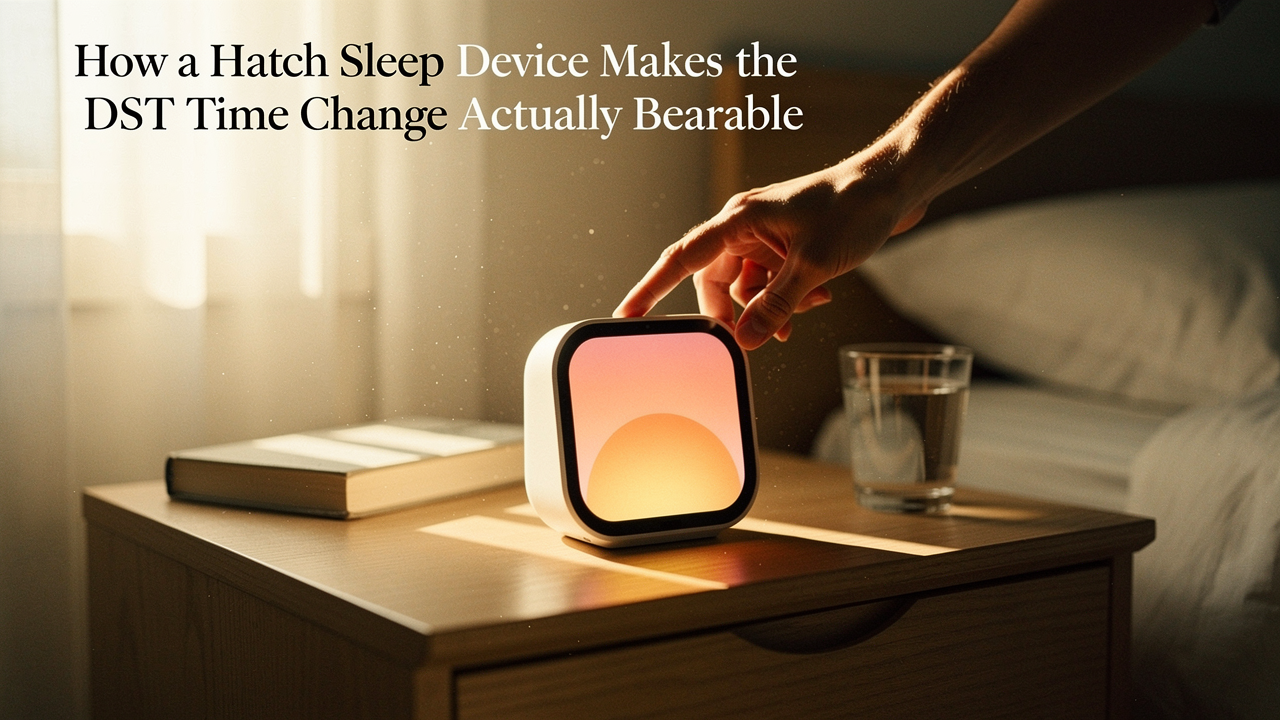
What finally clicked for me was realizing that my environment could do the heavy lifting for me. Instead of fighting my biology, I started using my Hatch device as an automated “sleep coach.” It’s become my secret weapon for navigating these shifts without the brain fog.
The Science of the ‘Shift’: Why We Hate the DST Time Change
The reason we feel so miserable isn’t just “missing an hour.” It’s circadian misalignment. When we shift the clocks, our “social clock” (the time on your phone) moves, but our “biological clock” (governed by the suprachiasmatic nucleus in your brain) stays put.
The struggle is real, and the data backs it up. Research shows that on the Monday following the “Spring Forward” shift, the average person loses about 40 minutes of sleep [1]. That’s not just a statistic; it’s a recipe for disaster. The American Academy of Sleep Medicine (AASM) has even highlighted that these transitions are linked to a measurable uptick in cardiovascular events and traffic accidents [2].
Dr. Phyllis Zee, a leading expert in circadian medicine, explains that our internal rhythms are incredibly sensitive to light cues. When the sun rises “later” according to our clocks in the spring, we miss that crucial morning light that tells our brain to stop producing melatonin and start producing cortisol to wake us up.
The 15-Minute Rule: Gradual vs. Abrupt Changes
I used to be a “cold turkey” person. I’d just change the clocks and hope for the best. That is a mistake. Sleep medicine professionals almost universally recommend the 15-minute rule. Instead of one jarring 60-minute jump, you shift your schedule by 15 minutes each day leading up to the change. This gives your hormones time to catch up.
Hatch Restore 2: My Personal ‘Circadian Coach’
For years, my wake-up routine was a high-stress event. My iPhone would blare a “Radar” alarm, my heart would pound, and I’d immediately feel behind on my day. It was the opposite of “living well.” I started looking for a way to wake up that didn’t feel like a jump-scare, especially during DST when the sun isn’t helping me out.
I’ll admit—I was skeptical about “sunrise alarms” at first. I thought, Is a glowing lamp really going to make me feel less tired? But after using the Hatch Restore for two years, I can’t go back. The device uses dawn simulation, which is backed by a 2014 study showing that light exposure in the last 30 minutes of sleep can significantly increase subjective alertness and physical performance upon waking [3].
What surprised me was how much the “morning rise” actually works. Instead of a noise waking me up, the light slowly brightens from a deep red to a bright morning sun over 30 minutes. Most days, I naturally drift awake about five minutes before the actual “alarm” sound (which is a gentle bird song, not a siren) even starts.
Micro-Verdict: The Restore 2 turns a jarring wake-up call into a gentle, light-led transition that leaves you feeling remarkably human.

The ‘Unwind’ Strategy: Killing the Blue Light Habit
The “wake” part is only half the battle. During the “Fall Back” transition, it’s actually the evening that trips us up. We get sleepy earlier, but we try to stay up to hit our “normal” bedtime, often filling that time with blue-light-emitting screens that wreck our melatonin production.
The Restore has an “Unwind” feature that I’ve programmed to start at 9:30 PM. It shifts the room to a warm, red-spectrum light (which doesn’t interfere with melatonin) and plays a “guided rest” or soft ocean sounds. It’s a physical cue to my brain that the day is over. In a 2023 survey, Hatch found that 11% of Restore users felt better rested simply by having a consistent evening routine [4].
Parenting Hack: The Hatch Rest and DST Assistant
If you think DST is hard for adults, try explaining it to a three-year-old who thinks 5:00 AM is the perfect time to start playing Legos. For parents, the “Fall Back” shift is the stuff of nightmares.
I’ve watched my friends in Austin lose their minds every November because their kids’ internal clocks don’t care about the clock on the microwave. This is where the Hatch Rest (the baby/toddler version) becomes a literal lifesaver. Hatch’s medical advisor, Dr. Angela Holliday-Bell, emphasizes that gradual shifts are even more critical for children whose rhythms are less flexible than ours.
The Hatch Rest ecosystem is an “all-in-one” that replaces about $700 worth of separate gear—sound machines, nightlights, and even 1:1 sleep consultant chats. But its best feature is the “Time-to-Rise” light. You can program the light to turn green only when it’s okay for them to leave their room. During DST, you can use the “Daylight Savings Assistant” in the app to automatically shift that green light by 15 minutes a day, so the child doesn’t even realize their schedule is moving.
Micro-Verdict: It’s the ultimate “peace of mind” tool that prevents 5:00 AM toddler wake-up calls during the autumn time shift.

The DST Sleep Reset Blueprint: A 4-Day Step-by-Step
To make this transition painless, you need a plan. Don’t wait until Saturday night. Start on Wednesday or Thursday. Here is the protocol I use with my Hatch to ensure I don’t feel like a ghost on Monday morning.
- Day 1 (Wednesday/Thursday): Shift your “Unwind” routine and your “Wake” alarm 15 minutes earlier (for Spring) or later (for Fall).
- Day 2: Shift another 15 minutes. This is usually when I also cut off caffeine by 1:00 PM to ensure my sleep drive is high.
- Day 3: Shift a third 15 minutes. By now, you are 45 minutes toward your goal.
- Day 4 (Saturday): Final 15-minute shift. Tonight, you’ll go to bed at the “new” time, and because you’ve moved incrementally, your body won’t fight you.
- Bonus: On Sunday morning, “anchor” your rhythm by getting 10 minutes of direct sunlight. Harvard Sleep Medicine suggests this is the most powerful way to reset your clock [5].
Configuring the Hatch App for Automation
The beauty of the Hatch app is that you don’t have to remember to do this manually every morning. Here’s how to set it up:
- Step 1: Open the Hatch app and go to your “Schedule.”
- Step 2: Use the “Daylight Savings Assistant” toggle if you have a Rest device, or manually adjust your “Morning Rise” start time on the Restore.
- Step 3: Set your “Brightness” level. For the spring transition, I recommend bumping the brightness up by 10% to mimic the stronger morning sun we’re losing.
- Step 4: Pick a “Signal” sound. Avoid anything too energetic; let the light do the work.
Hatch vs. The World: Are There Better Alternatives?
I’m often asked if you really need a $100+ device to do this. Could you just use a smart bulb and a phone alarm? Sure. But remember, we’re looking for High Lifestyle ROI.
- Hatch vs. Loftie: Loftie is beautiful and has a “two-stage” alarm that I love. However, it lacks the integrated high-quality sunrise light that Hatch excels at. If you want a no-screen experience, Loftie is great; if you want the circadian light benefit, go Hatch.
- Hatch vs. Philips SmartSleep: Philips is the “OG” in this space. It’s medically solid, but it’s bulky and looks like a piece of hospital equipment. Hatch fits the “Best Goods” aesthetic much better and has a far superior app experience.
- The Tech-Traveler Alternative: If you are constantly changing time zones (not just for DST), the Timeshifter app is the gold standard. It was developed with Dr. Steven Lockley and uses your specific flight data to tell you when to seek light and when to avoid it [6].
Common Pitfalls (And Why I Still Snooze)
Even with the best tech, I’m still human. There are a few things a Hatch can’t fix.
First, if you are a “Night Owl” (or what researchers call a late chronotype), you are naturally more vulnerable to DST disruption. Northwestern Medicine research shows that night owls have a harder time “advancing” their clocks in the spring. If that’s you, you might need a full 7-day transition instead of 4 days.
Second, there’s the “Partner Problem.” If you share a bed with someone who has a completely different wake-up time, a sunrise alarm can be tricky. My husband wakes up an hour after I do, so I keep my Hatch on a lower brightness setting and positioned closely to my side of the nightstand. It’s not perfect, but it’s better than a loud alarm waking us both up at 6:00 AM.
***
Living well isn’t about having a perfect life; it’s about having tools that support your best self when things get messy—like the government moving the sun on you. While we can’t stop the clock change, we can optimize our environment so it doesn’t stop us. A Hatch device is one of those rare purchases that pays for itself in “Morning Alertness” within the first week.
Stay rested, Austin.
***
References & Science-Backed Sources
- Sleep Foundation. (2024). “Daylight Saving Time: Health and Safety Impacts.” sleepfoundation.org
- American Academy of Sleep Medicine. (2020). “AASM Position Statement: Permanent Standard Time.” aasm.org
- Gabel, V., et al. (2014). “Effects of Dawn Simulation on Subjective Alertness and Cognitive Performance.” Journal of Sleep Research. ncbi.nlm.nih.gov
- Hatch Sleep Wellness Impact Survey. (2023). “Data on Restore and Restore 2 User Outcomes.” hatch.co
- Harvard Medical School Division of Sleep Medicine. (2025). “Tips to Help Adjust Your Sleep to Daylight Savings.” sleep.hms.harvard.edu
- Timeshifter Science. (2025). “The Circadian Logic of Time Shifts.” timeshifter.com
***
Affiliate disclosure: We may earn a commission on products purchased through our links. This guide is for educational purposes and not a substitute for medical advice.