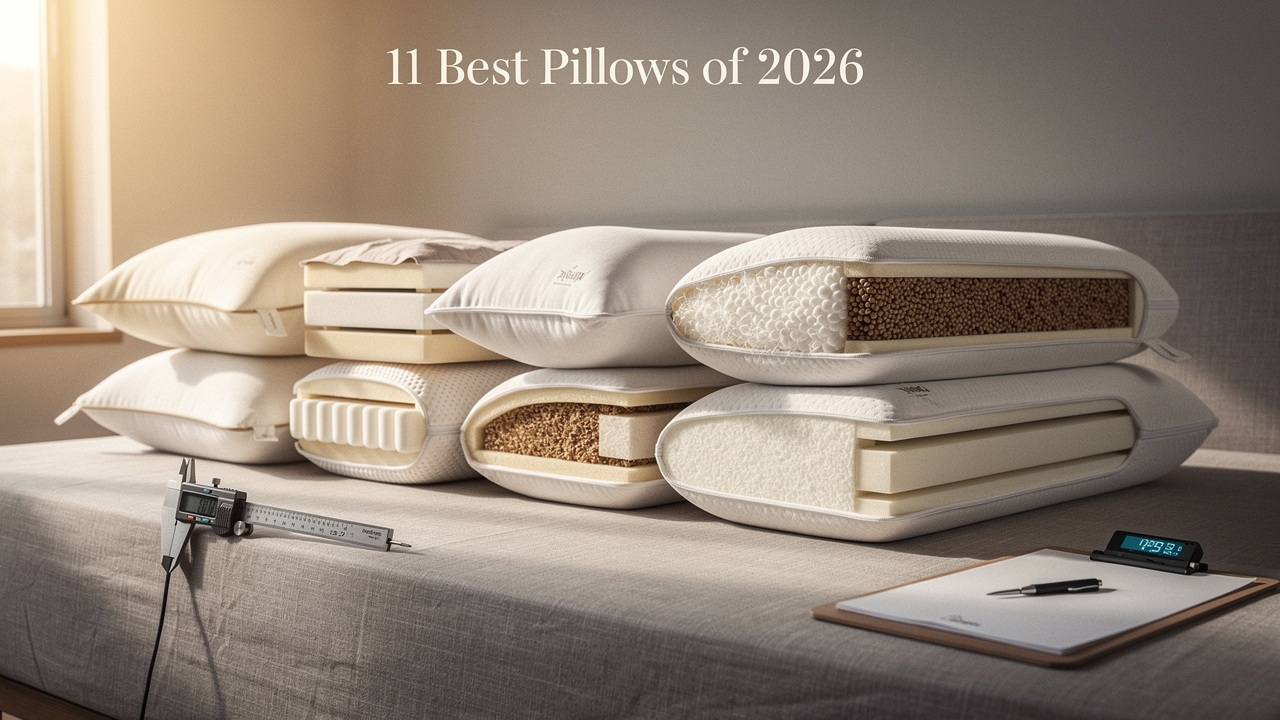
Here’s the thing: we spend a third of our lives with our heads on a pillow, yet most of us put more thought into our coffee beans than our bedding. I struggled with “morning neck” for years, assuming it was just a byproduct of getting older or pushing myself during yoga. What finally clicked for me was realizing that I was buying pillows based on how they felt in the store for five seconds, rather than how they supported my spine for eight hours.
If you’re waking up stiff, unrefreshed, or constantly “fluffing” your way through the night, your current setup is failing you. For 2026, my team and I put dozens of the market’s top contenders through a rigorous, clinician-reviewed “Pillow Prescription” protocol. We didn’t just look for soft; we looked for alignment.
The Pillow Prescription: Why Your Current Setup Fails You
Let’s get nerdy for a second. Your head weighs between 5 and 11 pounds [4]. Think of it like a bowling ball resting on a stack of delicate tea cups (your cervical vertebrae). If your pillow is too high or too low, those “tea cups” tilt, and the muscles and ligaments in your neck have to work overtime all night just to keep things stable. This is exactly how you end up with that dull, nagging neck pain or even arm numbness [4].
I used to think a “good” pillow was just a fluffy one. But I’ve learned that a truly ergonomic pillow support system is more like a bike fit or an ergonomic desk setup—it’s about geometry. According to the experts at Spine-health, “neutral alignment” means your ears, shoulders, and hips are in a relatively straight line [2].
If you want to see if your current pillow is the culprit, try the “Mirror Test”:
- Lie down in your usual position.
- Have a partner take a photo of your side profile.
- If your chin is tucked toward your chest or your head is tilted back significantly, your loft is wrong.
Our 2026 Testing Methodology
To find the 11 winners on this list, we didn’t just nap. We spent 30 days with each pillow, utilizing a diverse team of testers with different BMIs and shoulder widths. We focused on four key pillars:
- Support: Does it maintain its height (loft) under the weight of the head over 8 hours?
- Heat Retention: We used thermal sensors to measure how much heat the material trapped compared to ambient room temp.
- Loft Adjustability: Can the user customize the “fill” to match their shoulder width?
- Durability: Does it survive a “toss and turn” simulation without losing its shape?
Best Pillows for Side Sleepers (High Loft & Firm Support)
Side sleeping is the most common position, but it’s also the most demanding. You have to fill that large gap between your ear and the tip of your shoulder to keep your neck from collapsing [1].
I’ll be honest: I was skeptical at first about spending more than fifty dollars on a pillow. But after trying dozens of “budget” options that turned into pancakes by 3 AM, I realized that side sleepers need materials that actually fight back against gravity.
Let me tell you about the daily reality of a side sleeper: you spend half the night shoving your arm under the pillow just to get enough height. I did this for years until I discovered that a responsive, high-loft material could do the work for me. The Saatva Latex Pillow became my go-to because it features a shredded latex core that feels “springy” rather than “sinky.” It provides that immediate pressure relief but refuses to bottom out, even if you have broader shoulders.
Micro-Verdict: The ultimate “set it and forget it” support for broad-shouldered side sleepers.


For years, I woke up with a kink in my neck that felt like a permanent fixture of my personality. I tried every “contoured” foam pillow on the market, but they always felt too medicinal or rigid. Then I found the Eli & Elm Cotton Side-Sleeper. It has this unique U-curve at the bottom that creates a dedicated space for your shoulder to tuck in. This allows the head and neck to be supported without the pillow “shoving” against your shoulder blade.
Micro-Verdict: The best ergonomic design for side sleepers who hate the feel of traditional “medical” pillows.
If you’re like me and “run hot,” you know that flipping the pillow to the “cool side” is a desperate, short-lived victory. I tested the Helix GlacioTex Cooling Memory Foam Pillow during an Austin August, and it was the first time I didn’t wake up with a damp neck. It comes in two lofts, and the higher option is specifically calibrated for side sleeping. The cooling cover actually feels cold to the touch and stays that way.
Micro-Verdict: A must-have for side sleepers who prioritize temperature regulation above all else.
The Side Sleeper Persona Loadout
- Essential: A pillow with at least 5 inches of loft to bridge the shoulder-to-neck gap.
- Essential: A responsive material (latex or high-density foam) that won’t flatten.
- Pro Upgrade: A knee pillow to keep the hips aligned and prevent lower back rotation.
Best Pillows for Back and Stomach Sleepers (Low to Mid Loft)
Stomach sleepers, we need to talk. While it feels cozy, sleeping prone is the hardest position for your spine because it forces your neck to stay rotated at a 90-degree angle all night. To minimize the damage, you need the flattest pillow possible—or even no pillow at all [2].
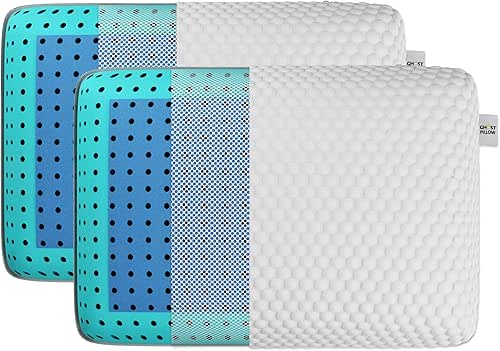
I ignored this advice for a long time because I love the “nesting” feel of a big pillow. But my lower back was paying the price. The GhostBed Memory Foam Pillow was a game-changer for my “prone” nights. It’s dense enough to support the head but low enough that it doesn’t crank the neck into an unnatural arch. Plus, the aerated foam kept me from feeling like I was suffocating into the fabric.
Micro-Verdict: The most durable, low-profile option for sleepers who need to stay close to the mattress.
What surprised me about the Honeydew Scrumptious Classic was how it managed to be both firm and low-loft simultaneously. Often, back sleepers find that “medium” pillows are too soft, allowing the head to tilt back too far. This pillow uses a copper-infused foam that you can actually remove to find your perfect height. I found that removing about two cups of fill created the perfect “cradle” for back sleeping.
Micro-Verdict: Highly customizable support that prevents the “head tilt” common in back sleepers.
The Best Universal/Adjustable Pillows (For Combination Sleepers)
If you’re a “rotisserie chicken” sleeper—constantly flipping from side to back to stomach—standard pillows are your enemy. You need something that can adapt.
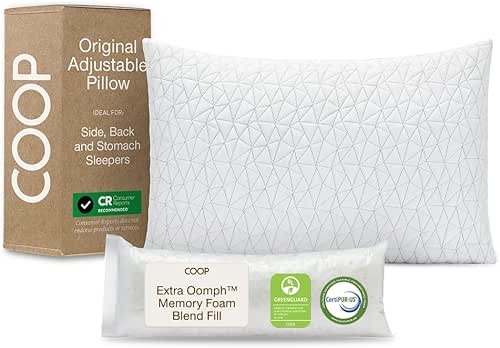
Choosing a pillow for a combination sleeper is a bit like making sourdough; you have to find the right “hydration” or mix of fill to get the result you want. The Coop Home Goods Original is the gold standard here. It arrives overstuffed with shredded memory foam and microfiber. You’re supposed to unzip it and literally pull out handfuls of fill until it matches your body type. It took me three nights of “tweaking” the fill level, but once I found the sweet spot, it worked across every position.
Micro-Verdict: The absolute best overall value for people who don’t stay in one spot.
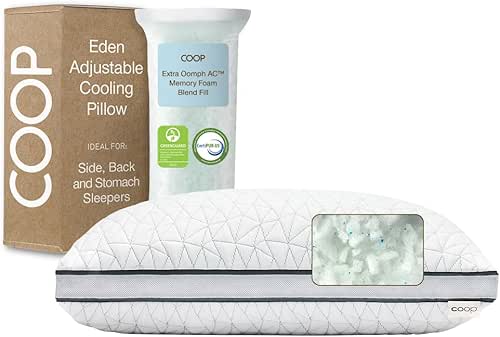
While the original Coop is great, I found the Coop Eden to be the “premium” version I didn’t know I needed. It uses a cooling gel-infused fill that feels a bit “plusher” than the original. In our lab tests, it earned some of the highest marks for shape retention, meaning it didn’t get “lumpy” after a week of heavy use. If you’re a minimalist who wants one pillow to do it all, this is the one.
Micro-Verdict: A luxury upgrade for combination sleepers who want cooling and adjustability in one package.
The Multi-User/Guest Room Loadout
- Essential: Adjustable pillows that guests can customize themselves.
- Essential: Machine-washable covers for hygiene.
- Pro Upgrade: A set of zippered pillow protectors to extend the life of the foam.
Deep Dive: Solving Heat and Sleep Quality Issues
Poor sleep quality isn’t just about feeling tired; it’s a legitimate health risk. Research published via the NIH indicates that chronic insomnia and poor sleep quality can double the risk of developing depression over time [3].
One of the biggest disruptors of that quality is “thermophysiological discomfort”—otherwise known as getting too hot. This is why I look for pillows with CertiPUR-US and OEKO-TEX certifications. These ensure you aren’t breathing in “off-gassing” chemicals while you sleep, which can irritate the airways and lead to more awakenings.
Maintenance: When to Toss Your Pillow
I’ll admit it—I used to keep pillows until they were yellowed and lumpy. But Kanuda USA, a leader in ergonomic design, recommends replacing foam pillows every 1 to 2 years [7].
Here’s why: foam eventually loses its “structural integrity.” Even if it feels soft, it may no longer be providing the Newtons of force required to hold your 10-pound head in neutral alignment. If you have to fold your pillow in half to get it to stay up, it’s already dead. Toss it and prioritize your “Lifestyle ROI.”
Better sleep isn’t a luxury; it’s the foundation of everything else we do. Whether you’re hiking the Austin greenbelt or just trying to survive a Monday of Zoom calls, your pillow is the unsung hero of your recovery. Find your position, measure your loft, and give your spine the “prescription” it deserves.
Affiliate Disclosure: We earn a commission if you purchase through our links. This guide is for educational purposes and not a substitute for medical advice from a chiropractor or physical therapist.
Sources & References
- Sleep Foundation (2025). Best Pillows for 2026: Testing Methodology and Results. [sleepfoundation.org]
- Spine-health (2024). Pillows for Different Sleeping Positions and Spinal Alignment. [spine-health.com]
- NIH / PubMed Central (2021). The Link Between Sleep Quality and Mental Health: A Meta-analysis. [PMC8651630]
- Centers for Advanced Orthopaedics (2025). Biomechanics of Cervical Support and Head Weight. [cfaortho.com]
- Good Housekeeping Institute (2025). Textiles Lab: Pillow Durability and Shape Retention Tests. [goodhousekeeping.com]
- Dr. Jon Saunders (2024). Chiropractic Demonstration: Proper Pillow Placement for Neck Pain. [chirofirst.ca]
- Kanuda USA (2025). Ergonomic Pillow Lifespans and Replacement Cycles. [kanudausa.com]