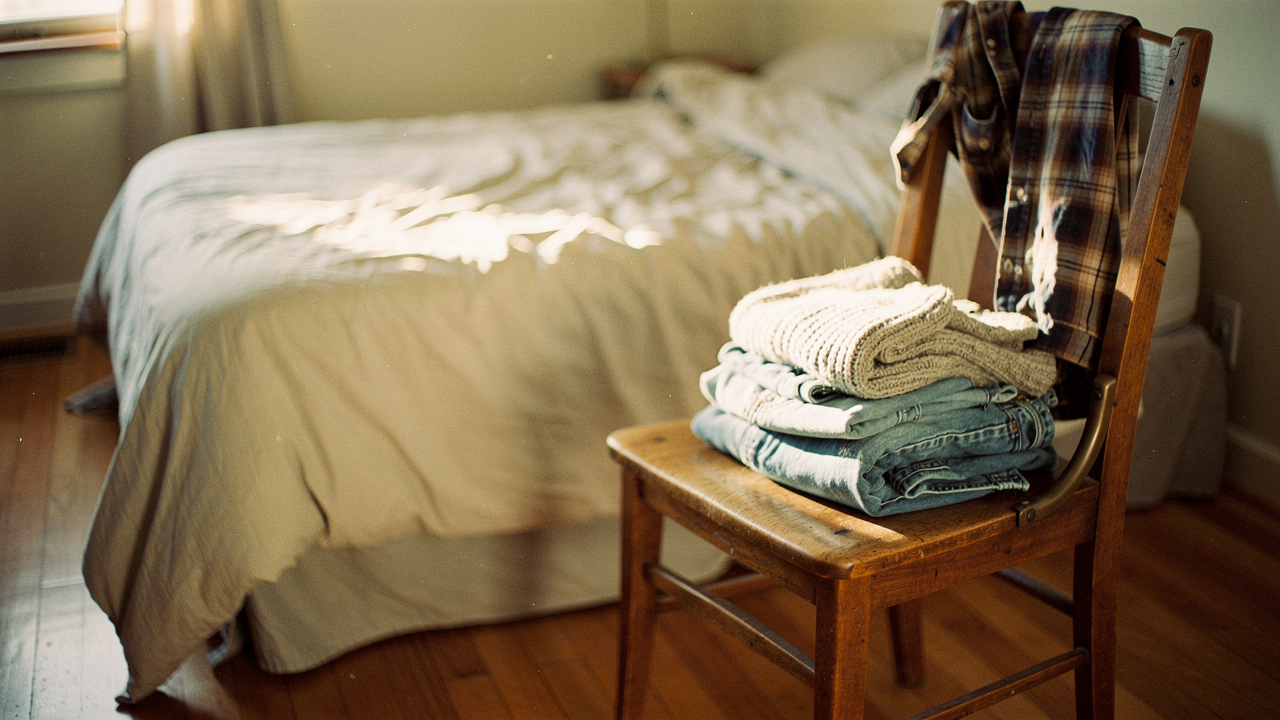
In the world of home optimization, we call this the “floordrobe” or the “chairdrobe.” It’s that purgatory for clothes that aren’t quite dirty enough for the hamper but aren’t quite “closet-clean” either. For years, I felt a twinge of guilt every time I saw that pile. I thought I just needed more discipline. But here’s the Jordan Miller philosophy: if a system requires you to change your fundamental human nature to work, the system is the problem, not you.
Living well isn’t about perfection; it’s about High Lifestyle ROI. It’s about finding products and systems that meet you exactly where you are—even if where you are is “too tired to use a hanger.” Today, I’m diving into the psychology of the clothes pile and reviewing a piece of furniture that might actually be the most honest invention of the decade: The Laundry Chair.
The Psychology of the ‘Chairdrobe’: Why We Pile and Why It Matters
Let’s be real—the reason we throw clothes on a chair isn’t because we’re lazy. It’s because of friction. Putting a semi-clean shirt back on a hanger, finding the right spot in a packed closet, and tucking it away feels like a high-effort task for something you might put right back on tomorrow morning.
According to professional organizers at Declutter Hub, this “in-between” category of clothing is one of the most common sources of bedroom stress [1]. We don’t want our clean clothes to touch the “outside world” germs on our worn jeans, but we also don’t want to do unnecessary laundry. It’s a legitimate storage gap.
For my friends in the neurodivergent community or those dealing with ADHD, this struggle is even more pronounced. The experts at Minimize My Mess highlight that “out of sight” often means “out of mind” [2]. If you hang that half-worn sweater back in the closet, you might forget it exists or forget that it’s already been worn once. We need low-friction, visual systems that allow us to see our options without the visual noise of a mounting pile.
The Star Solution: A Deep Dive Review of the Laundry Chair
I’ll be the first to admit it—I was skeptical when I first heard about a chair designed specifically to hold a mess. But then I looked at my own bedroom chair and realized I hadn’t actually sat in it for three months. It had become an expensive, upholstered shelf. That’s when I realized the genius behind the Laundry Chair.
I started following the journey of inventor Simone Giertz and her team at Yetch Studio when they first began prototyping a solution for the “chairdrobe” [3]. I wanted something that wouldn’t just hide the mess, but would organize it in a way that felt intentional. When I finally saw the finished design, it clicked. This isn’t just a chair; it’s a behavioral tool. The design features a series of rotatable armrests that function as a built-in hanging rail. You simply drape your clothes over the rails, and with a quick spin, the clothes move behind the backrest.
Micro-Verdict: The ultimate “honest furniture” that turns your natural clutter habit into a streamlined, hidden system.
Pros: Visibility Meets Concealment
The biggest win here is the ball-bearing mechanism. It allows you to flip the “mess” to the back when you want the room to feel calm and Sunday-reset-ready, but you can flip it forward to see your “in-between” options when you’re getting dressed. It preserves the seat for its actual purpose: sitting down to put on your shoes.
Cons: The Price of Innovation
Innovation usually comes with a footprint and a price tag. This is a statement piece, and it requires a bit more clearance space than a standard accent chair to allow for the rail to rotate. It’s a premium solution for a specific problem, which might not fit every budget or tiny Austin studio apartment.
Tiered Alternatives: From Free DIY to Designer Valets
If a designer chair isn’t in the cards right now, don’t worry. There are ways to achieve High Lifestyle ROI without a total furniture overhaul. The goal is to create a dedicated “Half-Worn Zone.”
The Budget Fix: The ‘Hook & Basket’ Method
I used to treat my closet door as a catch-all until I realized I was just creating a different kind of pile. I decided to experiment with a “path of least resistance” setup. I installed three sturdy, aesthetic hooks on the back of my door and placed a beautiful, open-top wicker basket directly underneath. Now, “hangable” items like cardigans go on the hooks, and “foldable” items like joggers go in the basket. No hangers, no folding, no stress.
Micro-Verdict: A $30 solution that eliminates the “floordrobe” by giving every in-between item a designated, low-effort home.
The Mid-Range Upgrade: Clothing Valets and Racks
You know that feeling when you walk into a high-end boutique and everything feels airy and curated? That’s the vibe of a dedicated clothing valet. I found that using a slim, minimalist valet stand worked wonders for my husband, who was the primary “chair-piler” in our house. It’s a historical solution—gentlemen have used valet stands for decades to prep their suits—but it works just as well for your favorite high-waisted denim and a vintage tee.
Micro-Verdict: A sophisticated way to display your “in-between” wardrobe while keeping garments wrinkle-free and aired out.
Persona Loadouts: Which System Fits You?
- The Minimalist (Small Spaces): An over-the-door rack with integrated mesh baskets. Keeps everything off the floor and uses vertical space.
- The Power User (Capsule Wardrobe): A small, rolling garment rack from IKEA. Allows you to “air out” items with maximum visibility [4].
- The Aesthetic Curator: A sculptural wooden ladder leaned against the wall. Perfect for draping scarves, jeans, and throws without looking like “clutter.”
The Hygiene Rules: When to Rewear vs. When to Wash
One of the biggest questions I get is: “Jordan, how do I know if it’s actually okay to put back in the pile?” We want to be sustainable, but we also want to be fresh. Here is the general rule of thumb I follow, backed by basic textile care and dermatology guidelines:
- Jeans: 3–5 wears. Denim is hardy; washing it too often actually breaks down the fibers.
- Sweaters/Hoodies: 2–3 wears, provided you wore a base layer underneath.
- Dresses/Blazers: 3–5 wears. These rarely touch high-sweat areas directly.
- Base Layers/Tees: 1 wear. These are the “workhorses” that absorb oils and sweat. Wash them after every use.
A huge part of the “Half-Worn Method” is aeration. Don’t immediately shove a worn shirt into a drawer. Let it hang on your Laundry Chair or a hook for a few hours to let the fabric breathe. This prevents that “stale” smell and keeps your clothes lasting longer.
The ‘Half-Worn Method’: A 3-Step System for Sustainability
To make sure your new system doesn’t just become a tidier version of the same old pile, you need a reset ritual. Here’s how I manage my “inbetweendrobe” [1]:
- The One-In, One-Out Rule: If your chair or basket is full, you aren’t allowed to add a new “half-worn” item until you’ve either moved something to the hamper or put a truly clean item back in the closet.
- The Sunday Reset: Every Sunday evening, while I’m winding down with a face mask, I clear the “Half-Worn Zone.” Anything left there gets a “sniff test.” If it’s still fresh, it goes back in the closet. If it’s questionable, it goes into the wash.
- The End-of-Life Audit: Once a month, check the items you’re consistently piling. If you realize you’re “half-wearing” something but never actually choosing to put it on again, it might be time to donate or recycle it. Use resources like Earth911 to find textile recycling near you for items that are too worn for donation [5].
Living an intentional life doesn’t mean you never have a mess—it means you have a plan for the mess. Whether you’re investing in a piece of functional art like the Laundry Chair or just adding a few hooks to your door, you’re reclaiming your space. And when your environment supports you, everything else—from your morning yoga to your evening sourdough prep—just flows better.
Which system fits your bedroom? Tag us in your #ClothesChairSolution on Instagram!
References & Authoritative Sources
- Declutter Hub (2024). The In-Between Clothes Dilemma: How to Manage the ‘Half-Worn’ Pile. https://declutterhub.com/half-worn-clothes/
- Minimize My Mess (2023). ADHD-Friendly Organizing: The Power of Low-Friction Systems. https://www.minimizemymess.com/blog/how-to-fold-laundry-faster
- Wired (2023). Simone Giertz and the Quest to Build the Perfect Laundry Chair. https://www.wired.com/story/simone-giertz-laundry-chair/
- IKEA (2025). Clothes Organizers and Wardrobe Systems. https://www.ikea.com/us/en/cat/clothes-organizers-10452/
- Earth911 (2024). How to Recycle Clothing and Accessories Responsibly. https://earth911.com/recycling-guide/how-to-recycle-clothing-accessories/
Disclaimer: This post contains affiliate links. Recommendations are based on hands-on testing and behavioral design principles. Jordan Miller only recommends products that meet the “Good Life Test” for efficiency, sustainability, and joy.