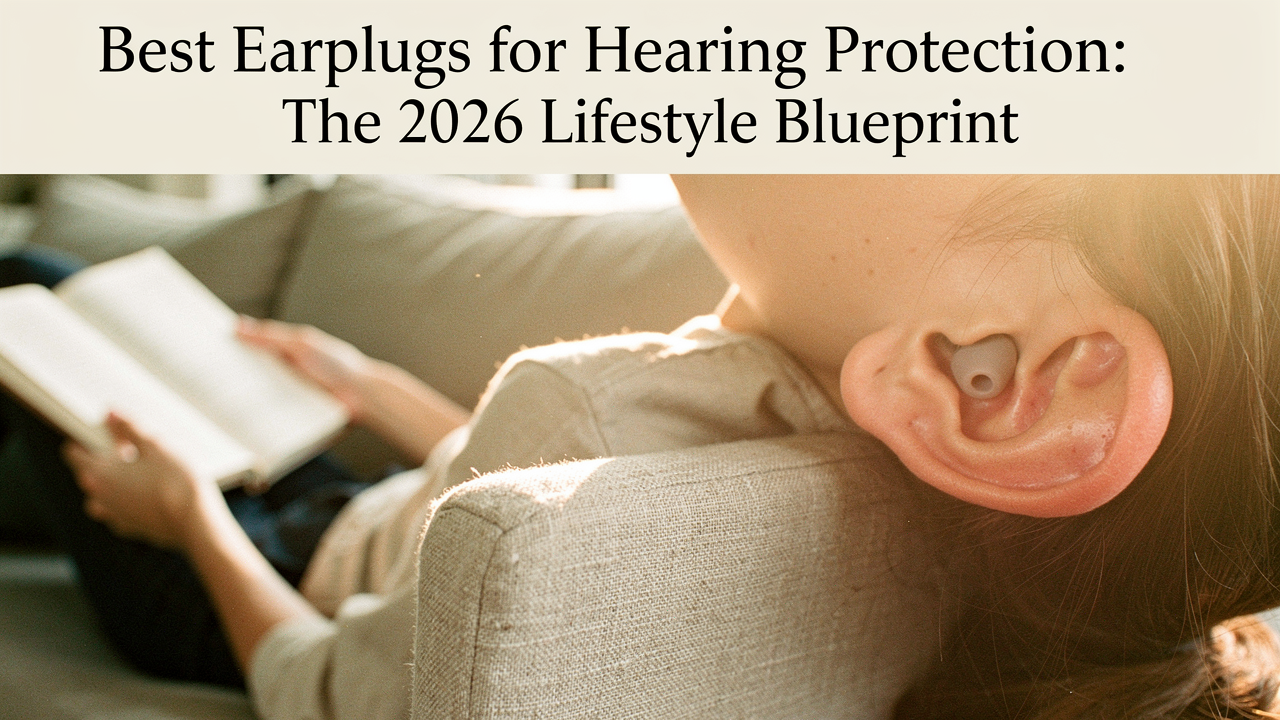
For a long time, I treated hearing protection like an afterthought—something for construction sites or shooting ranges. But as I’ve leaned deeper into the philosophy of “High Lifestyle ROI,” I’ve realized that hearing is perhaps our most precious, non-renewable resource. Once those delicate hair cells in your inner ear are gone, they don’t come back.
Think of it this way: You wouldn’t go for a long hike on a rugged trail without supportive shoes. Why would you walk into a 100dB concert or a high-decibel gym class without protecting your ears? In 2026, the best earplugs aren’t just about blocking sound; they’re about optimizing how we experience the world while ensuring we can still enjoy music and conversation decades from now.
In this guide, we’re going to decode the science of ear damage, demystify those confusing NRR ratings, and look at the curated picks that actually fit into a modern, intentional life.
The Invisible Risk: Why Hearing Protection is a 2026 Essential
We often don’t notice hearing damage because it’s a slow, silent thief. Noise-induced hearing loss (NIHL) and tinnitus (that persistent ringing that never seems to leave) are becoming a global epidemic. According to the World Health Organization, over 1 billion young people are currently at risk of permanent hearing loss simply due to unsafe listening practices in entertainment venues [1].
My personal philosophy is simple: Self-care starts with your space, and that includes your internal “soundscape.” When you protect your hearing, you’re investing in your future ability to connect with people. It’s the ultimate lifestyle ROI.
The Mechanics of Ear Damage
Inside your cochlea are thousands of tiny hair cells. When loud noises hit them, they bend. If the sound is loud enough or lasts long enough, they don’t just bend—they break. Because these cells don’t regenerate, the damage is permanent.
The National Institute for Occupational Safety and Health (NIOSH) recommends limiting exposure to noise at or above 85 dBA to an 8-hour average [2]. Here’s the catch: for every 3 decibels over 85, the “safe” time is cut in half. At a 100dB concert, you’ve reached your daily limit in about 15 minutes.
Decoding the Specs: NRR vs. SNR and the ‘Real World’ Math
If you’ve ever looked at a box of earplugs, you’ve seen the Noise Reduction Rating (NRR). It looks straightforward—if the box says 30, it should block 30 decibels, right?
Unfortunately, it’s not that simple. The NRR is a laboratory-derived number based on ideal conditions [3]. In the real world, we rarely get a perfect seal every time.
To get a more realistic estimate of how much protection you’re actually getting (the A-weighted reduction), safety experts at OSHA and NIOSH often use a “derating” formula:
Real World Protection = (NRR – 7) / 2
So, if you’re wearing foam plugs with an NRR of 33, you’re likely getting about 13 decibels of actual protection in a chaotic environment. This is why choosing the *right* type of plug for the *right* scenario matters more than just chasing the highest number on the box.
The 2026 Earplug Winners: Scenario-Based Picks
Not all noise is created equal. The plugs I use for a Sunday morning sourdough session (when the blender is roaring) are very different from what I wear to sleep or to a live show at the Continental Club.
Best for Live Music & Concerts (High-Fidelity)
I used to think that muffled, underwater sound was just the “price you paid” for not having ringing ears the next morning. I tried the cheap foam plugs at the back of the venue, but they always ruined the bass and made the vocals sound like they were coming from another room. After years of finishing shows with “concert amnesia” because the music felt so disconnected, I discovered high-fidelity filters. These don’t just block sound; they lower the volume evenly across all frequencies, preserving the clarity of the music.
Micro-Verdict: The ultimate win for music lovers who want to hear the crispness of the snare without the morning-after buzz.
The Concert Enthusiast Loadout
If you’re someone who spends 20+ nights a year at live venues, you need gear that feels invisible but works like a shield.
- Essential: High-fidelity earplugs with interchangeable silicone tips
- Essential: A keychain carrying case (if it’s not on your keys, you’ll forget it)
- Pro Upgrade: Custom-molded filters for a “flat attenuation” curve that mimics natural hearing
Best for Deep Sleep & Side Sleepers
Let me be honest: I ignored sleep earplugs for years. I thought I was a “natural” light sleeper and just accepted that every sirens’ wail or neighbor’s heavy footsteps was part of city life. The problem was that most plugs I tried were too bulky; as a side sleeper, they’d press into my ear canal, causing a dull ache by 3 AM. I eventually went on a quest for something low-profile and settled on ultra-soft, medical-grade silicone. The difference in my “Deep Sleep” scores on my tracker was almost immediate.
Micro-Verdict: A game-changer for light sleepers that provides a silent sanctuary without the “clogged ear” pressure.
Best for Industrial Work & DIY Projects
You know that feeling when the construction across the street starts at 7 AM, or you’re finally tackling that weekend DIY project with a power sander? This is where you stop worrying about “fidelity” and start worrying about maximum blockage. For years, I’d just grab whatever was in the junk drawer, but I realized my focus improved significantly when I used high-NRR foam plugs that actually sealed correctly. In environments exceeding 90 dBA, OSHA standards aren’t just suggestions—they’re survival guides for your hearing.
Micro-Verdict: The heavy-duty choice for when silence is the only priority.


Reusable vs. Disposable: The Sustainability & Hygiene Factor
In my Austin kitchen, I treat my sourdough starter with a lot of care—regular feedings, clean jars, the whole bit. I’ve started looking at my reusable earplugs the same way.
- Sustainability: Reusable silicone plugs can last months, whereas foam is usually a one-and-done deal. Over a year, reusables are significantly cheaper and keep hundreds of foam bits out of the landfill.
- Hygiene: To prevent ear infections, you must clean reusables with mild soap and warm water after every few uses.
- Performance: Foam often provides higher NRR, but silicone offers a more consistent, comfortable seal for daily wear.
Jordan’s Pro Tip: If your reusable plugs start to feel “stiff” or lose their elasticity, it’s time to toss them. A plug that doesn’t seal is just an expensive earring.
Next-Gen Protection: What’s New in 2026?
We’re entering the era of “Hearables.” The line between high-end earbuds and hearing protection is officially blurred. In 2026, we’re seeing smart earplugs that use active noise cancellation (ANC) to target specific frequencies—like the drone of a plane engine—while using “transparency modes” to let human voices through perfectly.
We’re also seeing a shift toward Sustainable Thermoplastic Elastomers (TPE). These materials are easier to recycle than traditional silicone and offer a “memory” fit that contours to your ear’s heat. It’s the kind of tech-meets-wellness optimization that makes a “Good Life” truly seamless.
Final Thoughts: The Best Earplug is the One You Actually Wear
At the end of the day, you can buy the most expensive, high-tech protection on the market, but if they’re sitting in your drawer because they’re uncomfortable, they’re useless. Start by identifying your biggest “noise pain point.” Is it the commute? The office? The sleep-stealing neighbors?
Pick a pair that matches your lifestyle, keep them on your keychain, and make protection a habit. Your future self—the one still enjoying deep conversations at 80—will thank you.
Medical Disclaimer: This guide is for informational purposes and does not replace professional advice from an audiologist. Includes affiliate links.
References & Authoritative Sources
- World Health Organization (2022). 1 billion people at risk of hearing loss. WHO Safe Listening Initiative. https://www.who.int/news-room/fact-sheets/detail/deafness-and-hearing-loss
- NIOSH (2024). Criteria for a Recommended Standard: Occupational Noise Exposure. Centers for Disease Control and Prevention. https://www.cdc.gov/niosh/topics/noise/
- ANSI (1974). Method for the Measurement of the Real-Ear Attenuation of Hearing Protectors. ANSI S3.19-1974.
- OSHA (2025). Hearing Conservation Program Guidelines. Occupational Safety and Health Administration. https://www.osha.gov/noise