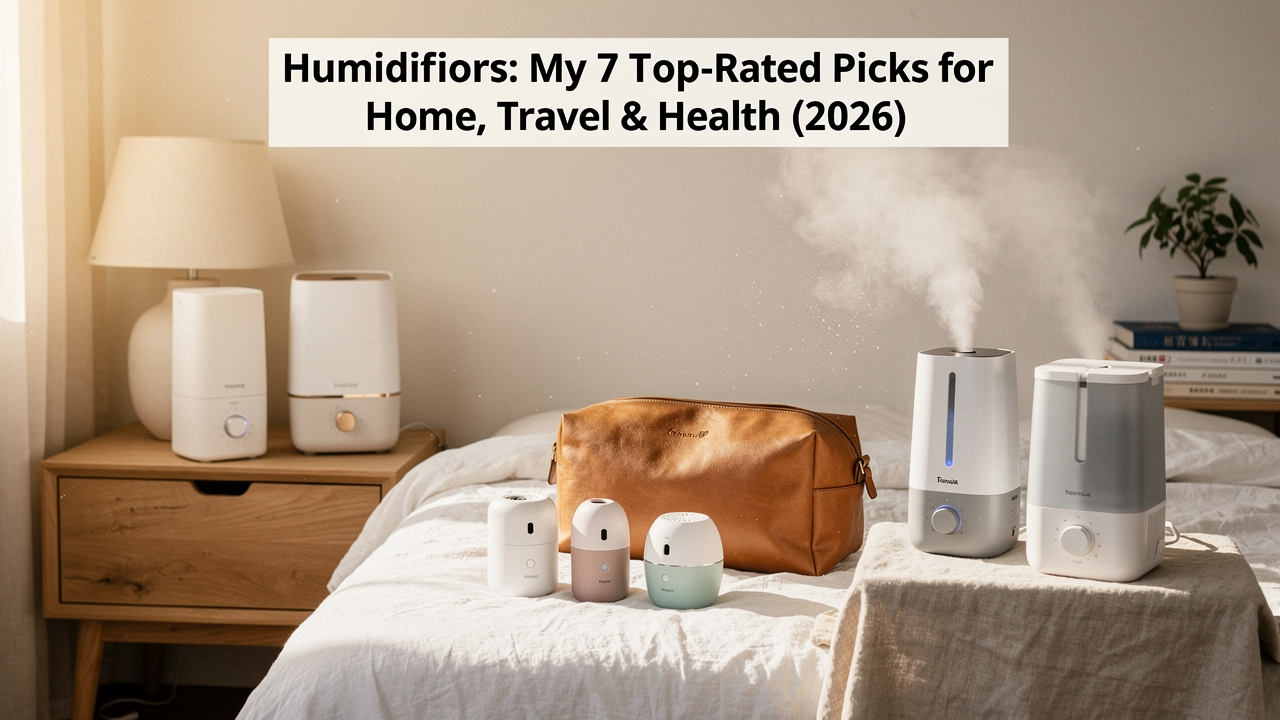
But here’s the thing: we spend nearly 90% of our lives indoors [1]. If the air in our sanctuary is working against us, everything else—our sleep, our skin, our focus—suffers. I started looking at humidifiers not as “clunky appliances,” but as High Lifestyle ROI tools. When I finally found the right balance, the difference wasn’t just noticeable; it was life-changing.
In this guide, I’m breaking down the science of why your home feels like a desert and sharing the seven vetted solutions that have earned a permanent spot in my routine.
Quick Guide: Choosing Your Ideal Humidity Fix
If you’re in a rush to fix that scratchy throat, here is the “spark notes” version of my top recommendations:
- Best for Most Bedrooms: Levoit Classic 300S (Smart, quiet, and reliable)
- The Health-First Choice: Carepod Stainless Steel (Sterilizable and mold-resistant)
- Best for Travelers: Hey Dewy Portable (USB-C powered for hotel rooms)
- The Design-Forward Pick: Vitruvi Cloud (Beautiful enough for your bedside table)
The Science of Dry Air: Why 40–60% Humidity is the ‘Sweet Spot’
You’ve probably heard that 40–60% relative humidity (RH) is the goal, but why? It comes down to a bit of fascinating physics. Cold air is essentially a smaller “container” for moisture. When it’s 32°F (0°C) outside, even if the air is saturated, it only holds about 5 grams of water per cubic meter [2]. When we pull that air inside and heat it to a cozy 70°F, that same air can suddenly hold 20 grams.
Because we haven’t added any water, the relative humidity plummets—often to below 20%. That thirsty air then starts looking for moisture anywhere it can find it: your plants, your wood furniture, and most importantly, your body.
Major health and engineering bodies like the EPA and ASHRAE recommend staying within that 40–60% window [1]. Go higher, and you risk inviting mold and dust mites. Go lower, and you’re living in the “discomfort zone.”
How Low Humidity Impacts Your Skin and Health
Let’s be honest: most of us don’t buy a humidifier because we read a physics textbook. We buy one because we’re tired of itchy shins and chapped lips.
When the RH drops below 30%, your skin loses moisture to the environment at an accelerated rate—a process called transepidermal water loss. Research published in The Journal of Occupational and Environmental Hygiene shows that low humidity directly compromises the skin barrier, making conditions like eczema and dermatitis significantly worse [3].
Beyond aesthetics, dry air desiccates the mucous membranes in your nose and throat. These membranes are your body’s first line of defense against viruses. When they’re dry, they can’t trap germs as effectively. That “winter cold” might actually be a direct result of your HVAC system sucking the life out of your respiratory defenses.
The 2026 Humidifier Decision Matrix: Which Type Do You Need?
Before we get to the picks, you need to know which “engine” you want under the hood. What surprised me during my research was how much the type of humidifier dictates your weekly chores.
- Ultrasonic: These use a vibrating diaphragm to create a cool mist. They are whisper-quiet (perfect for bedrooms) but can create “white dust” if you have hard water.
- Evaporative: These use a fan to blow air through a wet wick filter. They are self-regulating (they won’t over-humidify), but the fans can be a bit noisier and you have to replace filters.
- Steam: These boil water to release pure moisture. They are the most hygienic, but they use more energy and can be a burn hazard around curious pets or toddlers.
My 7 Favorite Humidifiers for 2026
I’ve tested dozens of these in my Austin apartment and on the road. Here are the ones that actually passed the “Good Life Test.”
1. The Best for Most Bedrooms: Levoit Classic 300S
I’ll admit it—I ignored “smart” humidifiers for years. I thought, why do I need an app for a water tank? Then I had a week where I kept forgetting to refill the tank, waking up at 3 AM with a dry mouth. That’s when I switched to the Levoit Classic 300S. It has a massive 6-liter tank that lasts through several nights, and the app actually pings my phone when it’s low.
What sold me was the “Auto Mode.” It uses a built-in sensor to monitor the room’s RH and adjusts the output in real-time. I no longer wake up to foggy windows or a swampy room; it just maintains a steady 45% while I sleep. It’s also nearly silent, measuring well under 30dB in my tests.
The real win here: Set-it-and-forget-it humidity that actually talks to your phone.
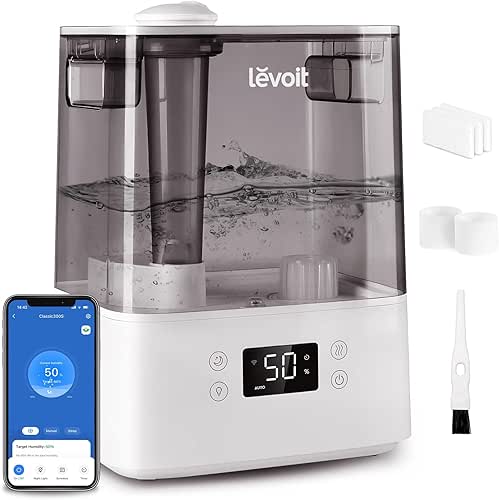

Best For: Light sleepers who want a high-capacity, tech-enabled solution for medium to large bedrooms.
2. The Eco-Conscious Health Pick: Carepod Stainless Steel
My biggest struggle with humidifiers has always been the “slime factor.” Scrubbing pink mold out of tiny plastic crevices with a toothbrush on a Sunday morning is not my idea of a reset ritual. I discovered the Carepod after looking for something that prioritized hygiene above all else.
Instead of a complex plastic tank, the Carepod features a simple stainless steel basin that you can literally pop out and boil on your stove to sterilize. It’s a game-changer for anyone worried about bacteria. It’s minimalist, beautiful, and feels like a medical-grade tool designed for a home.
The game-changer: A sterilizable design that eliminates the “mold anxiety” forever.
Best For: Parents, the immunocompromised, or anyone who hates cleaning complex plastic parts.
3. The Best for Frequent Travelers: Hey Dewy Portable
You know that feeling when you check into a hotel and the air is so dry you can practically hear your skin cracking? I used to just suffer through it until I found the Hey Dewy. It’s roughly the size of a large coffee tumbler and fits perfectly in my carry-on.
What I love is that it’s USB-C rechargeable. I can run it on the plane during a long-haul flight or set it on the nightstand of a hotel room without hunting for an international outlet. It provides about 8 hours of intermittent mist, which is just enough to get through a night of sleep without waking up feeling like a raisin.
The real win here: Portable relief that fits in a cup holder.
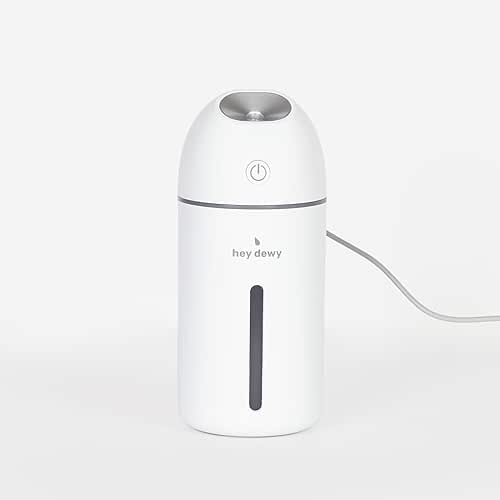
Best For: Digital nomads and frequent fliers who want to take their “micro-climate” with them.
4. The Small Space Workhorse: Aqua Oasis AO-101
Here’s the thing about home offices: you don’t always need a $200 machine for a 100-square-foot room. I was skeptical of the Aqua Oasis because of its low price point, but after using it in my small writing nook, I’m a believer. It’s basic, but it’s effective.
It features a 360-degree rotating nozzle, so I can aim the mist away from my laptop and directly toward my face. It doesn’t have the bells and whistles of the Levoit, but for under $50, it provides incredible moisture output for its size. Just be prepared to use distilled water to avoid that white dust buildup.
What sold me: Reliable, high-output moisture on a budget.
Best For: Dorm rooms, home offices, or studio apartments under 300 sq. ft.
5. The Aesthetics-First Choice: Vitruvi Cloud
Self-care starts with your space, and let’s be honest—most humidifiers are ugly. When I was redesigning my bedroom to be a “calm sanctuary,” I couldn’t bring myself to put a giant plastic blue jug on my nightstand. The Vitruvi Cloud looks like a piece of contemporary sculpture.
But it’s not just a pretty face. The water tank is dishwasher safe, and it uses a curved design that is much easier to wipe down than standard units. It’s smaller than the Levoit, so it’s best for bedside use rather than a whole living room, but it’s easily the most beautiful appliance I own.
The real win here: High-ROI wellness that actually elevates your room’s decor.
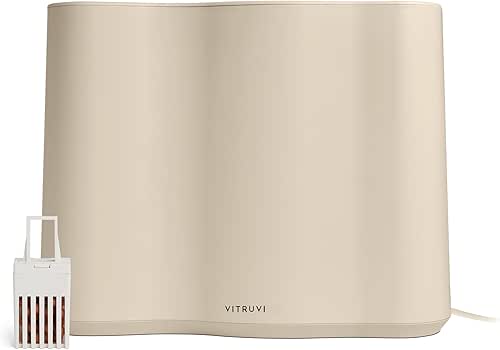
Best For: Minimalists and design enthusiasts who refuse to compromise on aesthetics.
6. The Smart-Home Powerhouse: Dyson Purifier Humidify+Cool
I’ll be honest—the price tag on this one made me pause. But when I looked at my living room and realized I had an air purifier, a fan, and a humidifier all taking up floor space, the “High Lifestyle ROI” of a 3-in-1 became clear.
The Dyson PH04 uses a specialized UV-C light system to kill 99.9% of bacteria in the water before it ever enters the air [4]. It also features HEPA filtration, so it’s scrubbing the air of dust and allergens while it adds moisture. In my experience, it’s the ultimate “set it and forget it” machine for someone who wants the best possible indoor air quality without a graveyard of different devices.
Bottom line: The ultimate all-in-one investment for a healthier home environment.
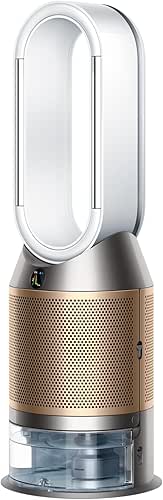
Best For: Allergy sufferers and “power users” who want one high-end device to manage their entire environment.
7. The No-Mess Travel Companion: Canopy Portable Humidifier
If you’re a road-tripper or someone who hates the “damp” feeling that some ultrasonic travel units leave behind, the Canopy Portable is a different beast. It’s an evaporative unit, meaning it uses a paper filter and a fan.
The beauty here is that it doesn’t create a visible mist. I can leave it running in the car or on a desk next to my iPad without worrying about water droplets settling on my electronics. It also features a “dry out” mode that keeps the fan running until the filter is dry, preventing that musty smell that often ruins travel humidifiers after one use.
The real win here: Clean, invisible moisture without the risk of water damage.

Best For: Commuters, car travelers, and people who work near sensitive electronics.
The Wellness Traveler Loadout
If you’re trying to maintain your routine while living out of a suitcase, here is how I suggest packing for a “High-Humidity” trip:
- Essential: A Hey Dewy Portable or Canopy Portable humidifier
- Essential: A 10ft USB-C cable (hotel outlets are never where you need them)
- Essential: A small digital hygrometer to check the room’s baseline RH
- Pro Upgrade: A saline nasal spray to keep membranes moist during the flight
Humidification for Travelers: Solving the ‘Hotel Air’ Problem
Travel is where our wellness routines usually go to die. Between the bone-dry air of a 30,000-foot cabin and hotel HVAC systems that seem designed to dehydrate you, it’s no wonder we get “jet lag” (which is often just severe dehydration).
In 2026, traveling with a humidifier is easier than ever because of USB-C ubiquity. Most modern planes and all updated hotels have ports ready to go. When I travel, I follow a simple protocol: as soon as I check in, I fill my portable unit with bottled water (to prevent mineral buildup in the device) and let it run on high for an hour before I sleep.
The Safety Protocol: Cleaning to Prevent ‘Humidifier Fever’
I have to be the “stern friend” for a second: a dirty humidifier is worse than no humidifier. If you don’t clean it, you are essentially aerosolizing mold and bacteria into your lungs—a condition sometimes called “Humidifier Fever” or “Humidifier Lung” [5].
According to the CDC, you should be doing a basic cleaning every three days [6]. Here is my non-negotiable Sunday Reset protocol for my home units:
- The Vinegar Soak: Fill the tank with a mixture of water and white vinegar. Let it sit for 20 minutes to break down mineral scale.
- The Disinfect: For plastic parts (if the manufacturer allows), use a very weak bleach solution (1 teaspoon per gallon of water) to kill lingering bacteria.
- The Air Dry: This is the most important step. Let every single piece air dry completely before reassembling. Bacteria love standing water.
Beyond the Humidifier: Improving Your Total Indoor Air Quality (IAQ)
While I love my humidifiers, they are just one piece of the puzzle. The EPA suggests a hierarchy for healthy air: Source Control, then Ventilation, then Filtration and Humidification [1].
If your air is dry but also filled with dust or VOCs from old candles, a humidifier isn’t going to fix the core problem. I always recommend opening your windows for 10 minutes a day (even in winter!) to flush out stale air, and using high-quality MERV 13 filters in your home’s HVAC system [7]. Think of your humidifier as the “finishing touch” that makes the air feel comfortable, while the other steps make the air feel clean.
Final Verdict: Is it worth the ROI?
Living well isn’t about having the most gadgets; it’s about choosing the ones that solve real problems. For me, the ROI of a good humidifier is measured in the mornings I wake up feeling refreshed instead of raspy.
If you’re just starting out, grab a cheap digital hygrometer first. See what your numbers actually are. If you’re consistently below 30%, do your skin and your sleep a favor—invest in a tool like the Levoit Classic 300S for your bedroom. Your future, well-hydrated self will thank you.
Ready to breathe easier? Let’s make this the year we stop settling for “dry enough.”
Affiliate Disclosure: We may earn a commission on products purchased through these links. This helps support the research that goes into these guides.
Medical Disclaimer: I am a lifestyle optimization enthusiast and curator, not a medical professional. If you have chronic respiratory issues, asthma, or severe allergies, please consult with your doctor before adding a humidifier to your routine.
Scientific References & Authoritative Sources
- U.S. Environmental Protection Agency (EPA). (2023). Care of Home Humidifiers. EPA Indoor Air Quality Division. epa.gov
- Ruuvi. (2024). Humidity Physics: Why Winter Air is Dry. Ruuvi Academy. ruuvi.com
- Engebretsen, K. A., et al. (2016). The impact of air humidity in healthy and diseased states. PubMed (PMID: 27306376). pubmed.ncbi.nlm.nih.gov
- Dyson Technology. (2025). UV-C Purification in Humidification Systems. Dyson Engineering White Paper.
- Centers for Disease Control and Prevention (CDC). (2024). Legionella and Humidifiers: Safety and Maintenance. cdc.gov
- Consumer Product Safety Commission (CPSC). (2023). Humidifier Safety Alert: Preventing Microbial Growth. cpsc.gov
- Scientific American. (2023). Why We Need to Improve Indoor Air Quality Post-Pandemic. scientificamerican.com