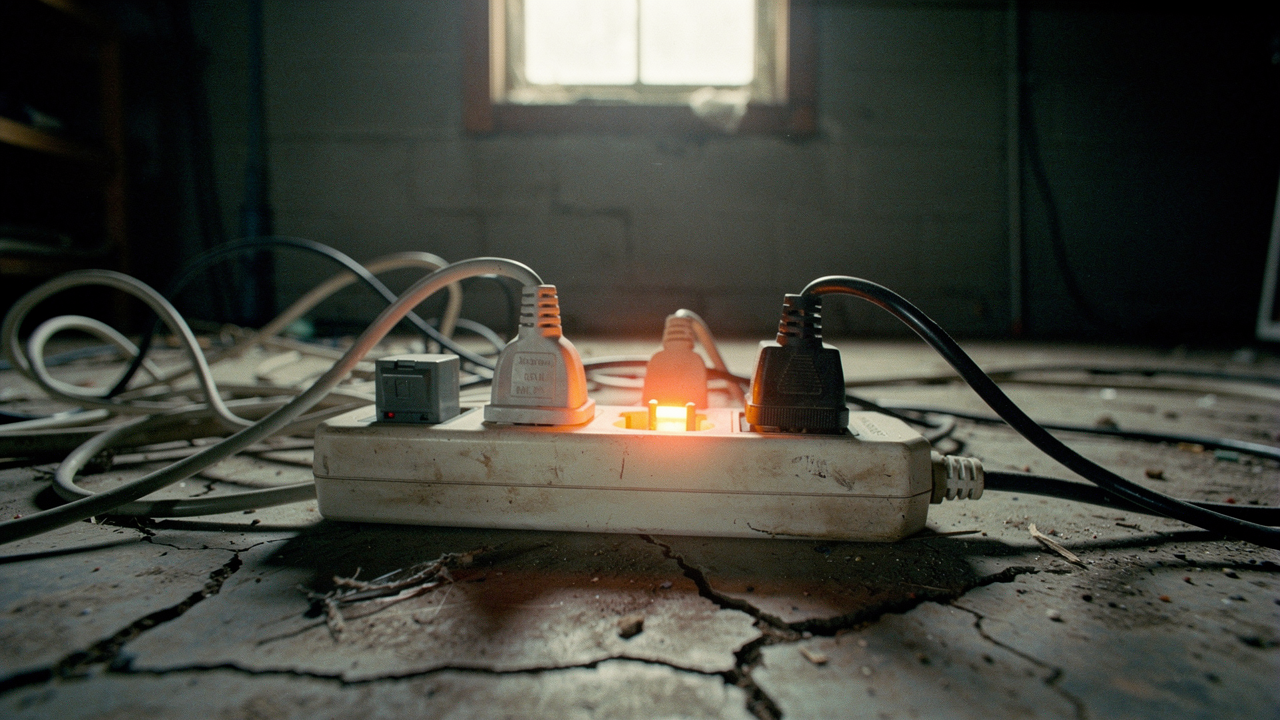
But recently, while tucking a stray cord behind my desk, I realized I’d committed a cardinal sin of home optimization. I had three different devices plugged into a small power strip, which was then plugged into another extension cord because the wall outlet was just six inches too far.
It looked like a harmless solution to a common problem. In reality, I was looking at a major electrical fire hazard.
According to the Electrical Safety Foundation International (ESFI), more than 3,300 home fires originate from power strips and extension cords every single year [1]. We treat these plastic bars like “infinite power” magic tricks, but they have very real, very dangerous limits. Today, I’m sharing the master plan I used to audit my own space—translating complex electrical codes into a simple, room-by-room system to keep your “Good Life” a safe one.
The ‘Infinite Power’ Fallacy: Why Daisy Chaining Is a Fatal Error
We’ve all been there: you have five things to plug in but only four outlets. The temptation to plug one power strip into another—a practice known as “daisy chaining”—is almost overwhelming.
Here’s the thing: power strips (or “Relocatable Power Taps” in industry-speak) are designed to be plugged directly into a permanently installed wall outlet [8]. When you chain them together, you create a chain reaction of heat. The first strip in the chain isn’t just carrying the load of its own devices; it’s carrying the entire load of every strip attached to it.
The Office of Compliance (OCWR) and OSHA both strictly prohibit this because it bypasses the safety grounding of the units and can easily exceed the amperage the wall circuit can handle without ever tripping the strip’s internal breaker [8]. It’s a “fatal error” because the failure doesn’t happen where you can see it; it happens inside the wires, melting insulation until a spark finds a way out.
The 80% Rule: How to Calculate Your Power Strip’s Real Limit
I used to think that if a power strip had six outlets, I could use all six for whatever I wanted. What I didn’t realize was that I was flirting with an outlet overload every time I turned on my space heater.
To prevent power strip fires, you have to understand the math. Most North American home circuits are rated for 15 amps at 120 volts. This means the total capacity is 1,800 watts [2]. However, the National Electrical Code (NEC) suggests a “continuous load” safety margin of 80% [2].
Your magic number is 1,440 watts.
If the total wattage of everything plugged into a single circuit (not just the strip, but the entire wall circuit) exceeds 1,440 watts for more than a few hours, you are stressing your home’s “nervous system.”
Example: The Ultimate Gaming Setup vs. Safety
Let’s look at a common Austin home office scenario to see how quickly the math adds up:
- Gaming PC (High-end): 500 Watts
- Two 27-inch Monitors: 100 Watts (50W each)
- Studio Speakers: 30 Watts
- Desk Lamp (LED): 10 Watts
- Total Current Load: 640 Watts
At 640 watts, you’re in the “Green Zone.” You have plenty of headrooms. But here is where the mistake happens: it gets a little chilly in the winter, so you plug a 1,500-watt portable space heater into that same power strip.
Suddenly, you’re at 2,140 watts. You’ve exceeded the 1,800-watt maximum of the circuit and blown past the 1,440-watt safety limit. This is exactly how most home electrical fires start [1].
The ‘Never List’: 10 Things That Will Kill Your Power Strip
When I was first researching proper power strip usage, I was shocked to find how many everyday items were on the “Never List.” Most of us assume that if the plug fits, it’s safe. But high-wattage appliances and those with “inrush current”—a massive spike of power needed just to start a motor—can melt a standard strip in minutes.
The Kitchen Culprits (Microwaves & Coffee Makers)
Kitchen appliances are the heavy hitters of the electrical world. Items like microwaves, toasters, and coffee makers use cycling heat elements that draw massive amounts of power. Because these elements turn on and off rapidly, they create thermal stress on the thin copper wiring inside a cheap power strip.
The ‘Hidden’ Dangers: Sump Pumps and Hair Dryers
I’ll admit it—I used to plug my hair dryer into a strip in my bathroom. But a standard hair dryer can pull 1,500 to 1,800 watts all by itself. Sump pumps and large power tools are also dangerous because their motors require a “kickstart” of energy that can be three times their running wattage, easily overwhelming a surge protector’s internal components.
Buying Guide: Surge Protectors vs. Basic Strips
If you’re like me, you probably have a junk drawer full of those $5 plastic power strips. But choosing a safe surge protector is one of the highest “Lifestyle ROI” moves you can make.
I struggled with tech clutter for years, constantly worried that a summer thunderstorm in Austin would fry my workstation. What finally clicked for me was learning about “Joule ratings.” A basic power strip is just an extension of your outlet; it offers zero protection. A surge protector, however, uses Metal Oxide Varistors (MOVs) to absorb excess voltage.
For your valuable electronics—laptops, TVs, and gaming consoles—you want a protector with a minimum of 1,000 to 2,000 joules [11]. It’s also vital to remember that surge protectors “wear out.” Every time they absorb a spike, those MOVs degrade. If your surge protector is more than five years old, its protective capacity is likely gone, even if the “on” light is still glowing.
I’ll be honest: I ignored the specs on my office setup for way too long until a nearby lightning strike took out my favorite monitor. I spent days researching a replacement that actually felt substantial, and I finally landed on the Tripp Lite Protect It! Series. Unlike the flimsy plastic strips you find at the grocery store, this feels like a piece of industrial equipment. It has a rugged housing and, most importantly, a clear “Protection Present” light that actually tells you when the internal components have sacrificed themselves to save your gear.
The real win here: Professional-grade protection that gives you permission to stop worrying every time the clouds turn grey.
Your Room-by-Room Electrical Audit
Self-care starts with your space, and that includes the parts of your space you can’t see. I recommend doing a 5-minute “Sunday Reset” for your outlets once a year. Here is your checklist for a safer home:
- The Touch Test: Feel your power strips and wall plates. If they are warm to the touch, unplug everything immediately. This is a sign of a loose connection or a dangerous overload.
- The “Squish” Check: Plugs should fit snugly. If a plug feels “squishy” or falls out of the strip easily, the internal contacts are worn out. This causes “arcing,” which is a primary cause of electrical fires [9].
- Damage Patrol: Look for frayed cords, kinks, or any place where a cord is pinched under furniture or run under a rug. Running cords under rugs traps heat and is a major fire hazard [10].
- The One-and-Done Rule: Ensure every power strip is plugged directly into the wall. No extension cords, no “cheater” adapters.
Persona Loadout: The Modern Home Office
If you’re a remote worker in a small space, you likely have more gadgets than outlets. Here is how to set up your “Command Center” safely:
- Essential: One high-quality surge protector (1,000+ Joules) plugged directly into the wall.
- Essential: A cable management box to keep cords from being stepped on or kinked.
- Pro Upgrade: A dedicated 20-amp circuit for your room if you are running a laser printer and a high-end PC simultaneously.
- Safety First: If you must use a heater, it gets its own dedicated wall outlet—nothing else sharing the plug.
Bottom line: High lifestyle ROI isn’t just about how a product looks—it’s about the peace of mind it provides. By respecting the 80% rule and ditching the daisy chains, you’re not just preventing a fire; you’re creating an environment that truly supports your best life.
***
Disclaimer: While I’m a tech optimization geek and home curator, I’m not a licensed electrician. This guide is for educational purposes based on industry safety standards. For major home rewiring, recurring breaker trips, or if you smell a “fishy” or burning odor near your outlets, always consult a licensed professional immediately.
Sources & Authoritative References
- ESFI, 2024, “Power Strip Safety Research and Statistics,” Electrical Safety Foundation International.
- NFPA, 2023, “National Electrical Code (NEC) Fact Sheet,” National Fire Protection Association.
- MidAmerican Energy, 2024, “Home Electrical Safety: Preventing Power Strip Fires,” https://www.midamericanenergy.com/articles/power-strip-safety-tips
- Bob Vila, 2024, “15 Things You Should Never Plug Into a Power Strip,” https://www.bobvila.com/articles/power-strip-safety/
- OSHA, 2022, “Standard Interpretations: Power Taps and Extension Cords,” Occupational Safety and Health Administration.
- Tripp Lite by Eaton, 2023, “Surge Protector Buying Guide: Understanding Joules,” https://tripplite.eaton.com/products/surge-protector-buying-guide
- Schneider Electric, 2023, “How to Choose the Right Surge Protection for Your Home,” https://blog.se.com/
- OCWR, 2021, “Fast Facts: Power Strips and Dangerous Daisy Chains,” Office of Congressional Workplace Rights.
- Alabama Fire College, 2024, “Understanding the Fire Hazards of Using Extension Cords,” https://www.alabamafirecollege.org/
- UCOP Risk Services, 2022, “Surge Protector and Power Strip Safety Guide,” University of California.
- Anker, 2024, “What Does Power Strip Safety Mean Today?”, https://www.anker.com/blogs/ac-power/