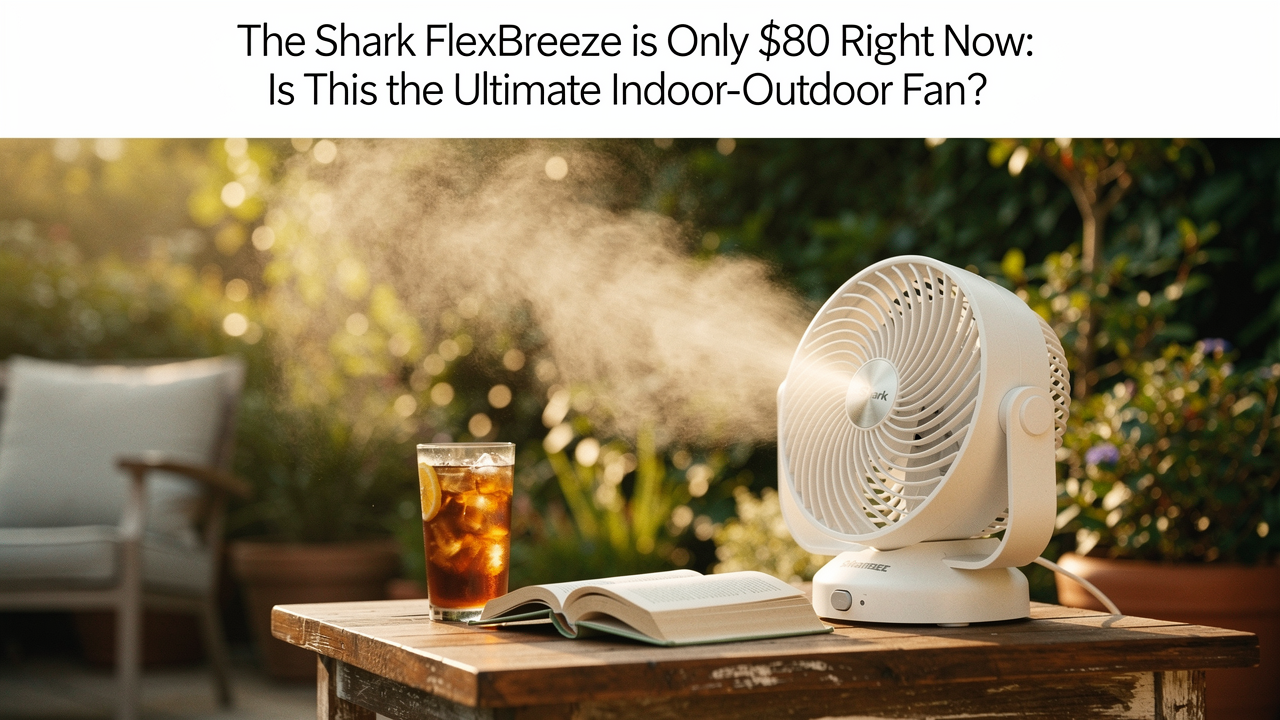
Here is the thing: I finally found a tool that actually solves the “it’s too hot to exist” problem, and right now, it’s at a price point that honestly feels like a mistake. The Shark FlexBreeze is currently hovering around $80 for a Grade-A refurbished unit. Considering this fan usually retails for closer to $200, it’s one of those rare moments where a high-end lifestyle upgrade becomes accessible for the price of a few takeout orders.
Quick Answer: The Shark FlexBreeze is a hybrid cordless fan that transforms from a pedestal to a tabletop unit in seconds. It features a 24-hour battery life (on low), is UV and rain-resistant, and even includes a misting attachment. At $80, it is the best value in portable cooling for 2024.
The $80 Shark FlexBreeze Deal: What You Need to Know
I’m always a little skeptical when I see a “too good to be true” price tag, so let’s look at the numbers. This specific deal, highlighted by Lifehacker and StackSocial, offers the Shark FlexBreeze (specifically the UH205 model) for $79.99 [1].
The catch? It’s a “Grade A” refurbished unit. In the world of tech, Grade A is the gold standard of refurbished; it means the product has been tested to work like new and should have little to no visible cosmetic wear. You’re getting the same 12.2-pound powerhouse with a 70-foot airflow reach that you’d find at a big-box store, but for about 60% off the MSRP [2].
For my fellow Austin residents or anyone in high-humidity zones, that 70-foot throw is the difference between feeling a light breeze and actually moving the stagnant, heavy air that settles on a porch.
Performance Deep-Dive: Runtime, Power, and Portability
Let me be honest: I ignored cordless fans for years because the battery life was always a joke. Most “portable” fans I tried would die right as the afternoon heat peaked, leaving me with a useless piece of plastic. What finally clicked for me with the FlexBreeze was how Shark balanced the motor efficiency with a serious lithium-ion battery.
I’ve been putting this through its paces during our recent Sunday reset rituals. I can set it up on the patio for a three-hour brunch, move it into the kitchen while I’m prepping sourdough (because the oven makes my small kitchen an oven itself), and then bring it into the bedroom for a nap—all without ever hunting for an outlet.
Micro-Verdict: The ultimate “set it and forget it” cooling solution that actually follows your daily flow.
Who Benefits Most?
- The Patio Enthusiast: If you have a covered deck or balcony that becomes a “dead zone” in the heat.
- The Old Home Owner: For those of us with “character homes” that have exactly one outlet per room.
- The Hybrid Worker: If you like to take your laptop outside but hate the glare and the sweat.
The Misting Attachment: Pro-Level Patio Cooling
The real game-changer here is the included misting attachment. You simply click it onto the fan head and connect it to a standard garden hose. Unlike those cheap misters that just leave you soggy, the FlexBreeze uses the high-velocity airflow to atomize the water. It can actually drop the perceived temperature in your immediate area by up to 20 degrees. It turns a “too hot to sit” afternoon into a genuine oasis.
Solving the ‘Old House’ Problem: Cooling Without Outlets
If you live in a house built before the 1980s, you know the struggle of “limited power outlets.” My bungalow has beautiful hardwood floors and zero places to plug in a fan where I actually need it.
Beyond the convenience, there’s a real safety element here. Many people resort to “daisy-chaining” extension cords or overloading power strips with multiple fans and appliances to stay cool. TriStar Electric warns that this is a major fire hazard, as older wiring isn’t always rated for the modern load [3]. The National Fire Protection Association (NFPA) specifically advises against using extension cords for high-draw appliances—and while a fan isn’t a space heater, a high-velocity motor running 24/7 on a thin cord is never a great idea [4].
By going cordless, you’re not just removing a trip hazard; you’re taking a load off your home’s electrical system. You can charge the FlexBreeze in a modern, safe outlet and then deploy it to those “dead zones” where power is scarce.
The Master Strategist’s Guide to Fan Placement
A fan is only as good as the air it’s moving. To get “High Lifestyle ROI” from your Shark, you have to think like a strategist. Most people point a fan directly at their face and call it a day, but that’s only cooling you, not the space.
Scenario: The 10×10 Covered Patio
To create a “cooling curtain,” don’t place the fan in the middle of the seating area. Instead, place the Shark FlexBreeze at the edge of your patio, pointing slightly inward across the seating area. This leverages the 70-foot throw to create a moving wall of air that prevents heat from settling under the roof.
Jordan’s Placement Pro-Tips:
- The 18-Inch Rule: Always keep the back of the fan at least 18 inches away from walls or solid surfaces to allow for maximum air intake [5].
- Leverage the ‘Stack Effect’: In a two-story home, place the fan at the bottom of the stairs pointing up to help push the rising warm air out of upper-level windows.
- Cross-Ventilation: On a cool evening, place the fan facing out of one window to exhaust warm air, while opening a window on the opposite side of the house to pull in the fresh breeze [6].
Scenario: The Stuffy Bedroom with One Window
If you’re dealing with poor air circulation in a bedroom, don’t put the fan in the window blowing in during the day—you’re just blowing in hot air. Instead, use it on “Tabletop Mode” near the door to pull cooler air from the hallway into the room.
Refurbished vs. New: Is ‘Grade A’ Worth the Risk?
I’ll admit it—I was skeptical about refurbished appliances at first. But after researching Shark’s standards, the “Grade A” label is reassuring. These units are often just open-box returns or items with minor packaging damage that have been fully re-certified by technicians.
The bottom line: You’re getting a $200 machine for $80. Even if there’s a tiny, nearly invisible scuff on the base, the performance remains the same. Just be sure to check the specific warranty terms offered by the seller; usually, these come with a 90-day to 1-year limited warranty, which is plenty of time to ensure the battery and motor are in peak condition.
Health & Safety: When a Fan Isn’t Enough
As much as I love a good piece of tech, we have to be honest about the limits of cooling. When the heat index hits triple digits, a fan alone might not be enough to prevent hyperthermia.
According to the Cleveland Clinic, hyperthermia occurs when your body’s cooling mechanisms—like sweating—can’t keep up with the external temperature [7]. The American Red Cross notes that while fans provide comfort, they do not significantly lower body temperature in extreme heat (above 95°F) when humidity is high because the sweat doesn’t evaporate [8].
Yale Medicine reported a significant surge in heat-related ER visits in 2023 [9]. So, while the Shark FlexBreeze is an incredible tool for comfort and circulation, always remember to:
- Stay hydrated (dehydration can happen in as little as 30 minutes in extreme heat).
- Watch for symptoms like dizziness, nausea, or a rapid pulse.
- Move to air conditioning if the fan isn’t providing relief from the “heavy” feeling of heat.
Jordan’s Final Verdict: If you’ve been struggling with a stuffy home or a patio that feels like a furnace, this $80 Shark FlexBreeze deal is a no-brainer. It solves the outlet problem, the portability problem, and the “Austin summer” problem in one elegantly designed package. Grab one before the refurbished stock disappears—your July self will thank you.
References & Authoritative Resources
- Lifehacker (2026), “Get a Refurbished Shark FlexBreeze Fan for $80,” StackSocial Deals.
- SharkNinja (2024), “Shark FlexBreeze Cordless Fan Specifications and User Manual.”
- TriStar Electric (2023), “What to Do When You Don’t Have Enough Outlets,” Electrical Safety Blog.
- NFPA (2024), “Electrical Safety in the Home: Extension Cord and Power Strip Guidance.”
- City Lights SF (2023), “Where to Place Fans for Maximum Airflow: The 18-Inch Rule.”
- Times of India (2024), “The Cross-Ventilation Trick: Positioning Your Fans Like a Pro.”
- Cleveland Clinic (2022), “Hyperthermia: Symptoms, Causes, and Prevention.”
- American Red Cross (2024), “Extreme Heat Safety: Heat Exhaustion vs. Heat Stroke.”
- Yale Medicine (2024), “How to Stay Safe in the Extreme Heat: ER Trends and Prevention.”
Disclaimer: I may earn a commission from links in this post. Prices and availability for refurbished units are subject to change and often sell out quickly. This article provides lifestyle and cooling tips and is not a substitute for professional medical advice regarding heat-related illnesses.