For me, this hit hard in my Austin apartment last winter. I was trying to lean into my Sunday reset rituals—sourdough prep and a little evening yoga—but my single, harsh overhead light made the flour look gray and my yoga mat feel like a spotlight in a parking garage. I needed a change that didn’t involve an electrician or a massive renovation budget. I’m a big believer in High Lifestyle ROI—choosing products that genuinely improve your daily flow for a reasonable investment—and that’s exactly when I brought a Govee smart lamp into my space. It didn’t just change the light; it changed how I felt in my home.
Quick Answer: How Govee Brightens Your Life
If you’re looking to fix a gloomy room quickly, a Govee smart lamp is the most versatile High Lifestyle ROI tool available. Unlike standard lamps, Govee uses RGBIC technology to display multiple colors simultaneously and offers a range of 2200K (warm amber) to 6500K (cool daylight). For maximum brightness, place the lamp in a corner and bounce the light off the walls. Use the Govee Home app to automate a Sunlight routine that mimics the natural day/night cycle to support your circadian rhythm and boost morning productivity.
The ‘Dull Room’ Dilemma: Why Your Space Feels Gloomy
The frustration of a dark room isn’t just in your head; it’s actually a matter of physics and psychology. Most older apartments and homes rely on a single central light source, which often leaves corners in deep shadow and creates a flat, uninviting atmosphere. According to the Illuminating Engineering Society (IES), living spaces generally benefit from 100–300 lux of light to feel comfortable and functional [1]. When you’re below that threshold, your brain can struggle to stay alert, and the space can feel physically colder.
The U.S. Department of Energy points out that traditional incandescent bulbs are notoriously inefficient at filling a room with high-quality light, often losing 90% of their energy as heat rather than visible light [2]. When you have poor home ambiance, it’s usually because you’re lacking layered lighting—the mix of ambient, task, and accent lights that designers use to create depth. Without these layers, even the most beautiful room feels sterile.
Enter Govee: A High-ROI Solution for Smart Lighting
When I started researching smart lighting, I felt overwhelmed. Many high-end systems require expensive hubs or bridges just to get started. What drew me to Govee was the accessibility—it’s a plug-and-play system that works directly with your Wi-Fi. But the real magic is their RGBIC (Independent Control) technology. Unlike standard RGB lights that can only show one color at a time, RGBIC allows a single lamp to display a gradient of colors simultaneously.
From an efficiency standpoint, these lamps are a win. Modern LED smart lighting can be up to 80% more energy-efficient than traditional bulbs, with lifespans reaching 25,000 hours [2]. For someone like me who keeps the “sunset mode” on for hours every evening, knowing it isn’t tanking my energy bill provides that extra bit of peace of mind.
How to Brighten Your Room With a Govee Smart Lamp
If your goal is to turn a cave into a bright, airy space, it’s not just about turning the brightness to 100%. You have to be strategic about where that light goes.
The Corner Bounce Technique
The biggest mistake I see is people pointing a lamp directly into the center of the room. This creates glare. Instead, I use what I call the Corner Bounce. By placing your Govee lamp about 6 to 10 inches away from a corner and facing the light toward the walls, the light reflects off the two wall surfaces and the ceiling. This effectively turns your walls into a giant light fixture, diffusing the glow and making the entire room feel significantly larger and brighter. For the best clean look, I set the color temperature to around 4000K–5000K, which mimics natural afternoon light.
Choosing the Right Model: Table vs. Floor
Finding the right lamp felt like a mission for a while. I struggled with a dark corner in my living room where my overhead light just couldn’t reach, no matter how high the wattage. I tried a few traditional floor lamps, but they were either too bulky or the shades blocked too much light. I finally cleared out the clutter and replaced them with a sleek, minimalist pole. It’s incredibly thin, meaning it fits into that awkward gap behind the sofa, but it puts out enough light to illuminate the entire ceiling.
- Micro-Verdict: The ultimate space-saving mood-shifter for large rooms.
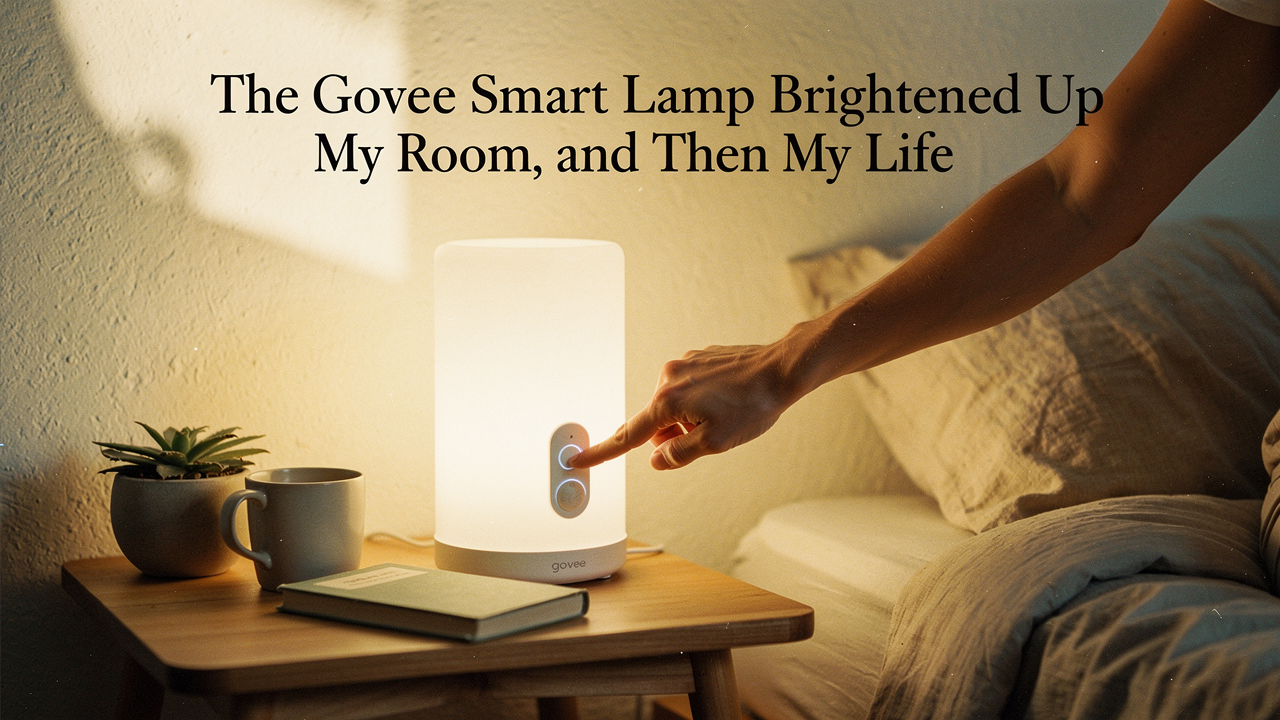
On the other hand, my bedside table was another struggle. I wanted something for my nightly journaling that felt cozy, but also something bright enough that I wasn’t squinting at my pages. Most lamps I tried were all or nothing—either a blinding reading light or a tiny nightlight. I eventually found a compact, cylindrical lamp that sits perfectly next to my coffee mug. It has a touch-sensitive top that lets me cycle through scenes without even opening my phone, which is a lifesaver when I’m half-asleep.
- Micro-Verdict: High-tech comfort for small spaces and nightstands.
Optimizing for Life: Productivity and Mood Scenes
One of the best ways to improve your lifestyle ROI is to align your home with your body’s internal clock. I noticed that my energy levels in my Austin home office were dipping around 3 PM, and I was having trouble winding down at 9 PM.
Research into circadian rhythms shows that blue-enriched light (around 5000K–6500K) boosts alertness by suppressing melatonin production—perfect for your morning coffee and work hours [3]. Conversely, warm amber tones (2200K–2700K) help your body prepare for sleep.
- Morning Routine: I have my Govee set to a Sunlight mimic. At 7:00 AM, it starts at 1% brightness in a deep orange and slowly transitions to a bright, 6500K cool white by 8:00 AM. It’s a much gentler way to wake up than a blaring phone alarm.
- Evening Routine: My favorite is the Austin Sunset mode I created. I set the lamp to 25% brightness with warm amber and soft purple tones. I often use the music sync feature at a low sensitivity so the light pulses very gently to the rhythm of my favorite lo-fi tracks while I read.
Setup and Automation: Making It ‘Smart’
Setting everything up was surprisingly intuitive. The Govee Home app guides you through the pairing process via Bluetooth first, then hands the connection off to your 2.4GHz Wi-Fi. Here’s a quick tip for the tech-conscious: I recommend setting up a guest network for your smart home devices (network segmentation) to keep your primary data more secure [4].
Once it’s connected, the automation possibilities are endless. I use Alexa to control my lighting hands-free. When I’m walking into the kitchen with a heavy grocery bag, being able to say, Alexa, brighten the room, feels like a small but significant luxury.
Govee vs. The Competition: Is It Worth It?
I’m often asked why I chose Govee over a prestige brand like Philips Hue. While Hue is fantastic and offers a very polished ecosystem, it often requires a Bridge hub, and the price per bulb is significantly higher.
- Govee Pros: No hub required, more affordable, RGBIC technology allows for moving light effects and gradients that most competitors can’t match.
- Govee Cons: It can congest your Wi-Fi if you have 20+ devices, and it doesn’t always have native Apple HomeKit support (though many newer models are Matter-compatible).
For me, the value is clear. Govee provides about 90% of the features of high-end systems at about 40% of the cost. That is a High Lifestyle ROI in my book.
The shift from a gloomy, uninspired room to a space that actually supports my mood has been incredible. My Austin apartment finally feels like a place where I can truly flow—whether I’m focused on a new sourdough recipe or just decompressing after a long day.
Check out my favorite
and start your room transformation tonight.References
- Illuminating Engineering Society (2023). Lighting Handbook: Recommended Light Levels for Residential Spaces. IES.org
- U.S. Department of Energy (2024). Lighting Choices to Save You Money. Energy.gov
- National Institute of General Medical Sciences (2025). Circadian Rhythms and the Effect of Light Exposure. NIGMS.nih.gov
- Govee Support (2026). Official Technical Manual and RGBIC Specifications. Govee.com
This post contains affiliate links. As a lifestyle curator and tech optimization enthusiast, I only recommend gear I’ve actually tested and lived with in my Austin home.