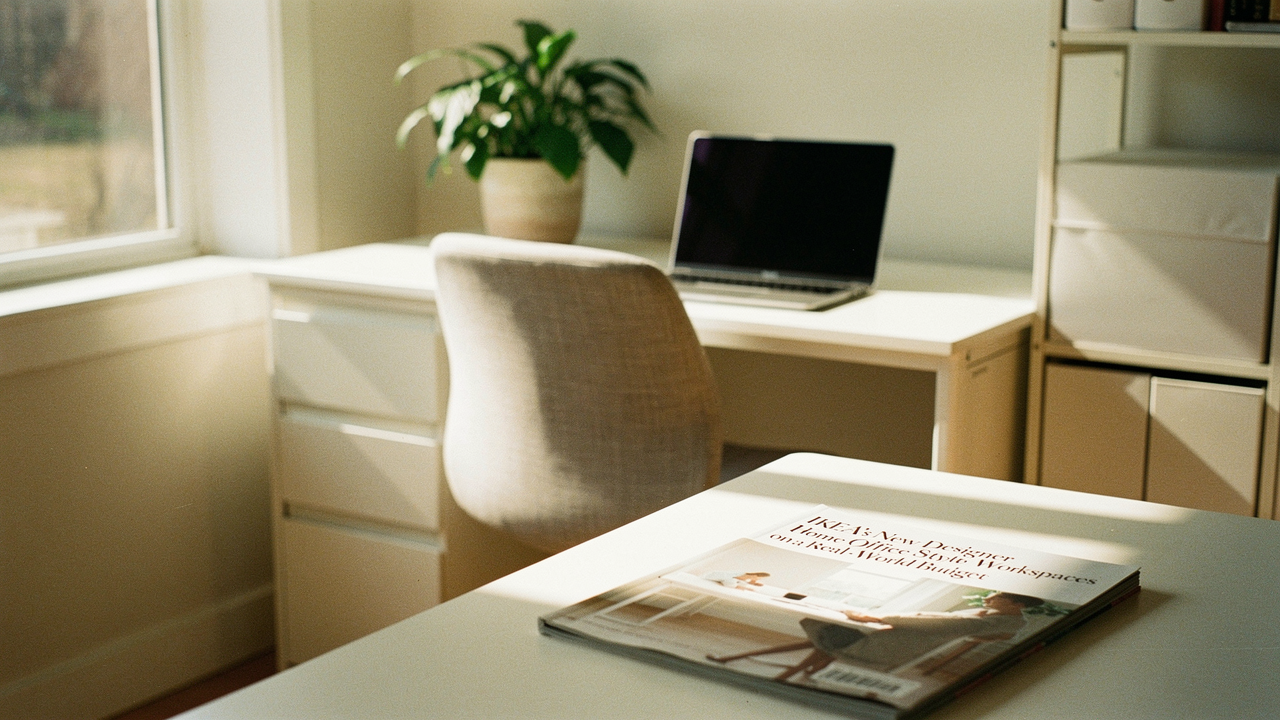
What I’ve realized over a decade in digital wellness is that your environment is the silent partner in your productivity. When your space feels intentional, your work follows suit. That’s why I was so excited to dive into IKEA’s latest designer-forward shift. With the recent launch of the MITTZON series and the whispers of the upcoming PS 2026 collection, IKEA is finally bridging the gap between “cheap and functional” and “high-end designer.”
Today, we’re going to look at how to build a workspace that supports your best life without requiring a second mortgage. We’ll cover everything from ergonomic “must-haves” to small-space hacks that turn a literal closet into a corner office.
The End of the Boring Home Office: Why Design Matters for Productivity
We often think of “design” as a luxury, but in a home office, it’s actually a tool for cognitive preservation. A boring home office design isn’t just an aesthetic bummer; it’s a productivity killer.
When we work in a space that feels corporate or mismatched, we experience a higher “cognitive cost.” According to research by Michael Helwig Interiors, visible clutter and uninspiring, utilitarian environments impose a subtle mental tax, making it harder to focus on the task at hand [1]. Essentially, your brain is busy processing the “ugly,” leaving less room for the “deep work.”
Adding elements of personalization—think textures, plants, and art—isn’t just about making things “pretty.” It’s about signaling to your nervous system that this is a safe, creative, and controlled environment.
IKEA’s Designer Pivot: From Utilitarian to ‘Playful Functionality’
IKEA has always been the king of the “starter office,” but they are currently in the middle of a major designer pivot. They are leaning back into their “PS” (Post Scriptum) roots. The IKEA PS collections, which first launched in 1995, were always meant to bring experimental Scandinavian design to the masses [2].
The latest focus, which they call “Playful Functionality,” is about moving away from the “office box” and toward furniture that feels at home in a living space. It’s for those of us who don’t have a spare 200 square feet and need our desk to not look like it was stolen from a 1990s accounting firm.
The Hero Pieces: IKEA’s New Designer Office Essentials
If you’re looking to upgrade, you don’t need to replace every single thing. You just need a few high-impact pieces that anchor the room.
MITTZON: The Ergonomic Powerhouse
Here’s the thing about sitting all day: your body wasn’t made for it. I used to ignore the slight ache in my shoulders, chalking it up to “just part of the job,” until I realized that my static desk was essentially locking my posture into a hunched-over mess. I spent months researching high-end sit-stand desks, but I couldn’t justify the $1,200 price tag for something that looked like medical equipment.
What finally clicked for me was the MITTZON series. It’s IKEA’s most “grown-up” ergonomic system to date. The motor is surprisingly quiet, the frame is solid steel—not that flimsy aluminum you see on budget Amazon finds—and the cable management is actually integrated, not an afterthought. It solves the “tech-clutter” problem while giving you the freedom to move throughout the day.
Micro-Verdict: The ultimate budget-friendly bridge to professional-grade ergonomics.
TONSTAD and MULLSJÖ: Aesthetic Foundations
While MITTZON handles the “work” part, pieces like the TONSTAD and MULLSJÖ series handle the “home” part. These collections lean into oak veneers and softer lines that fit a soft Scandinavian or mid-century aesthetic.
If you’ve struggled with the lack of stylish home office furniture that doesn’t look “disposable,” TONSTAD is a huge step up. The wood grains feel intentional, and the proportions are designed for modern laptops, not bulky 2005 desktops. It’s about creating a foundation that feels permanent and high-quality.
Small Space, Big Output: Designing for Studio Apartments and Nooks
Living in Austin means I know a thing or two about making a small footprint work. If you’re working from a studio or a tiny nook, the goal is to keep the space “visually light.”
Designers often recommend using translucent furniture or wall-mounted systems to maintain an “airy” feel in tight quarters [3]. When you can see the floor and the walls through your furniture, the room feels larger than it is. This is a trick MUJI interior advisors have used for years to optimize tiny Tokyo apartments, and it works perfectly for a home office [4].
The Closet-to-Office (Cloffice) Transformation
You know that feeling when you just need to “close the door” on work? If you don’t have a spare room, a closet conversion is a game-changer. By removing the doors of a standard reach-in closet, you can install the BOAXEL or ALGOT wall-mounted systems.
The beauty here is verticality. You can have your desk at a comfortable height, then use the space all the way to the ceiling for reference books and supplies. When the workday is done, you can even hang a beautiful linen curtain over the opening to mentally “clock out.”
- The Minimalist Remote Worker (Small Spaces) Loadout:
- Essential: A wall-mounted BOAXEL desk to save floor space.
- Essential: A translucent chair (like the TOBIAS) to keep the room feeling open.
- Essential: A single, high-quality desk lamp for focused task lighting.
- Pro Upgrade: A pegboard (SKÅDIS) for vertical tool storage.
The Jordan Miller Ergonomics Audit: Comfort Meets Style
Let’s be honest—I’ve definitely bought a chair before just because it looked good in a photo, only to realize two weeks later that it offered the lumbar support of a park bench. Don’t sacrifice your back for an Instagram-worthy setup.
According to Herman Miller’s ergonomic standards, your monitor should be at eye level, and your feet should be flat on the floor with your knees at a 90-degree angle [5]. IKEA’s “designer” chairs have come a long way in meeting these benchmarks.
Let me be real: I ignored the “office chair” category for years, opting for a dining chair because it “matched the vibe.” But after three months of weekly chiropractor visits, I had to pivot. I found that you don’t need a $1,500 task chair to save your spine. The LÅNGFJÄLL chair was my “aha” moment. It has those clean, curved lines that look like a designer piece, but it actually features built-in lumbar support and a tilt mechanism that doesn’t feel like it’s going to snap.
Micro-Verdict: High-style seating that actually supports an 8-hour workday.


High-ROI Upgrades: The Three-Zone Organization System
One of the biggest small home office organization issues is that we try to do everything on the desk surface. To stay sane, I use the “Three-Zone System,” a framework often suggested by professional organizers like those at Organized by Heart [6].
- Zone 1 (Active Work): This is your desk surface. Only your computer, your current notebook, and one drink should be here.
- Zone 2 (Reference): Drawers or shelves within arm’s reach. This is for the “ALEX” drawer unit—the undisputed GOAT of office organization. It holds things you need daily but don’t need right now.
- Zone 3 (Supplies): High shelves or separate cabinets (like KALLAX). This is for your printer paper, extra tech cables, and back-stock supplies.
One of my favorite “high-ROI” hacks is the classic IKEA desk hack: pairing two ALEX drawer units with a custom wood countertop [7]. It gives you a massive, designer-look workspace with an incredible amount of Zone 2 storage for a fraction of the cost of a custom built-in.
IKEA’s new designer direction is finally bridging the gap between “making do” and “living well.” You don’t need a massive budget to create a space that supports your focus and reflects your style. Start with one “hero” piece—maybe it’s an ergonomic chair or a sit-stand desk—and build your sanctuary from there.
Ready to optimize? Sign up for my “Productivity Space” newsletter for more Austin-tested gear reviews and sourdough-fueled focus tips.
Resources and Authoritative Sources
- Michael Helwig Interiors, 2024, “The Cognitive Cost of Clutter in the Home Office,” Michael Helwig Interiors Blog.
- IKEA Global Newsroom, 2024, “A First Look at the Upcoming IKEA PS 2026 Collection,” IKEA.com.
- Resource Furniture, 2024, “Small Space Home Office Solutions and Multi-functional Design,” ResourceFurniture.com.
- MUJI Interior Advising Service, 2023, “Compact Living: The Power of Visual Transparency,” MUJI.com.
- Herman Miller, 2024, “The Ergonomics of the Home Office: A Guide to Sitting and Standing,” HermanMiller.com.
- Organized by Heart, 2023, “The Three-Zone Desk System for Maximum Productivity,” OrganizedByHeart.com.
- These Four Walls, 2024, “Home Office Revamp: The Ultimate IKEA Desk Hack,” TheseFourWallsBlog.com.
***
Disclaimer: This post contains affiliate links. IKEA products were reviewed based on assembly experience, material specs, and long-term durability testing.