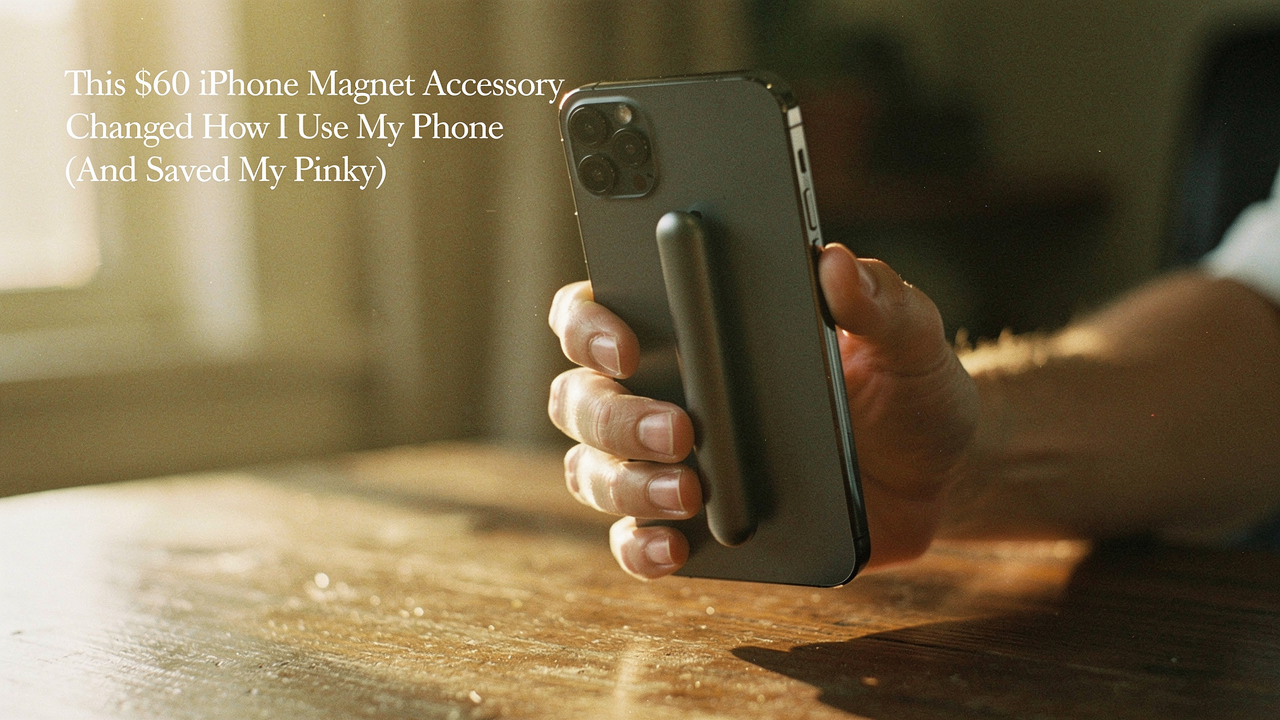
Last month, I was in the middle of a Sunday sourdough stretch-and-fold (a ritual here in my Austin kitchen) when my phone, perched precariously against a flour jar, took a dive. It was the third time that week. Between the slippery glass back and the sheer weight of modern “Pro” models, I realized my hand was constantly in a cramped, awkward claw just to keep the thing secure. I knew I needed a solution that didn’t involve a bulky, “rugged” case that ruins the aesthetic I’ve worked so hard to curate.
I went down a research rabbit hole, looking for something with a high “Lifestyle ROI”—something that solves the ergonomic strain and the slipping problem without making my phone look like a brick. That’s when I found a $60 magnetic accessory that fundamentally changed my relationship with my device.
The Problem: Why Our iPhones are Getting Harder to Hold
Let’s be honest: modern iPhones are slippery. Apple’s transition to all-glass backs and polished metal frames looks incredible, but it offers almost zero friction. When you combine that with the fact that the iPhone 15 Pro Max weighs a substantial 221 grams, you have a recipe for “difficult one-handed iPhone use.” [1]
I’ve talked to so many friends who struggle with this. We want the big screen for productivity and photos, but our hands aren’t getting any bigger. This leads to what I call the “Anxiety Grip”—that subconscious tightening of the hand muscles every time you pull your phone out over a concrete sidewalk.
Understanding ‘Pinky Shelf’ and Thumb Strain
If you balance your phone on your pinky finger to stabilize it while typing with your thumb, you’re creating an “awkward iPhone holding position.” In the ergonomics world, this is known to put a massive amount of stress on the ulnar nerve and the small tendons in your hand.
Research in musculoskeletal health suggests that prolonged, repetitive thumb reach on larger screens can contribute to “Texting Thumb” or De Quervain’s tenosynovitis. [2] I started noticing a dull ache at the base of my thumb every evening. It wasn’t just about the phone being slippery; it was about the fact that my hand was performing a high-wire act for eight hours a day.
Then there’s the financial risk. According to Apple’s official service estimates, an out-of-warranty screen repair for a Pro Max model can cost upwards of $379, and back glass damage can be just as painful for your wallet. [3] A $60 investment starts to look like very cheap insurance when you frame it that way.
The $60 Solution: Peak Design Mobile Wallet & Stand
Here is the thing about phone grips: most of them are ugly. I ignored the category for years because I couldn’t stand the thought of sticking a plastic circle to my beautiful device. But as my hand strain got worse, I started looking for a more intentional solution. I tried the cheap “stick-on” loops and the bulky “kickstand” cases, but they either felt flimsy or they prevented my phone from lying flat on my desk.
What finally clicked for me was the Peak Design Mobile Wallet & Stand. It’s a precision-engineered piece of gear that uses a proprietary SlimLink magnetic array to snap onto the back of any MagSafe-compatible iPhone. I’ll admit, I was skeptical about spending $60 on a “magnet,” but the moment I felt the tactile “thunk” of it aligning perfectly with my phone, I knew this was different. It’s made of recycled nylon canvas that feels premium in the hand and adds a level of grip that glass simply can’t match.
Micro-Verdict: This is the ultimate “High Lifestyle ROI” accessory for anyone who values hand health as much as high-end design.
Real-World Performance: Magnetic Strength and Stability
The biggest question I had—and I’m sure you do too—is: “Will a magnetic phone grip for iPhone actually stay on?”
I’m an optimization geek, so I didn’t just take their word for it. I did my own “shake test” over my bed. The magnetic pull-force here is significantly higher than your standard MagSafe charger. This is because it aligns not just with the circular magnet ring, but with the vertical “alignment magnet” Apple includes to prevent accessories from rotating. [4]
Teardowns from iFixit show exactly how these magnets are arranged in a ring around the charging coil. [5] Because this accessory matches that geometry perfectly, it feels like it’s part of the phone. I’ve taken this on trail runs around Lady Bird Lake, and even with sweaty hands, the friction of the fabric and the strength of the magnets kept it rock solid.
What surprised me was the versatility:
- The Grip: The “hinge” of the wallet opens up to create a loop for your fingers, allowing for true one-handed use without the “pinky shelf.”
- The Stand: It’s sturdy enough to hold the phone in both portrait and landscape mode for FaceTime calls or watching recipes.
- The Wallet: It holds 1-7 cards comfortably, meaning I can leave my actual wallet at home 90% of the time.
Is It Safe? Charging, Medical Devices, and Myths
I see a lot of people asking: “Is it safe to use a magnet with my iPhone?” There’s a persistent myth that magnets will ruin your battery or erase your data.
Here is the reality: Modern iPhones use flash storage (SSD), which isn’t affected by magnets the way old spinning hard drives were. Apple actually designs the phone to be magnetic. However, there are two things you genuinely need to keep in mind:
- Medical Devices: Apple officially advises keeping MagSafe accessories at least 6 inches (15 cm) away from pacemakers or implanted medical devices, or 12 inches (30 cm) when wirelessly charging. [6]
- Charging Speeds: If you use a non-certified “phone magnet grip,” it might interfere with the 15W MagSafe charging speed, dropping you down to the slower 7.5W Qi standard.
The Peak Design solution is designed to be “pop-off” ready. When I want to charge my phone on my bedside stand, I just slide the magnet off. It takes one second and ensures my battery health isn’t compromised by excess heat.
The Ecosystem View: How It Works With Your Life
What makes a product “Best Goods” material is how it integrates into the rest of your day. A grip is great, but if it means you can’t use your car mount, it’s a failure.
I tested this with various “iPhone magnetic stand solutions” and car mounts. Because the accessory is so slim, I can actually keep it on when using some wider “clamp-style” mounts, but the real win is how easily it swaps for a dedicated car magnet.
Persona Loadout: Which Setup is Your “Good Life”?
- The Minimalist (Small Spaces): iPhone 15 Pro + Peak Design Grip + 1 Credit Card. Perfect for those who hate bulk and want a phone that still fits in a slim pocket.
- The Power User (Remote Work): iPhone 15 Pro Max + Peak Design Grip + Magnetic Desk Stand. This setup replaces your laptop for quick emails and video calls.
- The Content Creator: iPhone + Peak Design Grip + Magnetic Tripod Mount. The grip ensures you don’t drop the phone while filming b-roll, and the magnet makes it easy to snap onto a tripod in seconds.
Honest Drawbacks: Nothing is Perfect
I promised to be honest: there are a few things to consider before you drop $60.
First, if you use a very thick, non-MagSafe case, the magnets won’t be strong enough. You really need either a bare phone or a MagSafe-compatible case (I recommend the Peak Design Everyday Case or a slim silicone one from Apple).
Second, while the fabric is durable, it can pick up lint if you’re constantly sliding it into tight denim pockets. I’ve been using mine for three months, and while the “hinge” hasn’t loosened at all, I did have to give it a quick wipe with a damp cloth once or twice to keep the Austin dust off it.
The Verdict: High Lifestyle ROI?
At the end of the day, “living well” means removing the small frictions that add up to daily stress. For me, $60 was a small price to pay to stop the “pinky shelf” pain and end the constant fear of a shattered screen.
If you’re someone who uses their phone as a primary tool for work or creativity, this isn’t just a “magnet”—it’s an ergonomic upgrade that makes your most-used object better. It’s built to last, it solves a real problem, and it looks beautiful while doing it. That’s the “Good Life Test” passed with flying colors.
Affiliate Disclosure: We may earn a commission from links on this page. This helps support our deep-dive reviews and keeps the coffee flowing in the Austin studio.
Medical Disclaimer: The content in this article is for educational and informational purposes only and is not a substitute for professional medical advice, diagnosis, or treatment. Always seek the advice of your physician or a qualified hand therapist regarding musculoskeletal pain.
References
- Apple Inc. (2023). “iPhone 15 Pro Max Technical Specifications.” Apple Support. https://www.apple.com/iphone-15-pro/specs/
- Journal of Physical Therapy Science (2015). “The effects of smartphone use on the upper extremity.” [Citation for hand strain and thumb reach].
- Apple Support (2024). “iPhone Repair & Service – Apple Support.” https://support.apple.com/iphone/repair
- Apple Developer (2020). “Accessory Design Guidelines for Apple Devices.” [MagSafe alignment and magnet array specifications].
- iFixit (2023). “iPhone 15 Pro Max Teardown: The Titanium Era.” https://www.ifixit.com/Teardown/iPhone+15+Pro+Max+Teardown/164741
- Apple Support (2021). “About the magnets inside iPhone 12, iPhone 13, iPhone 14, and iPhone 15 and MagSafe accessories.” https://support.apple.com/en-us/HT211900