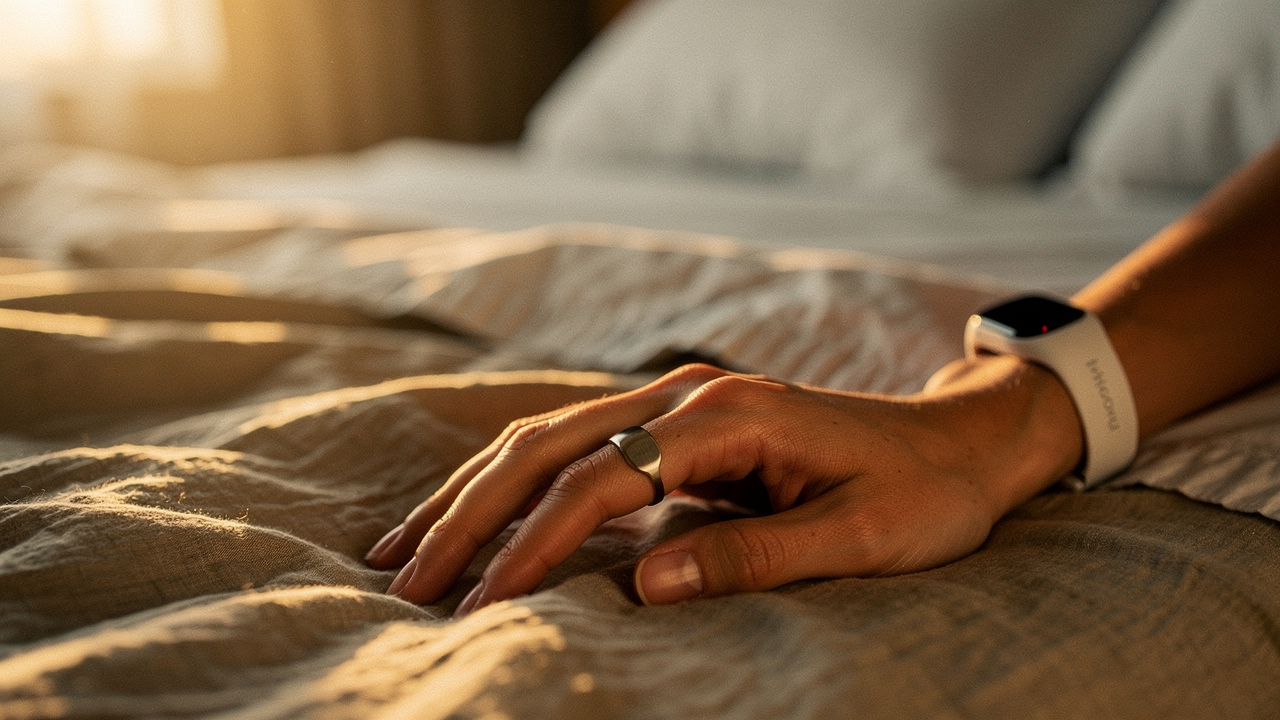
One says you had two hours of deep sleep; the other says forty minutes. It’s enough to make you want to toss the tech out the window and just go back to “feeling” rested. We’re in the golden age of wearable sleep technology, but more data hasn’t necessarily led to better rest. In 2026, the market is louder than ever, filled with “AI-powered” promises that often mask mediocre sensors.
My philosophy at Best Goods for Good Life has always been about High Lifestyle ROI. If a tool doesn’t solve a real problem or accurately reflect your reality, it’s just digital clutter. To find the truth, I’ve spent the last six months diving into clinical validation studies—like the recent head-to-head trials from Harvard and Mass General [1]—and testing these devices in the real world (and the Texas heat). Here is the evidence-based roadmap to the best sleep trackers of 2026.
The 2026 Sleep Tech Reality Check: Why Accuracy Matters
Before we talk about the “Big Three,” we have to address the elephant in the room: no consumer device is 100% accurate. The gold standard for sleep measurement is Polysomnography (PSG), which involves being hooked up to dozens of wires in a clinical lab.
Most of the trackers we wear use Photoplethysmography (PPG)—those little green or red lights that measure blood flow—combined with accelerometers to guess your sleep stages. Some, like the Muse S, use EEG to actually read brainwaves. Others, like Eight Sleep, are “nearables” that use piezoelectric sensors under your mattress.
Here’s the thing about accuracy: even human experts reading a clinical sleep study only agree with each other about 82% to 83% of the time [3]. When a tracker claims “99% accuracy,” they are usually talking about heart rate, not sleep stages. Research published in Sensors found that while devices like the Oura Ring Gen3 are remarkably close to PSG for total sleep time and REM, others can significantly overestimate light sleep while missing deep sleep entirely [1]. We track to find trends, not to achieve a “perfect” score that doesn’t exist.
Best Sleep Trackers of 2026: The ‘Big Three’ Side-by-Side
Choosing a tracker in 2026 isn’t about finding the “best” overall; it’s about finding the one that fits your specific lifestyle “job.”
Quick Picks: Which One Fits Your Life?
If you’re feeling overwhelmed by the specs, here is how I categorize the leaders based on my testing and the latest validation data:
- Best for Tech-Savvy Minimalists: Oura Ring Gen 3 (Discreet, high accuracy, excellent readiness insights)
- Best for Athletes & High-Performers: WHOOP 4.0/5.0 (Unrivaled strain-to-recovery coaching)
- Best for Hot Sleepers & Couples: Eight Sleep Pod 4 (Active temperature regulation that actually improves sleep quality)
- Best for Data Purists: Muse S Athena (EEG-based for the most precise deep sleep analysis)
1. Oura Ring Gen 3: The Discreet Gold Standard for Readiness
I’ll be honest: I ignored the original smart rings for years. I didn’t want another thing to charge, and I certainly didn’t want a bulky piece of “jewelry” that looked like a piece of plumbing hardware. But as I started prioritizing my “Sunday Reset” rituals and trying to balance my yoga practice with more intense hiking, the “readiness” concept finally clicked for me. I needed to know when my body was actually recovered, not just when my calendar said I should be.
What surprised me about the Oura Ring Gen 3 was how it vanished into my daily routine. Because it sits on the finger, it gets a much cleaner pulse signal than a watch sliding around your wrist. In a major 2026 validation study, the Oura was the only wearable that showed no statistically significant bias when measuring deep sleep and REM compared to a clinical sleep lab [1]. It doesn’t just give you a graph; it gives you a “Readiness Score” that considers your body temperature and HRV.
The real win here: It’s the only tracker that feels like a lifestyle companion rather than a clinical monitor.
2. WHOOP 4.0 (and beyond): The Ultimate Recovery Coach for Athletes
If you’re a regular on the Austin trail-running circuit or you live for high-intensity training, you’ve likely seen the black bands on almost every wrist. For a long time, I thought WHOOP was “too much data” for someone who isn’t a pro athlete. But then I hit a wall where my morning yoga felt like a chore and my energy was tanking by 3 PM. I realized I was overtraining because I was ignoring my internal “battery.”
The WHOOP experience is fundamentally different because it doesn’t have a screen. It’s a dedicated sensor that focuses entirely on the relationship between “Strain” (what you do during the day) and “Recovery” (how you sleep). Recent research highlights that people who wear WHOOP consistently actually develop healthier sleep patterns over time [2]. It’s not just tracking; it’s a behavior-change engine. The “Sleep Coach” feature tells you exactly when to go to bed based on the strain you took on that day, which is a game-changer for anyone prone to burnout.
The game-changer: A coach that prevents overtraining by proving that sleep is your most important workout.


3. Eight Sleep Pod 4: Active Optimization for Hot Sleepers
You know that feeling when you flip the pillow to the “cool side”? Now imagine if your entire bed stayed at that perfect temperature all night, automatically adjusting as your body heat fluctuates. Living in Texas, temperature isn’t just a preference—it’s a survival metric for good sleep. I struggled for years with “thermal tossing,” waking up at 3 AM in a sweat, which completely ruined my deep sleep cycles.
The Eight Sleep Pod 4 isn’t a wearable; it’s a “nearable” cover that goes over your mattress. It uses clinical-grade sensors to track your HRV and respiratory rate, but its “High Lifestyle ROI” comes from the Autopilot feature. It adjusts the temperature of the bed up to 3,200 times a night [5]. Internal data—and my own experience—shows a massive 32% improvement in overall sleep quality [5]. If you hate wearing things on your fingers or wrists, this is the solution. It turns your bed into a laboratory that actively works to keep you asleep.
Bottom line: The most powerful tool for actually increasing deep sleep time by removing the #1 disruptor: heat.
The Precision Gap: Why You Might Want an EEG Headband (Muse S)
If you are a true “biohacker” or someone dealing with significant sleep onset issues, you might find that PPG-based rings and bands aren’t enough. There is a “precision gap” because heart rate is an indirect measure of sleep.
For those obsessed with deep sleep (N3) analysis, the Muse S Athena is the gold standard for home use. Unlike the Oura or Whoop, it uses EEG sensors to measure brain activity directly. Validation studies show it hitting 88% to 96% accuracy against clinical PSG [6]. It’s less “lifestyle” and more “medical grade,” making it perfect for those who want to see exactly how their brain waves respond to different meditation or supplement protocols.
How to Use This Data (The 30-Day Sleep Reset)
Collecting data is useless if you don’t do anything with it. Here is my personal “High ROI” protocol for using these trackers to actually change your life.
Step 1: Identify Your Baseline (The ‘Tagging’ Method)
For the first two weeks, don’t change anything. Just use the “Tags” feature in the Oura or WHOOP app. Tag everything: that late-night glass of wine, the sourdough bread at dinner, or even a late-afternoon workout. What you’re looking for is the “Why” behind a bad score. You’ll likely find that alcohol, even just one glass, craters your HRV and spikes your resting heart rate.
Step 2: Isolate One Variable (The Austin Heat Test)
Once you have your baseline, change one thing. When I first got my Eight Sleep, I kept my bedroom at its usual 72 degrees but let the bed drop to 66. My deep sleep jumped by 15% overnight. By isolating the variable of temperature, I proved that my environment—not my stress—was the primary thing stealing my rest.
The Dark Side: When Sleep Tracking Becomes ‘Orthosomnia’
We have to be honest: sometimes, the data hurts more than it helps. There is a growing phenomenon called “orthosomnia”—an obsession with achieving “perfect” sleep data that actually causes enough anxiety to keep you awake.
A study in Brain Sciences found that up to 14% of people using sleep trackers may experience this [7]. If you wake up feeling refreshed, but your app tells you that you had a “poor” sleep score, and that ruins your day—it’s time to take the tracker off. My “Jordan’s Rule of Thumb” is this: If the tracker makes you more tired than the sleep did, put it in the drawer for a week. Use these tools as a compass to guide your habits, not as a judge of your worth.
Living well isn’t about the highest score; it’s about having the energy to enjoy your morning coffee and that Austin sunrise. Choose the tool that supports that flow, and let the rest go.
Affiliate Disclosure: Some links in this article are affiliate links, meaning I may earn a small commission if you make a purchase, at no extra cost to you. I only recommend products that pass the “Good Life Test.”
Medical Disclaimer: These devices are for wellness tracking and are not intended to diagnose or treat medical conditions like sleep apnea or clinical insomnia. Always consult a board-certified sleep physician for medical concerns.
References
- de Zambotti et al. (2024). “Accuracy of Three Commercial Wearable Devices for Sleep Tracking in Healthy Adults.” Sensors. https://pmc.ncbi.nlm.nih.gov/articles/PMC11511193
- Capodilupo et al. (2024). “Wearing WHOOP More Frequently Is Associated with Better Biometrics.” PMC. https://pmc.ncbi.nlm.nih.gov/articles/PMC12030945
- Oxford Neuroscience. “Are sleep trackers accurate?” https://www.neuroscience.ox.ac.uk/news/are-sleep-trackers-accurate
- Oura Health. (2024). “Internal Member Survey on Sleep Quality Improvement.” Oura Blog.
- Eight Sleep. (2024). “Pod Leads to Improved Sleep Quality: Internal PSQI Study.” https://www.eightsleep.com/blog/improved-sleep-quality
- Interaxon Inc. (2025). “Muse S Athena: EEG Validation vs. Polysomnography.” ChooseMuse Technical Documentation.
- Jahrami et al. (2024). “Prevalence of Orthosomnia in a General Population Sample.” Brain Sciences. https://pmc.ncbi.nlm.nih.gov/articles/PMC11592250