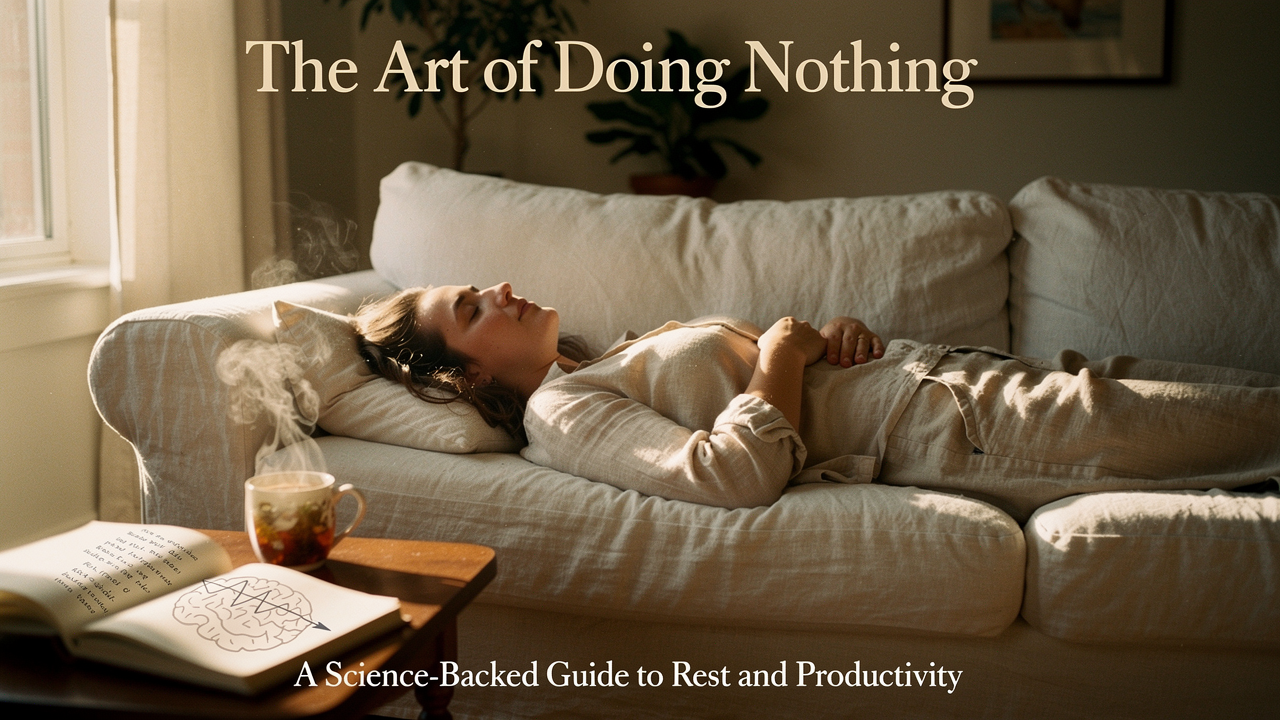
We live in a culture that treats “busy” as a badge of honor. In the world of digital wellness, we’re constantly told to optimize every second. But here’s the irony: I’ve found that the more I tried to squeeze productivity out of every minute, the less creative and more exhausted I became. What finally clicked for me was realizing that intentional inactivity isn’t the enemy of progress; it’s the prerequisite for it.
Doing nothing isn’t about being lazy. It’s a deliberate, science-backed reset for your nervous system. Today, I want to share why your brain actually needs these “blank spaces” and how you can reclaim them without feeling that nagging sense of guilt.
The Biology of the ‘Off’ Switch: Why Your Brain is Never Actually Idle
For a long time, scientists thought that when we stopped focusing on a task, our brains just went dark. What we’ve discovered is actually much more fascinating. When you stop “doing,” your brain flips a switch to something called the Default Mode Network (DMN) [1].
Think of the DMN as your brain’s “background processing” mode. Research led by Marcus E. Raichle shows that when we aren’t focused on the outside world, this network becomes highly active, handling memory consolidation and self-referential processing [1]. It’s why your best ideas usually come in the shower or during a long, quiet drive. Without the noise of a specific task, your brain is finally free to connect the dots.
Psychologists Jonathan Smallwood and Jonathan Schooler have explored this as “mind-wandering.” They found that allowing the mind to drift isn’t a waste of time—it’s actually essential for creative insight [2]. This is known as the “incubation effect.” While you’re staring out the window, your subconscious is busy solving the problem you’ve been banging your head against all morning.
The Productivity Paradox: Why Doing Nothing Makes You Better at Everything
The biggest barrier to rest is the fear of falling behind. We feel like if we aren’t moving, we’re losing. But the data tells a different story.
Research on micro-breaks and “wakeful rest” suggests that even short, non-task-focused intervals can improve subsequent performance by as much as 10–20% [3]. Humans aren’t built for 8-hour marathons of focus. We function on ultradian rhythms—natural cycles where we have about 90 minutes of high-frequency brain activity followed by a 20-minute dip where our bodies crave rest [5].
When we ignore these dips, we invite burnout. Christina Maslach, a leading researcher on occupational burnout, defines the condition by emotional exhaustion and a sense of reduced personal accomplishment [4]. By forcing yourself to stay “on” 24/7, you’re actually degrading the quality of your work.
I’ll be honest: I used to be the queen of “productive procrastination.” If I felt a dip in energy, I’d just switch to a “low-effort” task like checking emails or scrolling through industry news. But my brain was still processing information, still “doing.” I wasn’t actually resting; I was just vibrating at a lower frequency of stress.
I finally realized that my sensory system was simply fried from constant light and input. I tried meditation apps, but sometimes even the guided voice felt like another “to-do.” What changed the game for me was discovering the power of total sensory deprivation for just five minutes a day. I found this incredibly soft, weighted silk eye mask that actually blocks out 100% of the light without pressing on my eyelids. Now, when I feel that afternoon brain fog rolling in, I don’t reach for a third coffee. I put on the mask, sit in my favorite chair, and let the world disappear. Those five minutes of pure darkness do more for my focus than an hour of “powering through” ever did.
Micro-Verdict: The ultimate reset button for a fried nervous system.
The ‘Inactivity’ Trap: Differentiating Rest from Rot
Before we dive into the “how,” we have to make an important distinction. There is “good” inactivity and “bad” inactivity.
- Unhealthy Inactivity: This is passive numbing. It’s doomscrolling on TikTok, binge-watching a show you don’t even like, or sitting at your desk in a “frozen” state of overwhelm. It’s sedentary and often leaves you feeling more drained than before [6].
- Intentional Non-Doing: This is restorative. It is stimulus-free. It’s sitting on your porch without your phone, watching the rain, or lying on the floor and noticing the weight of your body.
The World Health Organization (WHO) warns that chronic physical inactivity is a major health risk, so we aren’t advocating for a sedentary life [6]. The goal is to balance an active, moving body with a still, quiet mind.
How to Practice Doing Nothing: A Step-by-Step Protocol
If you’re a high-achiever, “just sitting there” might actually feel physically painful at first. You have to train the muscle of stillness. Here are three low-barrier ways to start:
- The Window-Gazing Protocol: Set a timer for 5 minutes. Sit near a window and watch the movement outside—leaves blowing, cars passing, birds. Do not try to “meditate” or clear your mind. Just look. This is based on Attention Restoration Theory, which suggests that “soft fascination” helps our focus recover.
- The No-Input Walk: Leave your phone and headphones at home. Walk for 15 minutes around your neighborhood. The goal isn’t exercise or “steps”—it’s to exist in the world without a digital layer between you and reality.
- The Sensory Check-in: Close your eyes and name three things you can hear, then three things you can feel (the chair beneath you, the air on your skin). This grounds you in the present moment, moving you out of the “future-fixated” stress of your to-do list.
Overcoming the ‘Guilt Gap’
The moment you sit down to do nothing, a voice in your head will likely scream, “You should be doing something productive!”
This is the “Guilt Gap.” To get past it, I use a little Cognitive Behavioral Therapy (CBT) trick: I reframe the rest. Instead of saying “I’m doing nothing,” I tell myself “I am currently consolidating my memory and fueling my next creative breakthrough.” It’s much easier to grant yourself permission when you realize that rest is an active part of the work cycle, not a break from it.
The 4-Week Rest Training Plan
You wouldn’t run a marathon without training; don’t expect to sit in stillness for 30 minutes on day one. Try this graduated approach:
The Beginner’s Rest Loadout
- Week 1: The Micro-Reset. Twice a day, do the 2-minute “Window-Gaze.” No phone allowed.
- Week 2: The White Space Block. Schedule 10 minutes of “unassigned time” in your calendar. Use it for a no-input walk or just sitting with your coffee.
- Week 3: The Sensory Deep-Dive. Once a day, spend 5 minutes in total silence and darkness (this is where that silk mask comes in handy).
- Week 4: The Strategic Detachment. One afternoon a week, go “analog” for 2 hours. No screens, no goals, just following your curiosity or resting.
Frequently Asked Questions About Doing Nothing
Is doing nothing just being lazy?
No. Laziness is the avoidance of necessary work. Doing nothing is the intentional choice to recover so that you can do your work with excellence. One is an escape; the other is an investment.
What if I feel more anxious when I stop?
This is very common! When we stop the constant motion, the thoughts we’ve been outrunning finally catch up. If you feel overwhelmed, start with very small “doses” (1 minute) or try a “gentle focus” like watching a candle flame. If stillness feels genuinely traumatic, please consult a professional; rest shouldn’t be a source of suffering.
How do I explain this to my boss?
You don’t have to call it “doing nothing.” Frame it as “managing my cognitive load” or “taking a recovery interval to maintain high-quality output.” Most organizations are beginning to understand that a burned-out employee is an expensive and ineffective one.
Finding Your Blank Space
At the end of the day, the “High Lifestyle ROI” of doing nothing is simple: you get yourself back. The time you “lose” to stillness is returned to you tenfold in the form of clarity, patience, and the ability to actually enjoy the life you’re working so hard to build.
Jordan’s Challenge: This week, I want you to pick one “No-Input” window. Just five minutes. No phone, no book, no podcast. Just watch the world happen around you. Let me know in the comments—did you feel restless, or did you finally feel like you could breathe?
Disclaimer: This guide is for educational purposes and is not a substitute for professional medical or mental health advice. If you are experiencing severe burnout or depression, please consult a licensed professional.
References & Scientific Sources
- Raichle, M. E. (2015). The Brain’s Default Mode Network. Annual Review of Neuroscience. https://www.annualreviews.org/doi/10.1146/annurev-neuro-071013-014030
- Smallwood, J., & Schooler, J. W. (2015). The Science of Mind Wandering: Empirically Navigating the Stream of Consciousness. Annual Review of Psychology.
- Ariga, A., & Lleras, A. (2011). Brief and rare mental “breaks” keep you focused: Deactivation and reactivation of task goals preempt vigilance decrements. Cognition.
- Maslach, C., & Leiter, M. P. (2016). Understanding the burnout experience: Recent research and its implications for psychiatry. World Psychiatry.
- Kleitman, N. (1963). Sleep and Wakefulness. University of Chicago Press. (Foundational research on Ultradian Rhythms).
- World Health Organization (2020). WHO guidelines on physical activity and sedentary behaviour. https://www.who.int/publications/i/item/9789240015128