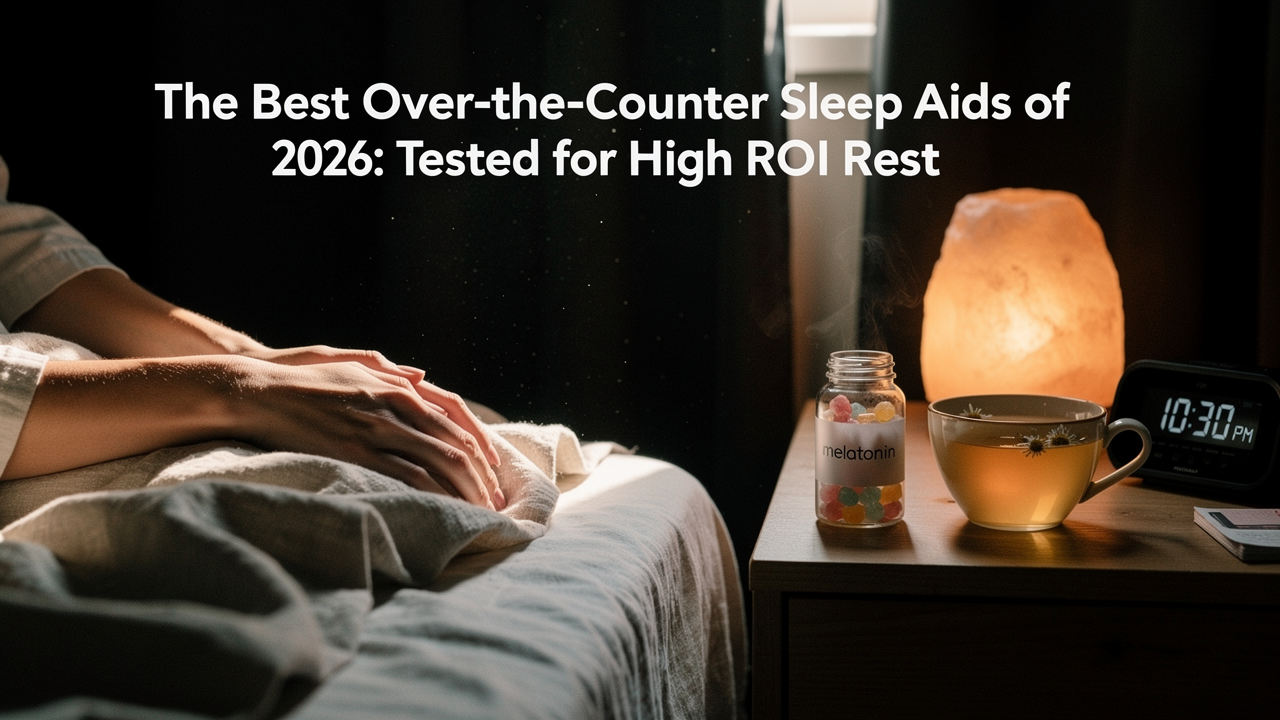
For years, my solution was to grab whatever blue bottle was on the pharmacy shelf, usually an antihistamine that left me feeling like a literal zombie the next morning. But in my journey as a lifestyle curator, I’ve realized that “High Lifestyle ROI” isn’t just about what you do while you’re awake; it’s about the quality of the recovery that fuels those hours.
In 2026, the sleep aid market has shifted. We’re moving away from “knockout” pills and toward sophisticated, evidence-based tools that support the body’s natural rhythms. If you’re tired of the “sleep hangover” and want to wake up feeling genuinely restored, here is my researched and tested guide to the best OTC sleep aids available today.
The 2026 Sleep Framework: Is Your Problem Onset or Maintenance?
Before we talk about pills or powders, we have to look at what’s actually keeping you up. In my experience, most of us just want “the best pill,” but sleep issues aren’t one-size-fits-all. According to the DSM-5 and ICSD-3 clinical criteria, chronic insomnia is defined as having trouble falling or staying asleep at least three nights a week for three months or more [1].
If you’re just having a rough week, it’s likely “acute.” Here’s how I break it down:
- Onset Insomnia: You’re tired, you’re in bed, but your brain won’t turn off. You need help “winding down.”
- Maintenance Insomnia: You fall asleep fine, but you wake up at 2 AM or 4 AM and can’t get back to the dream world.
- Circadian Rhythm Disruption: Your body clock is wonky because of travel (hello, jet lag) or shift work.
Here’s a hard truth I had to learn: The American College of Physicians (ACP) actually recommends Cognitive Behavioral Therapy for Insomnia (CBT-I) as the first-line treatment for chronic issues—not medication [2]. Sleep aids should be your short-term bridge or your “emergency kit,” not your permanent crutch.
Our 2026 Testing Methodology: The ‘Optimization Geek’ Standard
I don’t recommend products just because they have pretty packaging (though I do love a good aesthetic). To find the high-ROI winners for 2026, I looked at three specific factors:
- Third-Party Purity: A 2017 study found that melatonin labels are notoriously inaccurate—some products had 83% less melatonin than claimed, while others had 478% more [3]. I prioritize brands with NSF International or USP certifications.
- Anticholinergic Burden: I avoid “PM” painkillers for routine use. The “Beers Criteria” for older adults warns that ingredients like diphenhydramine (found in Benadryl) can increase the risk of falls and confusion [4].
- Next-Day Function: If I can’t drink my morning coffee and feel sharp by 8 AM, the product fails the test.
The Best OTC Sleep Aids of 2026: Quick Picks
Here is a quick look at how the top contenders stack up for daily life:
| Product Category | Best For | Main Ingredient | Hangover Risk |
|---|---|---|---|
| Long-Term Support | Stress/Anxiety | Magnesium + L-Theanine | Very Low |
| Melatonin-Free | Hormonal Balance | Lavender + Lemon Balm | Low |
| Short-Term Crisis | Acute Stress | Doxylamine Succinate | Moderate |
Best for Long-Term Support: Innerbody Labs Sleep Support
I used to think that “more is better” when it came to sleep ingredients, but that usually just leads to a groggy morning. My search for something sustainable led me to look for products that don’t just sedate the brain but actually nourish the nervous system. After months of testing various magnesium-based blends, I found that the most “high ROI” rest came from formulas that prioritized relaxation over a forced “knockout.” Innerbody Labs caught my eye because they use clinically relevant doses rather than “fairy dusting” a dozen ingredients in tiny amounts.
Micro-Verdict: The gold standard for people who need to “take the edge off” a stressful day without feeling drugged.
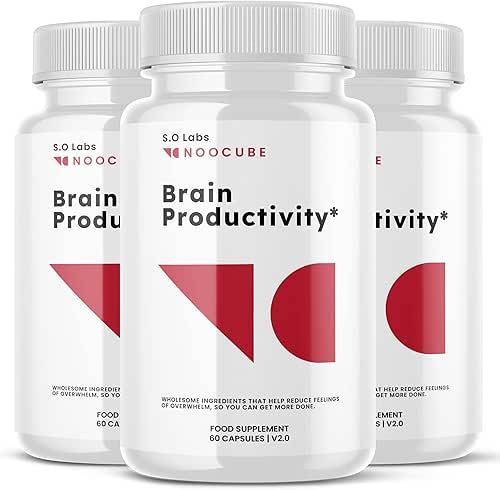
Best Melatonin-Free Option: NooCube Sleep Upgrade
Let’s be honest: I was skeptical about “melatonin-free” sleep aids for a long time. I figured if I wasn’t using the “sleep hormone,” it wouldn’t work. But after a few weeks of feeling “melatonin-flat”—that weird, low-mood feeling some people get after taking it every night—I decided to pivot. I wanted something that supported my body’s own production of melatonin rather than replacing it. NooCube became my Sunday-night ritual during high-stress work weeks. It uses a botanical-heavy approach that feels more like a deep meditation in a bottle than a pill.
Micro-Verdict: Perfect for minimalists who want to keep their hormonal health in check while still getting deep rest.

The ‘Short-Term Crisis’ Pick: Unisom SleepTabs
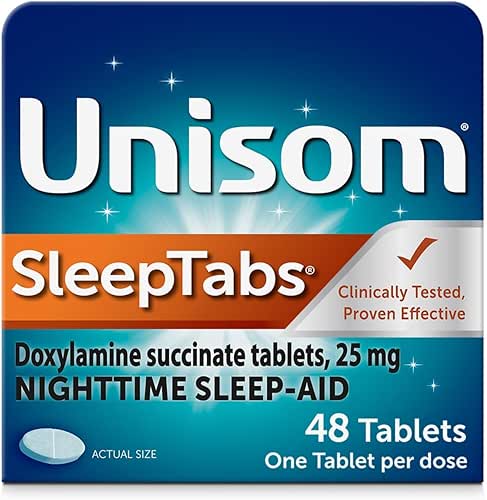
There are nights when “natural” just doesn’t cut it. Maybe it’s the night before a huge presentation, or you’re dealing with a personal loss, and your brain is simply screaming. In those rare, acute moments, I’ve found that a traditional pharmacologic approach is sometimes necessary. I tried the usual diphenhydramine options, but the “Benadryl hangover” was too much for me. What surprised me was the difference with doxylamine succinate. While it’s still a sedative antihistamine, for many people, it provides a slightly “cleaner” sleep for one-off emergencies compared to its cousins.
Micro-Verdict: The reliable “break glass in case of emergency” tool for acute, short-term sleeplessness.
Deep Dive: The Science of 2026 Ingredients
When you’re standing in the aisle (or scrolling online), the marketing will tell you everything is “natural” and “safe.” Here’s what the science actually says as of 2026.
Melatonin: The Hormone, Not a Vitamin
It’s easy to treat melatonin like a vitamin, but it’s actually a powerful hormone. The NIH’s National Center for Complementary and Integrative Health (NCCIH) notes that while it’s great for jet lag or “delayed sleep phase” (being a night owl), it’s not always the best choice for chronic insomnia [5]. More importantly, an American Heart Association report from early 2026 raised questions about the cardiovascular impact of long-term, high-dose melatonin use in certain populations [6].
Jordan’s Rule: Stick to 1–3mg. If you see a 10mg bottle, put it back. You’re trying to nudge your brain, not hit it with a sledgehammer.
Magnesium Glycinate & L-Theanine: The Relaxation Duo
If I could only keep two ingredients in my nightstand, these would be it. A study in Nutrients highlighted that magnesium supplementation can significantly reduce the time it takes to fall asleep, especially in older adults [7]. Magnesium “quiets” the nervous system, while L-Theanine (an amino acid found in green tea) promotes “alpha brain waves,” which are associated with relaxation. It’s like a warm hug for your neurons.
Safety Matrix: When ‘Natural’ Isn’t Risk-Free
“Natural” does not mean “harmless.” As someone who values home optimization and wellness, I have to be the one to say it: you can’t supplement your way out of a deeper medical issue.
The American Academy of Sleep Medicine (AASM) explicitly advises against the use of certain sleep aids in people with dementia due to increased risks of confusion [8].
- Your partner says you stop breathing or snort in your sleep (Sleep Apnea).
- You have an irresistible urge to move your legs at night (Restless Leg Syndrome).
- You wake up gasping for air.
- You are using OTC aids more than 3 nights a week for more than a month.
The 2-Week Sleep Reset (The Jordan Miller Protocol)
If you want to use these aids as part of a “High ROI” lifestyle, you need a protocol. You wouldn’t just take a protein shake and expect muscles to grow without lifting weights, right? Sleep is the same.
- Phase 1: Stimulus Control. Your bed is for sleep and intimacy only. No laptops, no “doomscrolling” Austin news, and no stressful work emails.
- Phase 2: The “Military Method.” Practice the 4-7-8 breathing technique: inhale for 4, hold for 7, exhale for 8. It’s a literal kill-switch for the “fight or flight” response [9].
- Phase 3: Targeted Supplementation. Use your chosen aid (like Innerbody or NooCube) 30–60 minutes before your desired sleep time.
- Phase 4: The Dim-Down. At 9:00 PM, turn off the overhead lights. Use amber lamps or candles. It signals to your brain that the sun has set.
Final Thoughts
At the end of the day, the “best” sleep aid is the one you eventually don’t need. My philosophy at Best Goods for Good Life is that we use tools to optimize our baseline, not to replace our body’s natural wisdom. Use these 2026 picks as a bridge to get back to your best self, but don’t forget that sunshine, movement, and a quiet mind are the ultimate “High ROI” ingredients.
Go get those miles in tomorrow—rested.
Medical Disclaimer: I am a lifestyle curator and optimization enthusiast, not a doctor. Sleep aids are intended for short-term support. If your sleep struggles persist for more than three months, please consult a healthcare professional.
Scientific References & Authority Sources
- American Psychiatric Association. (2022). Diagnostic and Statistical Manual of Mental Disorders (5th ed., text rev.).
- Qaseem, A., et al. (2016). Management of Chronic Insomnia Disorder in Adults: A Clinical Practice Guideline From the American College of Physicians. Annals of Internal Medicine.
- Erland, L. A., & Saxena, P. K. (2017). Melatonin Natural Health Products and Supplement Labelling Errors. Journal of Clinical Sleep Medicine.
- American Geriatrics Society. (2023). Beers Criteria® for Potentially Inappropriate Medication Use in Older Adults.
- National Center for Complementary and Integrative Health (NCCIH). (2025). Melatonin: What You Need To Know.
- American Heart Association. (2026). Annual Report on Cardiovascular Health & Emerging Supplement Data.
- Abbasi, B., et al. (2012). The effect of magnesium supplementation on primary insomnia in elderly: A double-blind placebo-controlled clinical trial. Journal of Research in Medical Sciences.
- American Academy of Sleep Medicine (AASM). (2024). Clinical Practice Guidelines for the Pharmacologic Treatment of Chronic Insomnia.
- Healthline. (2025). How to Fall Asleep Fast: The Military Method and Relaxation Techniques.