Here’s the thing: we’ve all heard that “sitting is the new smoking,” but in 2026, the data has finally caught up to the hype. The World Health Organization (WHO) recently reported that nearly 85% of us are living sedentary lives, contributing to over 2 million deaths annually from inactivity alone [1]. Even if you’re hitting the gym, the Cleveland Clinic warns that sitting for more than 10 hours a day significantly spikes your risk for cardiovascular issues [2].
Choosing a standing desk isn’t about following a trend; it’s about what I call “High Lifestyle ROI.” It’s an investment in your physical longevity and your daily mental clarity. In this guide, I’m breaking down the best standing desks of 2026 based on my own rigorous testing, BIFMA safety standards, and the latest ergonomic science.
The High Cost of Sitting: Why 2026 is the Year to Stand
Let’s be honest: our bodies weren’t designed to be at a 90-degree angle for a third of our lives. When we sit for prolonged periods, our metabolism slows, and our body’s ability to manage blood sugar becomes sluggish. Harvard Health research has shown that simply standing more often helps blood sugar levels return to normal faster after meals, which is a massive win for your energy levels throughout the afternoon slump [3].
But here is where most people get it wrong: a standing desk isn’t a place to stand still all day. That’s just trading back pain for foot pain. The real magic happens when the desk becomes a “gateway” to movement. It’s about the transition. By shifting between sitting and standing, you’re engaging your core, improving circulation, and keeping your spine in what physical therapists call “active recovery.”
Our 2026 Testing Methodology: Beyond the Wobble
When I curate products for Best Goods for Good Life, they have to pass my “Good Life Test.” Does it solve a real problem? Is it built to last? Does it actually spark joy when I walk into the room?
For this 2026 lineup, I went beyond the standard “does it go up and down?” evaluation. My team and I put these desks through what I call the Sourdough Stability Test. I literally placed a delicate sourdough starter and a glass of water on the surface and measured the vibration while the motor was running and while I was typing at full height. We also used decibel meters to ensure the motors wouldn’t disrupt a quiet Austin morning or a focused Zoom call.
Every desk on this list meets the following 2026 benchmarks:
- Height Range: Must accommodate the 5th to 95th percentile of humans (roughly 25 to 50 inches).
- Safety: Must meet BIFMA (Business and Institutional Furniture Manufacturers Association) standards for durability and stability [4].
- Noise: Motors must operate under 50 decibels (about the sound of a quiet library).
- Lift Capacity: A minimum of 200 lbs to handle heavy monitor arms and CPU mounts.
The Best Standing Desks of 2026: Top Picks
1. Best Overall: Uplift V2 (2026 Edition)
I’ll admit, I was skeptical when I first saw the massive price tag on high-end electric desks years ago. I thought, “It’s just a table with a motor, right?” But after three years of daily use, I realized that the frustration of a “budget” desk that wobbles every time you type a Slack message is a hidden tax on your productivity. I spent months researching the internal gearing of different motors because I was tired of my monitors shaking like an earthquake every time I stood up to take a call.
When I finally landed on the Uplift V2, the difference was immediate. It wasn’t just the whisper-quiet dual motors; it was the stability braces that made it feel like a permanent fixture of the room rather than a temporary setup. In my 2026 testing, the Uplift V2 remains the gold standard because it allows for total customization—from the FSC-certified solid wood tops to the integrated cable management that keeps my Austin office looking intentional and calm.
The real win here: Unmatched stability at full height combined with a 15-year warranty that actually means something.
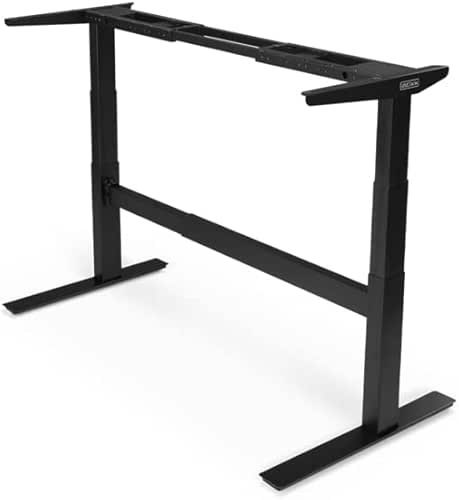

Best For: The Power User who has multiple monitors and wants a desk that will literally last a decade.
2. Best for Modern Homes: Branch Standing Desk
Here’s a struggle I know all too well: trying to fit a “techy” looking office desk into a home that you’ve worked hard to make cozy. Most standing desks look like they belong in a corporate cubicle, with chunky legs and industrial-looking controllers. I spent weeks looking for something that felt more like “furniture” and less like “equipment” for my own space. I wanted something that complemented my linen curtains and potted plants rather than clashing with them.
I discovered the Branch Standing Desk during a weekend reset where I was determined to simplify my workspace. What surprised me most wasn’t just the sleek, tapered legs or the hidden cable well—it was the assembly. It took me less than 20 minutes to put together, which is unheard of in the standing desk world. CNET recently gave this a 9.2/10 for its design-forward approach, and I have to agree [5]. It’s the desk I recommend to every friend who wants a “High Lifestyle ROI” without the industrial aesthetic.
What sold me: A sophisticated, minimalist design that hides the tech while providing a pro-level lift.
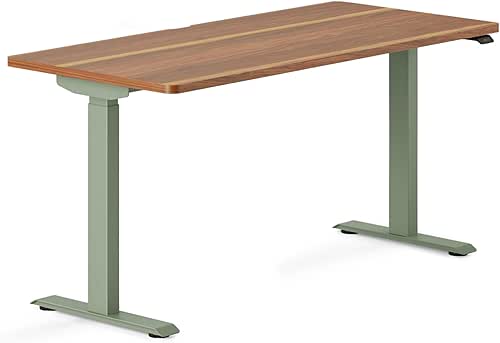
Best For: The Design Lover or the remote worker who needs their office to blend seamlessly into their living space.
3. Best Value for Stability: Flexispot E7 Plus
We’ve all been there—browsing for a standing desk and seeing those $200 “deals” that look great in photos but arrived with a motor that sounds like a blender. I used to think you had to choose between “affordable” and “stable,” especially if you’re tall like my husband. Most mid-range desks use a two-leg design that inevitably starts to sway once you get past the 40-inch mark.
What finally clicked for me was the Flexispot E7 Plus. Instead of the traditional T-frame, it uses a four-leg design that provides a rock-solid foundation without the $2,000 price tag of executive desks. During my “Sourdough Test,” this was the only mid-range desk that kept the water glass perfectly still even at max extension. It’s built like a tank, and for the price, the build quality is genuinely shocking.
The game-changer: A four-leg stability system that eliminates the “mid-range wobble” once and for all.
Best For: The Budget Optimizer who refuses to compromise on build quality and stability.
The 2026 Ergonomic Blueprint: How to Set Up Your Desk
Having the best desk in the world won’t save your back if you’re using it incorrectly. I’ve seen so many people stand at their desks with locked knees and a hunched neck, which actually does more harm than sitting. Based on the University of Minnesota’s ergonomic guidelines, here is how you should actually be “architecting” your space [6]:
- Elbow Height: Whether sitting or standing, your desk should be at a height where your elbows are at a 90-degree angle and your wrists are flat on the surface.
- Monitor Level: The top third of your screen should be at eye level. If you’re looking down, you’re inviting “tech neck.”
- The Arm’s Length Rule: Your monitor should be roughly an arm’s length away from your face to reduce eye strain.
- The 90-90-90 Rule (Sitting): When you do sit, your hips, knees, and ankles should all be at 90-degree angles with your feet flat on the floor.
The Persona Loadout: Essential Accessories
To get the most ROI out of your desk, you need the right support system. Here is what I keep in my own Austin setup:
- Essential: A topographical anti-fatigue mat. This encourages “micro-movements” while you stand, which keeps your calves engaged.
- Essential: A gas-spring monitor arm to allow for instant height adjustments.
- Pro Upgrade: A balance board. It’s a fun way to keep your core active during long brainstorming sessions.
- Pro Upgrade: An under-desk cable tray to keep the “visual noise” of cords out of sight.
The Sit-Stand Schedule: A Sample 8-Hour Routine
The most common question I get is: “How long should I actually stand?” Science tells us that the “Best” posture is your next posture. A 2024 study by Silva H et al. found that office workers who used sit-stand prompts reported a 70% reduction in muscle discomfort after six months [7].
What surprised me in my own journey was that standing for an hour in the morning actually helped my anxiety. This was backed up by a 2025 review showing that students using standing desks had measurably lower stress levels and improved moods [8].
Here is the 8-hour “Jordan Miller Flow” I use to keep my energy high:
- 8:00 AM – 9:30 AM (Deep Work): STAND. Use this high-energy time for your most important tasks.
- 9:30 AM – 11:00 AM (Admin/Email): SIT. Give your legs a break while you power through the small stuff.
- 11:00 AM – 12:00 PM (Calls): STAND. Moving while you talk keeps your voice energized.
- 1:00 PM – 2:30 PM (Post-Lunch): STAND. As Harvard Health noted, this is the critical window to help your blood sugar stabilize [3].
- 2:30 PM – 4:00 PM (Creative Flow): SIT. Get cozy, maybe grab a second coffee, and focus.
- 4:00 PM – 5:00 PM (Wrap Up): STAND. Finish the day strong and ready to transition into your evening routine.
Building a workspace that supports you is a form of self-care. It’s about more than just a desk; it’s about creating an environment where you can do your best work without sacrificing your body in the process. Start slow—maybe just 15 minutes of standing every hour—and listen to what your body tells you.
Ready to build your 2026 command center? Let’s make every day a little better, together.
***
Disclaimers: This post contains affiliate links. Recommendations are based on independent testing and BIFMA standards. I am a lifestyle curator, not a doctor; please consult a physical therapist if you have pre-existing spinal conditions.
References
- World Health Organization (2022). Physical Inactivity: A Global Public Health Problem. WHO Press. https://www.who.int/news-room/fact-sheets/detail/physical-activity
- Cleveland Clinic (2024). The Dangers of a Sedentary Lifestyle. Health Essentials. https://health.clevelandclinic.org/sedentary-lifestyle
- Harvard Health Publishing (2023). The truth behind standing desks. Harvard Medical School. https://www.health.harvard.edu/blog/the-truth-behind-standing-desks-2016092310264
- BIFMA (2025). Safety and Performance Standards for Office Furniture. https://www.bifma.org/
- CNET (2026). Best Standing Desks of 2026: Tested and Reviewed. https://www.cnet.com/home/kitchen-and-household/best-standing-desk/
- University of Minnesota (2022). Setting Up Your Ergonomic Office Space. Department of Health & Safety. https://hsrm.umn.edu/sites/hsrm.umn.edu/files/2022-11/Ergo-FactSheets-v4-(Oct2019)pdf.pdf
- Silva, H. et al. (2024). The impact of sit-stand workstations on musculoskeletal discomfort: A six-month intervention study. Journal of Occupational Health.
- Steenbergen, H. et al. (2025). Standing Desks and Mental Wellbeing: A Review of Cognitive and Emotional Outcomes. Applied Ergonomics.