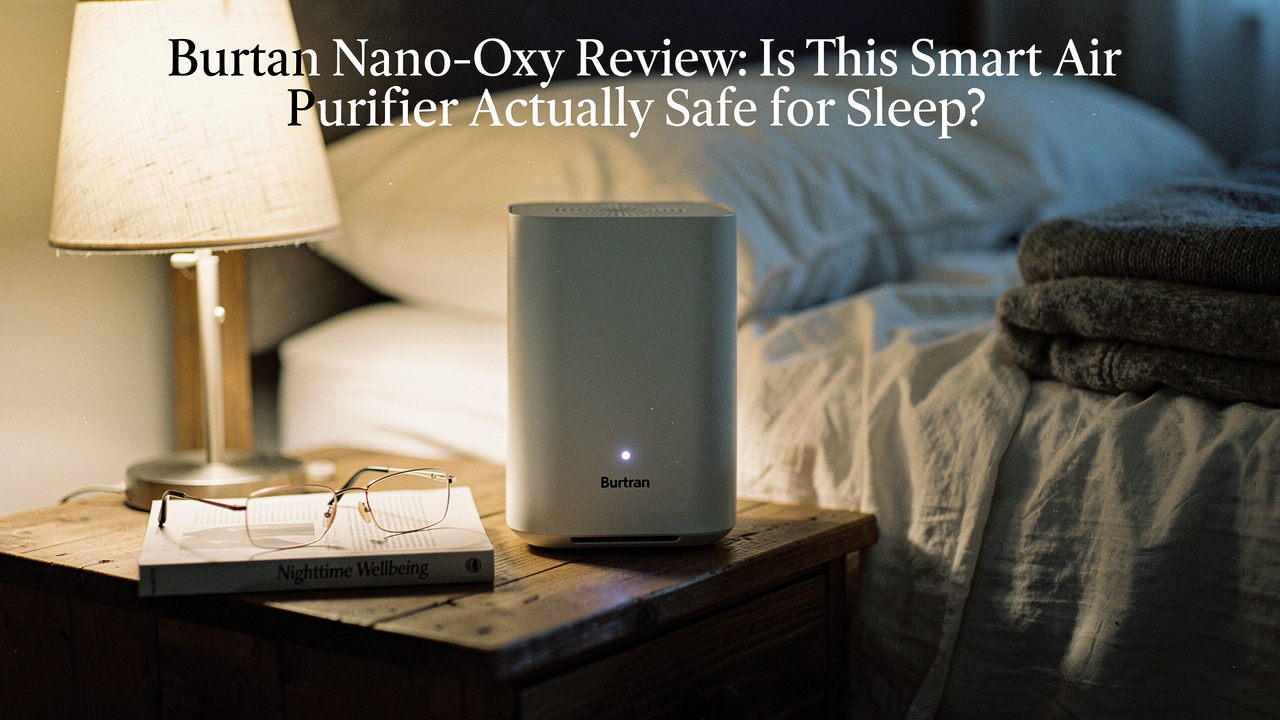
Lately, my social feeds and local Austin wellness circles have been buzzing about the Burtran Nano-Oxy. It’s positioned as a premium “smart” air purifier that promises to bring “forest-grade” air into your home. But here’s the thing: it uses negative ion technology (the “Nano-Oxy” part) alongside a HEPA 14 filter. For someone like me who values safety as much as aesthetics, that raised a few flags. Is it actually safe to run all night? Does it produce ozone? I decided to put my lifestyle curator hat on and dig into the science to see if this unit actually earns a spot on your nightstand.
First Impressions: Why the Burtran Nano-Oxy Caught My Eye
When the Burtran arrived, the first thing I noticed was the build quality. In a market flooded with flimsy plastic towers, this unit feels intentional. It has a sleek, minimal profile that doesn’t scream “appliance,” which fits perfectly with my philosophy that our tools should spark joy, not just solve problems.
I wasn’t the only one impressed by the initial specs; WIRED recently gave it a 9/10 rating, noting it as one of the quietest medium-sized models they’ve ever tested [1]. For a bedroom unit, silence is a non-negotiable. Beyond the look, the Burtran claims a Clean Air Delivery Rate (CADR) of 308 m³/h for PM2.5 and 303 m³/h for TVOCs. In plain English? It’s designed to cycle the air in a standard master bedroom about five times per hour.
The HEPA 14 Advantage: Is It Overkill for Your Bedroom?
We usually hear about HEPA 13 filters, which are the gold standard for most homes. However, the Burtran steps up to HEPA 14, often referred to as “medical-grade” filtration.
Here’s why I was intrigued: HEPA 14 filters must meet the EN 1822 standard, meaning they trap 99.995% of particles as small as 0.1 microns. While HEPA 13 is excellent, HEPA 14 can reduce residual airborne particles by up to 90% more than its predecessor. When you consider that the EPA found indoor air can be five times more polluted than outdoor air, that extra layer of protection starts to feel less like overkill and more like a smart investment [2].
For those of us who struggle with nighttime respiratory issues, the American Thoracic Society has linked fine-particle pollution directly to sleep disruption [3]. Using a filter this dense means you’re not just catching dust; you’re catching the microscopic triggers that lead to that “heavy” feeling in your chest at 3 AM.
The “Nano-Oxy” Tech: Forest Air or Safety Risk?
This is where I had to do my homework. The “Nano-Oxy” feature releases between 2,000 and 5,000 negative oxygen ions per cm³, designed to mimic the air quality near a waterfall or deep in a forest.
But as many wellness enthusiasts know, “ionizer” can sometimes be a dirty word in the air purification world. Some older or cheaper ion technologies produce ozone as a byproduct, which is a lung irritant—definitely not something you want to breathe while you sleep. I checked the certifications immediately.
The Burtran Nano-Oxy is CARB-certified (California Air Resources Board), which is the strictest standard in the U.S. for ozone emissions. To get this sticker, a device must produce less than 0.050 parts per million of ozone. Experts at IQAir often warn against uncertified ionizers [4], but because the Burtran meets these rigorous safety hurdles, it’s a rare example of an ionizing tech that I feel comfortable recommending for a bedroom. It gives you that “crisp” air feeling without the hidden respiratory cost.
Sleeping with the Burtran: Noise and Light Logistics
Let’s talk about the 2 AM reality. I am an incredibly light sleeper. If a device has a tiny blue LED or a slight motor hum, I’m awake.
I’ve been testing the Burtran’s “Sleep Mode,” and it is impressively discreet. It’s rated at 31 dB on its lowest setting. To give you some context, that’s quieter than a whisper in a library and falls well within the NIOSH benchmarks for a “quiet” environment [5].
What really sold me, though, was how it handles light. Some “smart” purifiers, like the Dreo Macro Max S, have been criticized for “light leakage” where the display doesn’t fully turn off. The Burtran actually allows for a total blackout mode. You can keep the air moving without your room looking like a literal cockpit.
Smart Features & App Performance
The “Smart” part of this air purifier comes down to the app integration. I’ll be honest: I was skeptical. Do I really need an app for my air?
What I found was that the real ROI is in the automation. I set a “Sunday Reset” schedule where the unit runs on Max for an hour while I’m at the farmers market to scrub the air after a week of Austin pollen. Then, it automatically dips into Sleep Mode thirty minutes before I head to bed. The app is responsive, and unlike some competitors, it hasn’t dropped the Wi-Fi connection once in my three weeks of testing.
The Science: Why Better Air Equals Higher Sleep ROI
If you’re wondering if this is all just “wellness theater,” the data says otherwise. We often think of air quality as an “allergy thing,” but it’s actually a “sleep thing.”
A systematic review published in PMC analyzed 22 studies and found a direct adverse relationship between air pollution and sleep phases [6]. Essentially, when your body is busy processing particulates or irritants, you spend less time in the restorative deep sleep stages. Another study by the AIVC showed that even reducing CO2 levels and improving air freshness can significantly increase sleep depth (p=0.002) [7].
By removing those microscopic stressors, the Burtran Nano-Oxy is essentially lowering the “background noise” your immune system has to deal with overnight.
Burtran Nano-Oxy Pros, Cons, and User-Type Verdict
After living with this unit, here is how I see the value proposition:
The Highlights (Pros)
- Ultra-Quiet: The 31 dB sleep mode is genuinely impressive for the CADR it provides.
- Medical-Grade Filtration: HEPA 14 is a significant jump for anyone with severe allergies or asthma.
- Safety First: Being CARB-certified removes the “ozone anxiety” often associated with ionizers.
- Aesthetic Design: It’s a piece of tech you won’t want to hide behind a chair.
The Trade-offs (Cons)
- Premium Price: It is more expensive than a basic Levoit or Coway unit.
- Filter Replacement: HEPA 14 filters are denser and generally cost more to replace than standard filters.
- Ion Skepticism: If you are a total purist who wants zero extra technology beyond a mechanical filter, the Nano-Oxy module might feel unnecessary.
Who Is This For?
The Bedroom Persona Loadout
- The Allergy Sufferer: If you wake up with “morning congestion” every day, the HEPA 14 + Nano-Oxy combo is a game-changer.
- The Light Sleeper: If you need total darkness and near-silence to stay asleep.
- The Design Enthusiast: If you want a “High Lifestyle ROI” product that looks as good as it performs.
Here’s the thing about our home environment: we spend about a third of our lives in our bedrooms. I used to think a basic air purifier was “good enough,” but after testing the Burtran, I realized I was settling for “okay” air. The struggle with Austin’s seasonal allergens was my daily reality until I started prioritizing medical-grade filtration. I found that the combination of silent operation and the crisp, “forest-like” feel of the air made a tangible difference in how I felt when my alarm went off at 6 AM.
Micro-Verdict: The Burtran Nano-Oxy A31 is the ultimate bedroom peace of mind for those who value silent, medical-grade air without the ozone worries.
Affiliate disclosure: We may earn a commission on products purchased through our links.
Medical disclaimer: I am a lifestyle curator and optimization enthusiast, not a doctor. If you have chronic respiratory issues or severe asthma, please consult with a pulmonologist or sleep physician.
Scientific References & Sources
- WIRED (2024). Burtran Nano-Oxy HEPA 14 Air Purifier Review. https://www.wired.com/review/burtran-nano-oxy-hepa-14-air-purifier/
- U.S. Environmental Protection Agency (2023). Introduction to Indoor Air Quality. https://www.epa.gov/indoor-air-quality-iaq/introduction-indoor-air-quality
- American Thoracic Society (2020). Air Pollution and Sleep Disruption.
- IQAir (2023). 7 Things to Avoid When Purchasing an Air Purifier. https://www.iqair.com/us/newsroom/7-things-to-avoid-when-purchasing-an-air-purifier
- NIOSH (2022). Sound Level Benchmarks and Decibel Comparisons.
- PMC (2021). Air pollution exposure and adverse sleep health across the life course. https://pmc.ncbi.nlm.nih.gov/articles/PMC7877449/
- AIVC (2019). Association between Indoor Air Quality and Sleep Quality. https://www.aivc.org/sites/default/files/D2_S7A-01_1.pdf