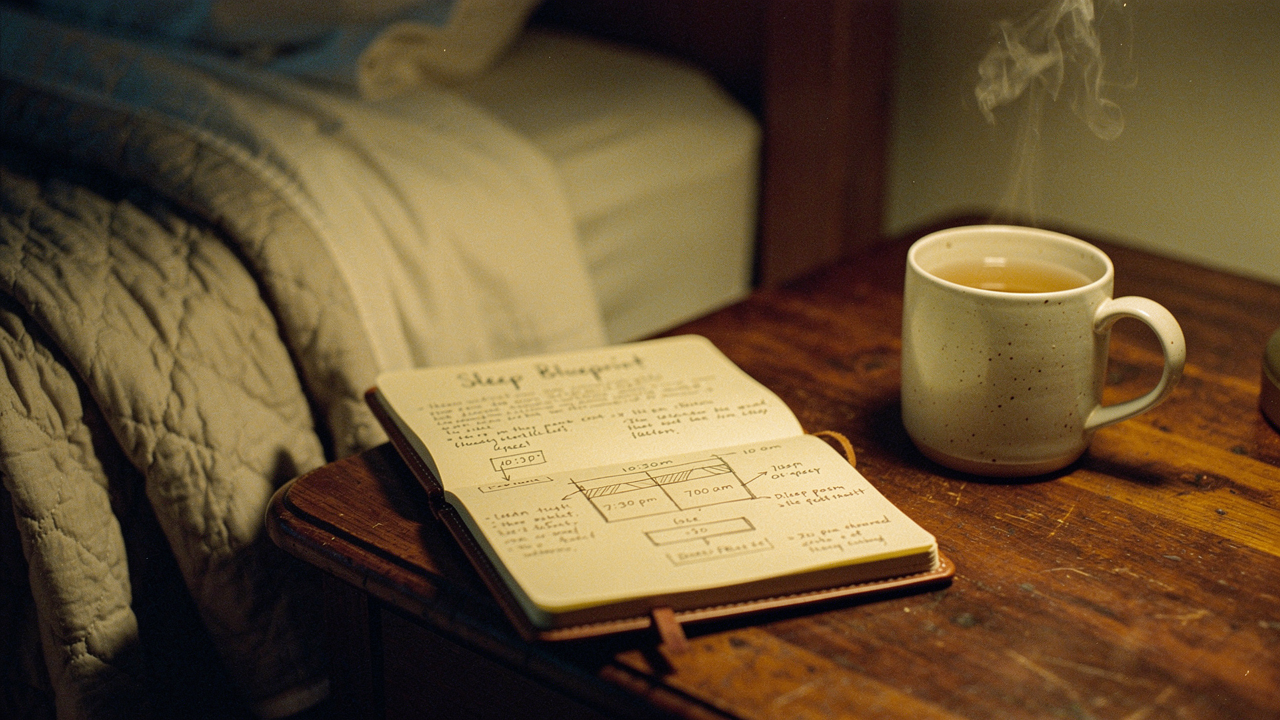
For years, I lived in the “junk sleep” cycle. I knew sleep was important—I’d read the articles and bought the expensive pillows—but I couldn’t bridge the gap between knowing what to do and actually doing it. I was frustrated, groggy, and tired of generic advice that didn’t account for my actual life.
If you’ve ever felt like you’re “trying everything” but still waking up exhausted, this isn’t another list of tips. This is a personalized blueprint. We’re going to look at the circadian science and the “High Lifestyle ROI” habits that actually move the needle, so you can build a system that works for your unique life.
Quick Answer: The 3 Pillars of a Perfect Sleep Routine
If you’re looking for the “too long; didn’t read” version, a successful sleep routine rests on three science-backed foundations:
- Consistency: Going to bed and waking up within the same 30-minute window every day to stabilize your internal clock [1].
- Circadian Alignment: Using light and temperature cues to signal your brain that it’s time for melatonin release [2].
- The Wind-Down: A dedicated 30–60 minute buffer zone that reduces cognitive arousal and physical stress before your head hits the pillow [3].
The Science of the ‘Perfect’ Night: Why Routines Win
Here’s the thing about your brain: it loves a predictable script. Our bodies operate on a roughly 24-hour internal clock called the circadian rhythm. This rhythm isn’t just about sleep; it regulates your hormones, metabolism, and even your mood.
When we talk about a sleep routine, we’re really talking about “anchoring” this clock. One of the most fascinating things I learned from neurobiology research is that your sleep routine actually starts the moment you wake up. Morning light exposure—ideally 10 to 30 minutes of natural sunlight—triggers a biological countdown [2]. This exposure sets a timer for the release of melatonin, the “sleep hormone,” approximately 12 to 14 hours later.
What the American Academy of Sleep Medicine (AASM) emphasizes is that consistency is the secret sauce [1]. When you perform the same actions in the same order every night, you’re using classical conditioning to tell your nervous system, “It’s safe to power down now.”
Phase 1: Diagnosing Your Sleep Bottlenecks
Before we build the routine, we have to figure out where the system is breaking. I’ve found that most people struggle with one of two things: sleep duration (not spending enough time in bed) or sleep quality (spending 8 hours in bed but waking up feeling like you were hit by a truck).
According to the CDC, more than one-third of U.S. adults aren’t getting enough sleep [4]. But how do you know if your quality is the issue? The Merck Manual defines poor sleep quality through three main lenses:
- Sleep Latency: It takes you more than 30 minutes to fall asleep.
- Efficiency: You’re awake for long periods in the middle of the night.
- Wakefulness: You wake up feeling unrefreshed or “non-restorative” sleep [5].
The ‘Sleep Debt’ Myth vs. Inconsistent Schedules
I used to be the queen of the “weekend catch-up.” I’d skimp on sleep from Monday to Friday and then sleep until noon on Sunday. I thought I was fixing the problem, but I was actually giving myself “social jetlag.”
Recent research from the American Heart Association (AHA) found that inconsistent sleep schedules—even if you get enough total hours—are linked to a higher risk of atherosclerosis (hardened arteries) [6]. Irregularity confuses your heart and your hormones. The goal shouldn’t be to “catch up,” but to stop the debt from accruing in the first place by stabilizing your wake-up time.
Phase 2: Building Your Personalized Sleep Blueprint
Now for the fun part: designing the routine. The “perfect” routine is the one you actually enjoy. If you hate meditating, don’t force it. If you love a 10-step skincare routine, keep it.
The AHA actually recommends that adults treat themselves like toddlers and set a “bedtime alarm” [7]. It sounds silly until you realize how easily an hour can disappear into a Netflix scroll.
The T-Minus 60 Script (The Standard Hour)
For most of us, a 60-minute wind-down is the gold standard for high lifestyle ROI. Here is how I break it down:
- T-60: The Tech Handover. Plug your phone in across the room (or in another room). Dim the overhead lights.
- T-45: The Hygiene Ritual. Hot shower or bath. This isn’t just for cleanliness; the drop in body temperature after you get out of the water is a powerful biological trigger for sleep [8].
- T-30: The Brain Dump. If you’re a night-thinker like me, write down your to-do list for tomorrow. Getting it on paper gets it out of your head.
- T-15: The Low-Arousal Activity. Read a physical book or listen to a calm podcast. Reading for just six minutes can reduce stress levels by up to 68% [7].
The ‘Minimalist’ 15-Minute Protocol
Let’s be honest: some nights are just chaotic. If you’ve worked late or the kids are restless, you can still anchor your brain with a condensed version:
- 5 Minutes: Dim every light in the house and set the thermostat to a cool 65°F.
- 5 Minutes: Quick hygiene (brush teeth, face wash).
- 5 Minutes: Three minutes of “box breathing” (inhale 4, hold 4, exhale 4, hold 4) once you’re under the covers.
Phase 3: Tailoring for Your Chronotype
One of the biggest breakthroughs in my wellness journey was realizing I’m a “Lion” (a natural early bird). Trying to force myself to stay up late for social events was literally making me sick.
Your chronotype is your genetic predisposition for when you feel most alert or sleepy. The Sleep Foundation categorizes these into four “animal” types [9]:
- Lions (Early Birds): Most productive in the morning, crash early evening. Routine Tip: Start your wind-down earlier than you think.
- Bears (Traditional): Follow the sun. Most of us (50%) are bears. Routine Tip: Stick to a consistent 11 PM to 7 AM window.
- Wolves (Night Owls): Productive at night, struggle with early mornings. Routine Tip: Use bright light therapy in the morning to “push” your clock forward.
- Dolphins (Insomniacs/Light Sleepers): Often alert at night and tired during the day. Routine Tip: Focus heavily on the “Brain Dump” to reduce night-time anxiety.
If you aren’t sure where you fall, the Morningness-Eveningness Questionnaire (MEQ) is a validated tool that can help you find your peak windows [9].
The Hardware of Sleep: Optimizing Your Environment
Your bedroom should feel like a sanctuary, not an office or a gym. To get the best ROI on your sleep, we have to look at the “Hardware.” Clinical research suggests the ideal sleep environment is “Cool, Dark, and Quiet.” Most experts agree that 60 to 67°F (15.5–19.5°C) is the sweet spot for the body to maintain its deep-sleep core temperature [8].
Jordan’s Optimization Gear
Here’s the thing about the Austin heat: it is the absolute enemy of deep sleep. I used to wake up at 3:00 AM drenched in sweat, even with the AC blasting. I tried every “cooling” sheet on the market, but nothing really worked until I addressed the surface temperature of my mattress. I was skeptical about adding more tech to my bed, but I finally invested in a temperature-controlled cover. It circulates water to keep the bed at a precise degree all night.
Micro-Verdict: The real win here: sleeping through the night without a single hot flash.
Best For: Hot sleepers or couples who can never agree on the thermostat setting.
I’ll admit it—I used to think sleep masks were just for people on long-haul flights. But my bedroom gets that bright, direct Texas sun early in the morning, and it was snatching away my last hour of precious REM sleep. I tried those cheap silk masks, but they’d always slide off or press against my eyelids in a way that felt claustrophobic. What finally clicked for me was finding a mask with deep “eye cups.” It allows me to blink freely while creating a total blackout environment, even when the sun is beaming.
Micro-Verdict: Bottom line: It creates a true blackout experience that actually stays put.
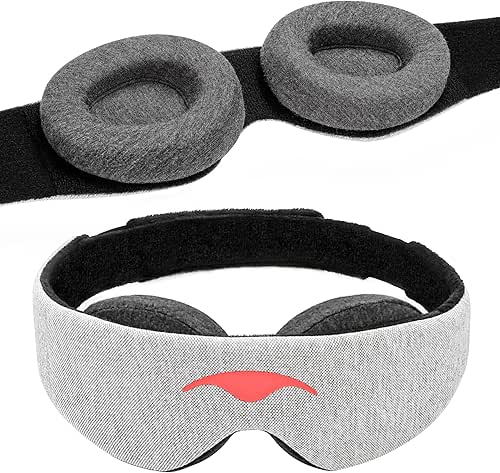

Best For: Light-sensitive sleepers, day-sleepers, or anyone with a partner who likes to read with the light on.
Troubleshooting Real-Life Constraints
I know what you’re thinking: “Jordan, this sounds great, but I have a newborn,” or “I work the night shift.” Life is rarely “optimal.”
If you’re dealing with an inconsistent schedule due to work, the AASM recommends a “phased shift.” If you need to move your sleep time, do it in 15 to 30-minute increments every few days rather than trying to change it by three hours all at once [10].
For parents or those in small apartments, focus on what you can control. If you can’t control the noise, use a white noise machine. If you can’t control the timing, focus on the order of your rituals. Even 10 minutes of a consistent sequence can signal to your brain that it’s time to rest.
Creating Your 14-Day Reset
A “perfect” routine isn’t the one you do once; it’s the one you can sustain. I recommend a 14-day “Build & Test” phase.
- Pick one wind-down script (60 or 15 mins).
- Set a consistent wake-up time (yes, even on Saturday).
- Track how you feel on a scale of 1-10 each afternoon.
By the end of two weeks, your body will start to take over, and that groggy “junk sleep” feeling will start to fade. You deserve to wake up feeling like your space and your routine are actually supporting you.
References & Scientific Resources
- American Academy of Sleep Medicine (2023). Healthy Sleep Habits and Consistency. https://aasm.org/resources/pdf/choosing-wisely-sleep-habits.pdf
- Huberman, A. (2022). Using Light to Optimize Health. Huberman Lab Podcast. https://www.hubermanlab.com/newsletter/improve-your-sleep
- Sleep Foundation (2024). Bedtime Routines for Adults. https://www.sleepfoundation.org/sleep-hygiene/bedtime-routine-for-adults
- Centers for Disease Control and Prevention (2023). Data and Statistics: Short Sleep Duration Among Adults. https://www.cdc.gov/sleep/data-and-statistics/index.html
- Merck Manual (2023). Insomnia and Excessive Daytime Sleepiness (EDS). https://www.merckmanuals.com/home/brain,-spinal-cord,-and-nerve-disorders/sleep-disorders/insomnia-and-excessive-daytime-sleepiness-eds
- American Heart Association (2023). Irregular Sleep Patterns Linked to Atherosclerosis. Journal of the American Heart Association. https://www.heart.org/en/news/2023/02/15/irregular-sleep-patterns-linked-to-atherosclerosis
- American Heart Association (2022). How to Sleep Better with a Bedtime Routine. https://www.heart.org/en/healthy-living/healthy-lifestyle/sleep/how-to-sleep-better-with-a-bedtime-routine
- Cleveland Clinic (2024). The Best Temperature for Sleep. https://health.clevelandclinic.org/what-is-the-ideal-sleeping-temperature-for-your-bedroom
- Sleep Foundation (2023). Chronotypes: Definition, Types, and Effect on Sleep. https://www.sleepfoundation.org/how-sleep-works/chronotypes
- American Academy of Sleep Medicine (2022). Shift Work Disorder Management Guidelines. https://jcsm.aasm.org/doi/10.5664/jcsm.9344
Disclaimer: This guide is for educational purposes and does not replace professional medical advice. If you suspect you have chronic insomnia or a sleep disorder like apnea, consult a healthcare provider.