=
What I eventually realized—and what changed everything for my work and my yoga practice alike—is that sleep isn’t just “rest.” It is your cognitive infrastructure. If the infrastructure is crumbling, no amount of time-blocking is going to save your workday. When I started tracking my sleep not just as a health metric, but as a productivity KPI, I stopped guessing why I was tired and started optimizing my life for what I call “High Lifestyle ROI.”
The Invisible Drain: Why Your Current Productivity Hacks are Failing
We’ve all been there: the 2:00 PM slump where you’re staring at a spreadsheet and the numbers start to look like ancient hieroglyphics. You might think you just need more discipline, but the reality is likely much simpler—you’re operating on a massive “Sleep Debt.”
Here’s the thing about sleep: your brain is incredibly good at lying to you about how impaired it actually is. Research from the Sleep Research Society has shown that after two weeks of sleeping only six hours a night, your cognitive performance drops to the same level as someone who has been awake for 24 hours straight [2]. The scariest part? Those participants felt like they were doing just fine. They had no idea their reaction times and decision-making skills were in the gutter.
This isn’t just a niche problem. According to Gallup data cited by Harvard Health, about 14% of Americans report they don’t have the energy they need to get through their daily tasks [1]. We are a nation of “walking zombies” trying to use Pomodoro timers to fix a biological deficit. Poor sleep quality doesn’t just make you grumpy; it accelerates “brain age,” with some studies suggesting that poor sleepers have brains that appear a full year older than their chronological age [5]. If you want to be more productive, you have to stop viewing sleep as the thing that happens when work is done and start viewing it as the fuel that makes work possible.
Choosing Your Sensors: The Best Sleep Tracking Methods for High Performance
When I first decided to take this seriously, I felt overwhelmed. I didn’t want another gadget that just gave me a “score” without telling me what to do with it. I wanted something that would help me decide if I should crush a deep-work session or move my meetings to tomorrow. After a decade of testing lifestyle products, I’ve found that the “best” tracker is the one you actually forget you’re wearing.
I used to struggle with the bulk of traditional smartwatches. Trying to fall asleep with a glowing mini-computer strapped to my wrist felt like bringing my office into bed, and the blue light was doing me no favors. I needed something that felt like a natural part of my Sunday reset rituals—quiet, intentional, and high-quality. That’s when I switched to a smart ring, and it was the first time sleep tracking actually felt sustainable. It sat discreetly on my finger, and instead of just telling me I slept “poorly,” it started showing me the direct correlation between that late-night glass of wine at a South Congress dinner and my heart rate variability (HRV) the next morning.
Micro-Verdict: The ultimate choice for those who want deep data without the “tech-heavy” feel of a screen-based wearable.
Of course, the ring isn’t for everyone. I have friends who are die-hard ecosystem fans and wouldn’t dream of leaving their wrist empty. If you’re someone who is already tethered to your notifications and wants a device that handles everything from your Austin trail runs to your REM cycles, a more robust smartwatch is the way to go. I found that having the data right there on my wrist helped me make real-time decisions, though I had to be careful not to let the “Always-On” display ruin my wind-down routine. What eventually won me over was the sheer accuracy of the newer sensors—it’s the closest most of us will get to a lab-grade sleep study without the wires.
Micro-Verdict: Best for the high-power user who wants their sleep data integrated into a total health and communication ecosystem.
Then there are the “performance junkies.” I’ll admit, during my peak training months, I get a little obsessed with recovery. I was finding myself constantly burnt out, pushing through workouts when my body was screaming for a break. I discovered a strap-based tracker that focuses almost entirely on “Strain vs. Recovery,” and it was a game-changer. It taught me that my “low energy at work” wasn’t always about sleep duration; sometimes, it was because my nervous system hadn’t recovered from the previous day’s stress. It shifted my focus from “hours in bed” to “readiness to perform.”
Micro-Verdict: The go-to for athletes and high-stress professionals who need to know exactly how much gas is left in the tank.


Recommended Sleep Persona Loadouts
To help you decide which setup fits your lifestyle, I’ve put together these three “loadouts” based on your primary goals:
- The Minimalist Remote Worker: Oura Ring 4 + a high-quality silk sleep mask. Focuses on discreet tracking and maximizing environment quality.
- The Data-Obsessed Power User: Apple Watch Series 10 + the AutoSleep app. Best for those who want to see every granular detail on a dashboard.
- The Hybrid Athlete: WHOOP 4.0 + a blue-light blocking bulb for the bedside lamp. Prioritizes recovery scores to balance physical training and cognitive output.
The Metrics That Matter: How to Perform Sleep Data Analysis
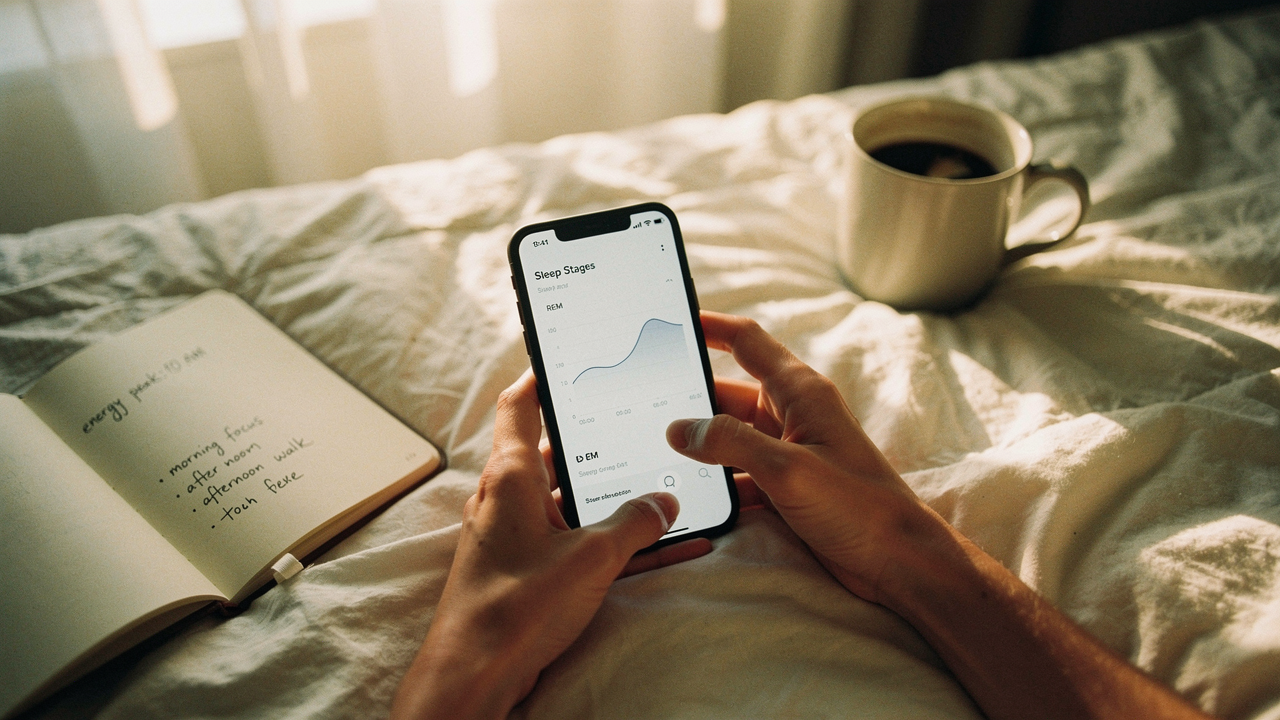
Here’s a secret the tech companies don’t always tell you: most of the data on your dashboard is just “noise.” You’ll see charts for REM sleep, Deep sleep, and Light sleep, but consumer trackers are notoriously imperfect at distinguishing between these stages [4]. If you spend your morning stressing over why you only got 40 minutes of Deep sleep, you’re likely creating more anxiety than productivity.
What I’ve learned from experts at Johns Hopkins Medicine is to focus on the Signal, not the noise [4]. There are three metrics that actually move the needle for your work performance:
- Sleep Efficiency: This is the percentage of time you spend asleep versus the time you spend lying in bed. If you’re in bed for 9 hours but only sleep for 6.5, your efficiency is low. This usually points to a “wind-down” problem, not a sleep problem.
- Sleep Debt: This is the cumulative amount of sleep you’ve lost over the last 14 days. This is the ultimate “unproductive morning” predictor. If your debt is over 5-8 hours, your cognitive “hardware” is officially throttled.
- Consistency (The Sleep Window): Going to bed and waking up within the same 30-minute window every day is the single most important factor for circadian health.
The If-Then Protocol: Turning Data Into Daily Action
The biggest mistake people make is looking at their sleep score and saying, “Oh, that’s neat,” then going about their day exactly as planned. To make sleep tracking a productivity hack, you have to use it to make decisions. I use a simple “If-Then” protocol every morning while I’m brewing my coffee.
Rule 1: The ‘Deep Work’ Triage
If my Sleep Debt is high (over 90 minutes) or my recovery score is in the “red,” I know my prefrontal cortex isn’t at 100%. On these days, I move my most creative, demanding tasks—like writing this guide—to the afternoon when my natural circadian rhythm gives me a slight second wind. I use the morning for “administrative shallow work” like clearing emails or organizing my calendar. This prevents the frustration of trying to force “Deep Work” when my brain simply doesn’t have the bandwidth.
Rule 2: The Social Jetlag Reset
We’ve all had those Sunday mornings where we sleep in to “catch up” after a late Saturday night in Austin. This actually makes Monday worse by creating “social jetlag.” If my tracker shows a late night, I still try to wake up within an hour of my normal time. I’ll then use a 20-minute “Power Nap” before 2:00 PM to bridge the gap. This keeps my internal clock consistent so I don’t start the work week with a “Monday morning hangover.”
Avoiding the Dark Side: Orthosomnia and Data Obsession
I’ve seen it happen to the best of us: you wake up feeling great, but then you check your app, see a “Sleep Score” of 62, and suddenly you feel exhausted. This is a real phenomenon called Orthosomnia—the preoccupation with perfecting your sleep data to the point that it actually causes insomnia [6].
If you find yourself getting anxious about your numbers, it’s time to take a break. Remember, these devices are tools, not judges. I’ve had to implement a “Minimal Effective Dose” strategy where I only check my data three times a week. It’s enough to spot trends without becoming obsessed with nightly fluctuations.
Also, it’s important to know when a tracker isn’t enough. If your data consistently shows high restlessness or if you’re waking up gasping for air, no app is going to fix that. Those are medical red flags that require a visit to a board-certified sleep physician, not a new wearable.
The 14-Day Productivity Experiment
Ready to stop guessing? I want to challenge you to a 14-day experiment. For the next two weeks, track your sleep and log one thing: your “Focus Score” (on a scale of 1-10) at 11:00 AM every day. By the end of the second week, look at the correlation between your Sleep Consistency and that Focus Score. I bet you’ll find that a consistent wake-up time is worth more to your productivity than a dozen cups of coffee.
Living well isn’t about having more data; it’s about choosing better actions based on that data. Your brain is the most expensive piece of equipment you own—it’s time you started maintaining it like a pro. Start your experiment tonight, and let’s reclaim those mornings together.
Disclaimer: This guide is for informational purposes and does not replace professional medical advice. If you suspect you have sleep apnea, chronic insomnia, or another sleep disorder, please consult a board-certified sleep physician.
References
- Harvard Health Publishing (2024). “9 Tips to Boost Your Energy Naturally.” Harvard Medical School.
- Sleep Research Society (2003). “The Cumulative Cost of Additional Wakefulness: Dose-Response Effects on Neurobehavioral Functions and Sleep Physiology From Chronic Sleep Restriction.” Journal: SLEEP.
- Sleep Foundation (2025). “Best Sleep Trackers of 2025.” Sleepfoundation.org.
- Johns Hopkins Medicine. “Do Sleep Trackers Really Work?” Hopkinsmedicine.org.
- JAMA Neurology (2024). “Sleep Quality and Brain Aging: A Longitudinal Study.”
- Frontiers in Computer Science (2024). “The Psychosocial Impact of Sleep Tracking: Orthosomnia and Beyond.”
- American Academy of Sleep Medicine (AASM). “Position Statement on Consumer Sleep Trackers.”