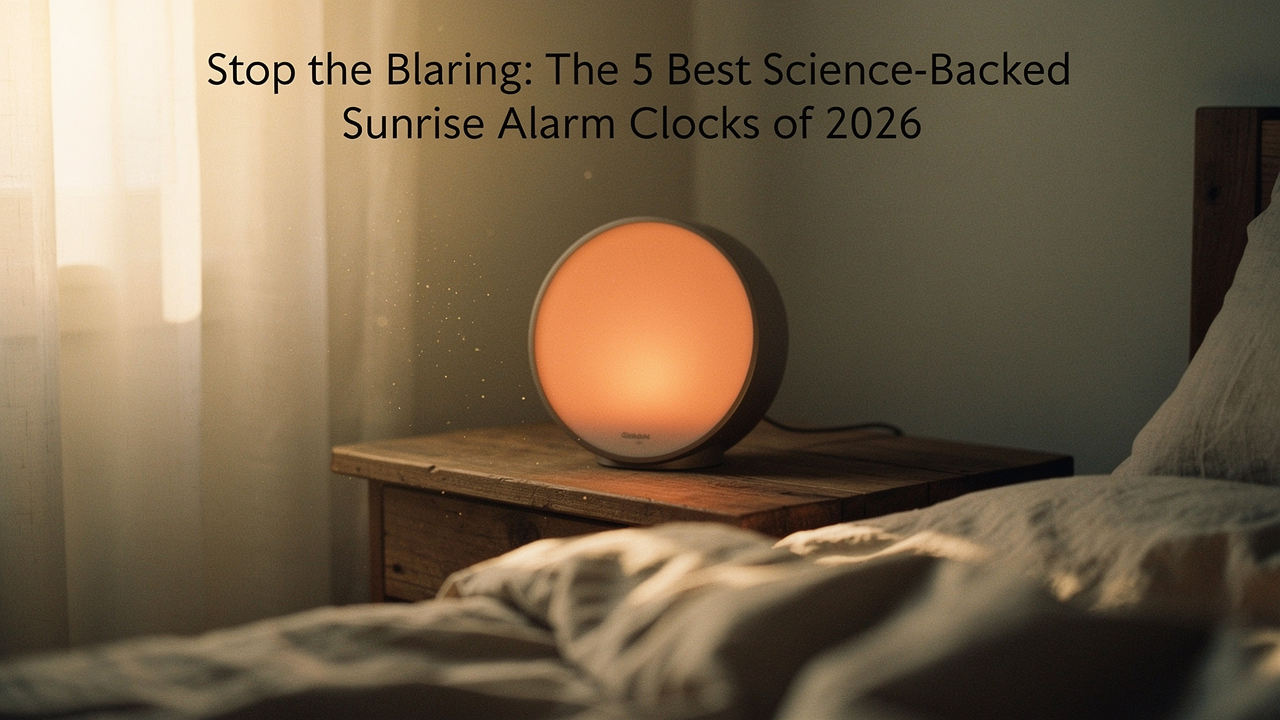
As someone who obsesses over “High Lifestyle ROI,” I started looking at my morning routine through a different lens a few years ago. If the first thirty minutes of our day dictates our mood, focus, and energy, why are we starting them with a fight-or-flight response?
Living well isn’t about having more gadgets; it’s about choosing tools that actually support your biology. That’s where the sunrise alarm clock comes in. Unlike that heart-stopping phone beep, these devices use a gradual light “ramp” to mimic a natural dawn. Here’s the wild part: research shows that about 10% of environmental light actually penetrates your closed eyelids [1]. This tiny bit of light cues your brain to start winding down melatonin and ramping up cortisol before you even open your eyes.
I’ve spent the last few months testing the 2026 lineup, looking past the marketing fluff to find the clocks that offer the best “Good Life” return—balancing technical specs like lux and spectrum with the aesthetics that make a bedroom feel like a sanctuary.
The Science of the ‘Gentle Wake Up’: Why Your Phone is Failing You
The technical term for that heavy, “hit by a truck” feeling we get in the morning is sleep inertia. When a loud alarm shocks you out of a deep sleep stage, your brain doesn’t just “turn on.” You’re left in a state of cognitive fog that can last anywhere from 15 minutes to several hours [2].
Traditional alarms are reactive—they wait until you’re supposed to be up and then scream at you. Sunrise alarms are proactive. By simulating a natural dawn, they ease you through the transition from deep sleep to light sleep. This process helps align your internal clock, or circadian rhythm, with your actual schedule [3].
The Sleep Foundation warns that “blaring” alarms can actually trigger morning anxiety, putting your nervous system on edge before you’ve even had your first cup of coffee [4]. Switching to light isn’t just “nice”—it’s a way to protect your mental real estate.
Quick Picks: The Best Sunrise Alarms at a Glance
If you’re currently reading this while sipping your morning brew and just want the highlights, here is how the 2026 leaders stack up:
- Best Overall: Lumie Bodyclock Shine 300 (High-fidelity light, medical-grade heritage)
- Best Smart Features: Hatch Restore 3 (Customizable routines, great sound library)
- Best Simulated Sunrise: Philips SmartSleep HF3650 (Smooth, multi-stage color transitions)
- Best Budget: JALL Wake Up Light (Reliable performance at an entry-level price)
- Best for Heavy Sleepers: Roxicosly Super Loud + Bed Shaker (Light plus tactile vibration)
The 5 Best Sunrise Alarm Clocks of 2026: Deep Dives
1. Best Overall: Lumie Bodyclock Shine 300
For years, I struggled with the “winter blues.” Living in Austin means we get plenty of sun, but those early January mornings can still feel incredibly bleak. I tried several cheaper lamps, but they often felt “flickery” or the light was a harsh, sickly blue. I finally decided to invest in the Lumie after reading about their roots in medical-grade light therapy. The difference was immediate. The light didn’t just get “brighter”—it felt like actual sunlight was filling my room.
The Shine 300 stands out because it treats light as a science. It hits that crucial 250+ lux mark at a standard bedside distance, which is what you need to actually trigger those biological wake-up signals [5]. What really sold me, though, was the evening setting. It uses a low-blue-light spectrum for its sunset mode, meaning it won’t interfere with your own melatonin production while you’re winding down with a book.
Micro-Verdict: The gold standard for anyone serious about using light to fix their circadian rhythm.


2. Best Smart Features: Hatch Restore 3
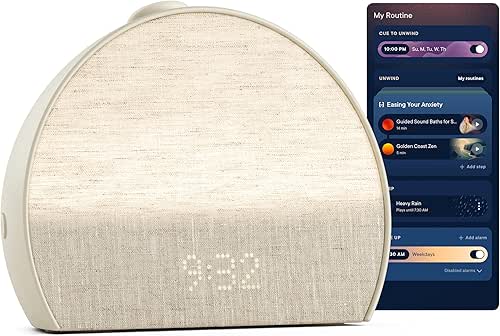
I’ll be honest: my nightstand used to be a graveyard of half-baked ideas. A sound machine, a reading lamp, a phone charger, and a traditional clock. It felt cluttered, and clutter is the enemy of a calm mind. I wanted a “one-stop shop” that didn’t feel like a piece of cold tech. When I found the Hatch Restore, I was skeptical about another app-controlled device, but the 2026 Restore 3 has become the “Sunday Reset” of my morning routine.
What makes the Restore 3 special is the “Routine” functionality. You can program a seamless flow: a reading light that fades into a “pink noise” soundscape, followed by a sunset simulation, and finally a gradual sunrise in the morning. The 2026 model expanded the sound library significantly—I personally love the “Austin Creek” setting. It’s perfect for the minimalist who wants a high-tech brain but a low-clutter aesthetic.
Micro-Verdict: The ultimate bedside companion for people who love a curated, app-driven sleep ritual.
3. Best Simulated Sunrise: Philips SmartSleep HF3650
One of the biggest complaints I hear from friends about cheaper sunrise clocks is that the light “jumps” in steps. Instead of a smooth transition, it’s like someone is slowly clicking a dimmer switch. It’s distracting enough to wake you up too early. I went on a quest to find the smoothest “curve” on the market, which led me back to the Philips SmartSleep series.
The HF3650 is widely regarded by testers at places like Wirecutter for its color fidelity. It doesn’t just go from dim white to bright white; it starts with a deep, volcanic red, shifts into a rich orange, and eventually reaches a bright, crisp yellow. It feels intentional. When I used this during a particularly busy week of sourdough testing (which means a lot of 5 AM starts), the “Ocean Waves” sound paired with that red-to-orange ramp made the early hour feel like a gift rather than a chore.
Micro-Verdict: Unmatched color realism for those who want the most “natural” feeling dawn possible.
4. Best Budget: JALL Wake Up Light
I know that spending $150+ on an alarm clock feels like a lot when you’re just starting your wellness journey. I’ve recommended the JALL to so many people who were “sunrise curious” but didn’t want to commit a huge portion of their budget. It’s a perennial Amazon bestseller for a reason: it gets the job done without the premium price tag.
While the color transitions aren’t as sophisticated as the Philips—it can feel a bit “LED-heavy”—the core functionality is surprisingly robust. It features dual alarms (perfect if your partner has a different schedule) and a built-in FM radio. If you’re a student or just looking for a simple, effective entry point into light-based waking, this is where I’d start. It’s a low-risk way to prove to yourself that light waking actually works.
Micro-Verdict: The best “proof of concept” clock that delivers the core benefits without the premium price.

5. Best for Heavy Sleepers: Roxicosly Super Loud with Bed Shaker
Let’s be real: some of us are “zombie” sleepers. You could have a stadium light in your room and you’d still snooze through it. I used to be this way in college, and a light-only alarm would have been a disaster. If you genuinely fear missing your 8 AM meeting because you’re too deep in dreamland, you need a multi-modal approach.
The Roxicosly isn’t “pretty” in the traditional Austin-boutique sense, but it is incredibly effective. It combines the sunrise light with an incredibly loud buzzer and—the real game-changer—a “bed shaker” puck that you slide under your pillow. It uses tactile vibration to physically stir you while the light prepares your brain. It’s the “fail-safe” option for heavy sleepers who want to transition away from blaring noise but aren’t quite ready to trust light alone.
Micro-Verdict: A “no-fail” system for the heaviest sleepers who need more than just a glow to get moving.
The Technical Checklist: What Actually Matters
When you’re shopping for a high-ROI lifestyle product, you have to look past the box. Here is Jordan’s “Geek Corner” for sunrise alarms:
- Lux Levels: Look for at least 250-300 lux at 12 inches. If the light isn’t bright enough, it won’t penetrate your eyelids effectively.
- Spectral Quality: The best lamps have a high CRI (Color Rendering Index). Cheap LEDs can have a high “flicker rate” that causes subtle headaches or eye strain in the morning.
- Ramp Duration: You want a clock that allows at least a 30-minute ramp. Anything shorter can feel too abrupt.
- Battery Backup: This is non-negotiable. If the power blinks at 3 AM, you need that alarm to still go off.
Alarm Hygiene: How to Optimize Your Sunrise Setup
Buying the clock is only half the battle. To get the most out of your investment, you need to set the scene. Here is how I suggest setting up your new routine:
- The 45-Degree Rule: Place the clock about 12–18 inches from your head, ideally at a 45-degree angle. You want the light to hit your face, but you don’t want to be staring directly into the “sun” the moment you open your eyes.
- Start with Sound: For the first two weeks, keep a backup sound alarm (like a soft bird chirp) set for the end of the light ramp. Your brain needs time to “learn” to wake up to light.
- Volume Titration: Gradually turn the sound volume down over a month as your body becomes more sensitive to the light cues.
- Consistency is Queen: The American Academy of Sleep Medicine emphasizes that a consistent wake time—even on weekends—is the single best thing you can do for your sleep health [6].
Common Questions: SAD, Smart Bulbs, and Safety
Do these work for Seasonal Affective Disorder (SAD)?
Here’s the thing: while sunrise alarms are incredible for circadian support, they are generally not the same as clinical light therapy. True SAD lamps usually require 10,000 lux [7]. If you’re struggling with severe seasonal depression, a sunrise alarm is a great adjunct, but you should talk to a professional about a dedicated light box.
Can I just use a smart bulb?
You can, but it’s often “clunky.” Most smart bulbs don’t have the sophisticated color-shifting curves (red to orange to yellow) that dedicated units like Philips or Lumie offer. Plus, having a dedicated physical device helps keep the phone out of the bedroom—a huge win for sleep hygiene.
Are they safe for kids?
Absolutely. In fact, they are a godsend for teenagers whose circadian rhythms naturally shift later. It’s a much gentler way to get a sleepy teen out of bed than a shouting match.
Final Thoughts: Investing in Your “Morning ROI”
At the end of the day, your environment should support the person you want to be. If you want to be someone who wakes up with calm, intentional energy, stop letting your phone’s blaring alarm dictate your mood.
For the busy professional who wants the best of the best, the Lumie Bodyclock Shine 300 is my top pick. If you love a tech-integrated home, the Hatch Restore 3 will change your life. And if you’re a heavy sleeper, don’t be ashamed to grab the Roxicosly—it’s about finding what works for your biology.
Let’s make our mornings a little better, together.
Affiliate disclosure: We may earn a commission on products purchased through our links.
Medical disclaimer: Sunrise alarms are circadian support tools, not medical treatments for SAD or sleep disorders. If you have persistent sleep issues, please consult a medical professional.
References
- Wu, J. (2025). Light Penetration and the Circadian Bridge. Expert Commentary, Allure.
- Hilditch, C. J., et al. (2016). “Sustained effects of dawn simulation on sleep inertia.” Industrial Health.
- Chang, A. M., et al. (2012). “Human responses to bright light of different durations.” Journal of Physiology.
- Sleep Foundation (2025). “Alarm Clocks and Morning Anxiety: The Impact of Sound on the Nervous System.” https://www.sleepfoundation.org/how-sleep-works/sleep-inertia
- Cleveland Clinic (2025). “Circadian Rhythm Disorders and Light Intervention.” https://my.clevelandclinic.org/health/diseases/11429-sleep-disorders
- OptimizeYourBiology (2025). “Spectrometer Analysis: Lux and Flicker Rates of 2025 Sunrise Alarms.” https://optimizeyourbiology.com/best-sunrise-alarm-clocks
- Brandt, H. (2024). “Clinical Lux Thresholds for SAD vs. Circadian Support.” University of Maryland.