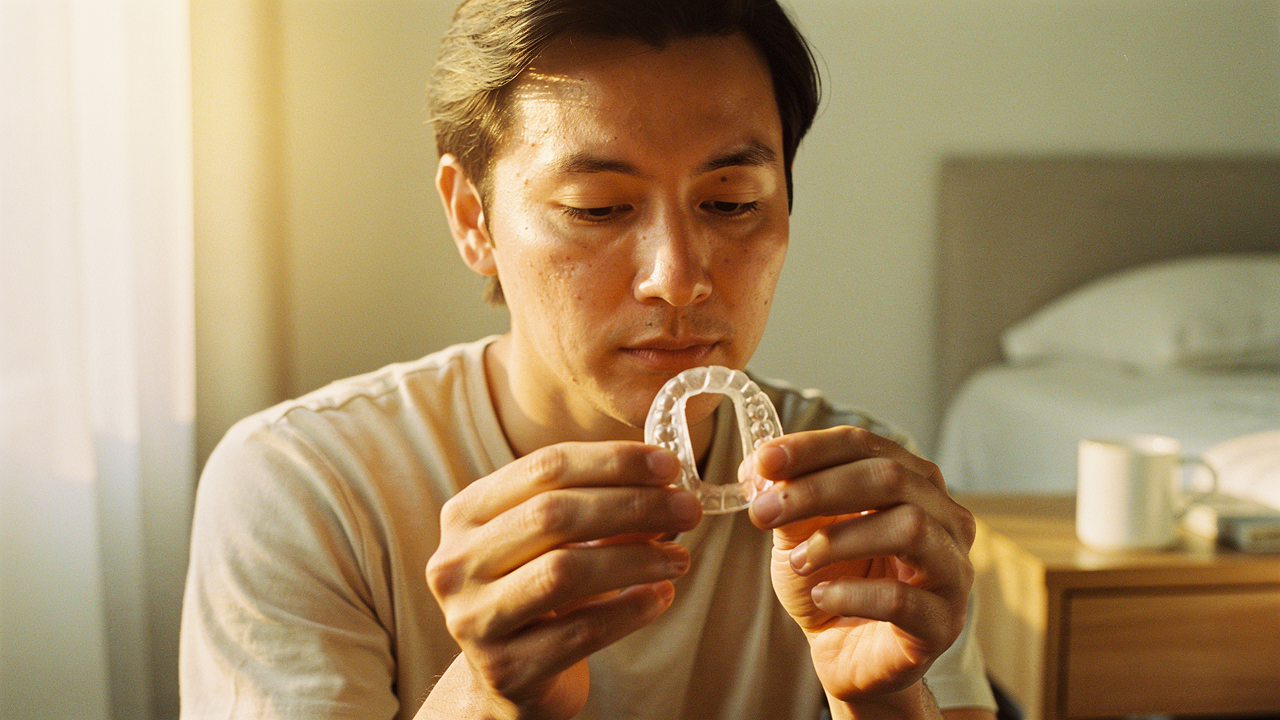
I realized I was a victim of what dentists call bruxism—the clinical term for teeth grinding. Here’s the thing: I didn’t even know I was doing it. It was happening in the dark, during those hours when I was supposed to be recovering.
If you’ve ever looked in the mirror and noticed your teeth looking a bit shorter, or if your partner has complained about a “clicking” sound coming from your side of the bed, you’re in the right place. In my world of “High Lifestyle ROI,” fixing your grind is one of the best investments you can make. It’s not just about protecting your smile; it’s about reclaiming deep sleep and avoiding the $10,000 restorative dental bills that come from years of neglect.
This is the roadmap I wish I had when I first felt that jaw fatigue. Let’s walk through how to stop the grind, starting tonight.
The Anatomy of a Grind: Understanding Sleep vs. Awake Bruxism
Before we can fix the problem, we have to understand what we’re up against. According to the American Dental Association (ADA), bruxism is the involuntary clenching or grinding of teeth [1]. But not all grinds are created equal.
There are actually two distinct versions of this habit:
- Awake Bruxism: This is usually clenching rather than grinding. You might do it while focusing at your desk, driving in traffic, or during a stressful meeting. It’s often a physical reaction to stress or deep concentration.
- Sleep Bruxism: This is the nocturnal version where you actually slide your teeth back and forth. It’s classified by many experts as a sleep-related movement disorder [2].
What surprised me during my research was that bruxism is often divided into “primary” (occurring on its own) and “secondary” (caused by an underlying condition like sleep apnea or certain medications) [2]. Here’s a sobering statistic: in 2021, the ADA Health Policy Institute reported that over 70% of dentists saw an increase in patients with grinding and clenching issues [4]. We are a stressed-out society, and our jaws are bearing the brunt of it.
The True Cost of Grinding (It’s Not Just Your Teeth)
I like to think of chronic grinding like redlining your car’s engine while it’s still in park. You aren’t going anywhere, but you’re creating an incredible amount of wear and tear on the machinery. Dentists often see the “Triad of Damage” when bruxism goes untreated:
1. Oral Destruction: The NIH News in Health notes that while enamel is the hardest substance in the human body, the constant friction of grinding eventually wins [7]. This leads to flattened chewing surfaces, micro-cracks, and tooth sensitivity as the dentin becomes exposed.
2. Sleep Fragmentation: This was the “Aha!” moment for me. According to MedLink data, between 25% and 50% of people with sleep bruxism report poor subjective sleep quality [9]. Every time you grind, your brain experiences a “micro-arousal”—essentially a tiny spike in brain activity that pulls you out of deep, restorative sleep without you ever fully waking up.
3. The TMJ Spiral: The Cleveland Clinic warns that chronic grinding is a leading cause of Temporomandibular Joint (TMJ) disorders [10]. This manifests as that clicking or popping sound when you chew, or in severe cases, your jaw “locking” in place.
Phase 1: The Immediate Relief Protocol
If you woke up this morning with a “locked” jaw or a headache, you need relief now. We can’t solve the root cause in five minutes, but we can lower the temperature on the physical pain.
The “Lips Together, Teeth Apart” Mantra
This is the simplest behavioral hack for daytime clenchers. I used to catch myself with my jaw clamped shut while answering emails. Now, I keep a small sticky note on my monitor that says “L.T.T.A.”
The goal is to train your facial muscles to rest. Your teeth should only touch when you are actively chewing. The rest of the time, there should be a sliver of space between your upper and lower arches. I even set a “jaw check” reminder on my phone every hour to make sure I’m not wearing my shoulders as earrings.
Warm Compresses and Gentle Stretches
Before bed, I’ve found that a five-minute heat ritual works wonders. Applying a warm, damp cloth to the sides of your face helps increase blood flow and relax the masseter muscles—the powerful muscles that drive the grind.
The Mayo Clinic recommends gentle jaw relaxation exercises [11]. Try this: Place the tip of your tongue against the roof of your mouth behind your front teeth and let your jaw drop open slowly. It’s about teaching the muscles that they don’t need to be “on” 24/7.
Phase 2: The Mouthguard Selection Guide
Let’s talk gear. While a mouthguard doesn’t technically “stop” the brain from sending the signal to grind, it acts as a helmet for your smile. It absorbs the force and prevents your teeth from destroying each other.
Custom Dental Guards vs. OTC ‘Boil-and-Bite’
I’ll be honest: when I first saw the $500 price tag for a custom guard at my dentist’s office, I gasped. I ran to the local drugstore and bought a $20 “boil-and-bite” version. It was bulky, made me drool, and honestly felt like I was sleeping with a hockey puck in my mouth.
The Cleveland Clinic points out that store-bought guards are generally less effective for long-term protection [10]. They can also shift your bite over time because they aren’t precisely calibrated to your teeth. However, if you’re in a pinch, an OTC guard is better than nothing for a few nights while you wait for a better solution.
Top Recommendations by Grinding Severity
For those of us looking for that sweet spot of High Lifestyle ROI, mail-order custom guards have changed the game. You get the professional fit without the “doctor’s office” markup.
I spent weeks comparing different labs because I wanted something that wouldn’t feel like a foreign object in my mouth. I kept coming back to the idea of a professional-grade lab that deals directly with consumers. I finally tried a kit where you take your own impressions at home—it felt a bit like a middle-school science project—and the result was a guard so thin and precise I actually forgot I was wearing it.
Micro-Verdict: The best balance of professional quality and value for those who want a “forever” solution without the $500 bill.
Sometimes, life happens. Maybe you’re traveling and forgot your guard, or you’re just starting to notice a little morning tension and aren’t ready to commit to a lab-made piece. I remember a weekend trip where I realized my jaw was starting to ache after a stressful flight. I grabbed a quick-fit option from a pharmacy, and while it wasn’t a permanent fix, it saved my teeth for the rest of the trip.
Micro-Verdict: A solid “right now” solution for occasional clenchers or as a temporary stopgap.
The Persona Loadout: Finding Your Fit
Depending on how you live and work, your “kit” for jaw health might look different. Here’s how I’d break it down:
The High-Stress Remote Worker
You spend your day in “deep work” mode, often clenching without realizing it while staring at spreadsheets or code.
- Essential: A thin, “daytime” clear splint to prevent clenching during work hours.
- Essential: A “Lips Together, Teeth Apart” visual cue near your webcam.
- Pro Upgrade: A magnesium glycinate supplement before bed to support muscle relaxation.
The “Power Grinder” (Sleep Specialist)
You wake up with significant jaw pain and have already noticed visible wear or “flatted” spots on your molars.
- Essential: A hard, acrylic custom-fit night guard (3mm thickness) from a professional lab.
- Essential: A nightly 5-minute warm compress routine before bed.
- Pro Upgrade: A consultation with a sleep doctor to rule out obstructive sleep apnea.
Phase 3: Root Cause Mitigation (Stress & Sleep)
The guard protects the teeth, but we want to reduce the urge to grind in the first place. This requires looking at the “Why.”
Stress Management: The Mayo Clinic notes that Cognitive Behavioral Therapy (CBT) can be highly effective for stress-related bruxism [11]. It’s about identifying the triggers that make you tense up and replacing that physical response with something else—like diaphragmatic breathing.
The Sleep Apnea Connection: This is a big one. Johns Hopkins Medicine points out a strong link between obstructive sleep apnea (OSA) and grinding [12]. Sometimes, the body grinds the teeth as a subconscious effort to keep the airway open. If you snore or feel exhausted despite getting 8 hours of sleep, your “grind” might actually be a “gasp” for air.
Dietary Triggers: I hate to be the bearer of bad news, but that third cup of coffee might be the culprit. Cleveland Clinic data suggests that heavy caffeine (6+ cups) and alcohol consumption can double the risk of bruxism [5]. Alcohol, in particular, relaxes the throat muscles, which can trigger sleep-related grinding events.
When to Call the Pros: A Triage Checklist
I’m all for self-optimization, but some things require a license. You should stop self-managing and see a professional if you experience these “Red Flags”:
- The “Lock”: Your jaw gets stuck in an open or closed position.
- Visible Damage: You can see chips, cracks, or “shorter” teeth in the mirror.
- Persistent Pain: Morning headaches that don’t resolve with stretching or OTC pain relief.
- Bite Changes: Your teeth don’t seem to “fit” together the way they used to.
If you’ve already suffered damage, Delta Dental notes that restorative options like bonding or crowns can fix your smile [8]. However—and this is crucial—a good dentist will insist on managing the grinding habit first. There is no point in putting a beautiful new porcelain crown on a tooth if you’re just going to grind it into dust in six months.
Living the Good Life, Pain-Free
Recovering from bruxism isn’t an overnight fix. It’s a three-pronged approach: Protect your teeth with a high-quality guard, Relieve the physical tension with stretches, and Resolve the underlying stress or sleep issues.
Since I started this roadmap, my morning pour-over tastes a lot better without the jaw ache. Taking care of your smile is one of those high-ROI habits that pays dividends for decades. After all, life is a lot easier to enjoy when you aren’t waking up with a headache.
Medical Disclaimer: I’m an optimization geek, not a doctor. This guide is for informational purposes. If you’re experiencing severe pain or cracked teeth, see a dentist immediately.
Scientific References & Resources
- American Dental Association (ADA). (2023). Teeth Grinding (Bruxism). MouthHealthy. https://www.mouthhealthy.org/all-topics-a-z/teeth-grinding
- StatPearls. (2024). Bruxism Management. National Center for Biotechnology Information (NCBI). https://www.ncbi.nlm.nih.gov/books/NBK482466/
- ADA Health Policy Institute. (2021). Survey on Teeth Grinding Trends. American Dental Association.
- Cleveland Clinic. (2023). Bruxism (Teeth Grinding): Symptoms, Causes & Treatment. https://my.clevelandclinic.org/health/diseases/10955-teeth-grinding-bruxism
- NIH News in Health. (2021). Taking on Teeth Grinding and Clenching. National Institutes of Health. https://newsinhealth.nih.gov/2021/12/taking-teeth-grinding-clenching
- Delta Dental. (2023). What is Teeth Grinding? https://www.deltadental.com/us/en/protect-my-smile/oral-health-conditions/what-is-teeth-grinding.html
- MedLink Neurology. (2023). Sleep-Related Bruxism: Quality and Fragmentation Study.
- Cleveland Clinic. (2023). Types of Mouth Guards & How They Protect Your Teeth. https://my.clevelandclinic.org/health/treatments/10910-mouthguards
- Mayo Clinic. (2024). Teeth Grinding (Bruxism) – Diagnosis and Treatment. https://www.mayoclinic.org/diseases-conditions/bruxism/diagnosis-treatment/drc-20356100
- Johns Hopkins Medicine. (2023). Bruxism and Sleep Apnea: The Connection. https://www.hopkinsmedicine.org/health/conditions-and-diseases/bruxism