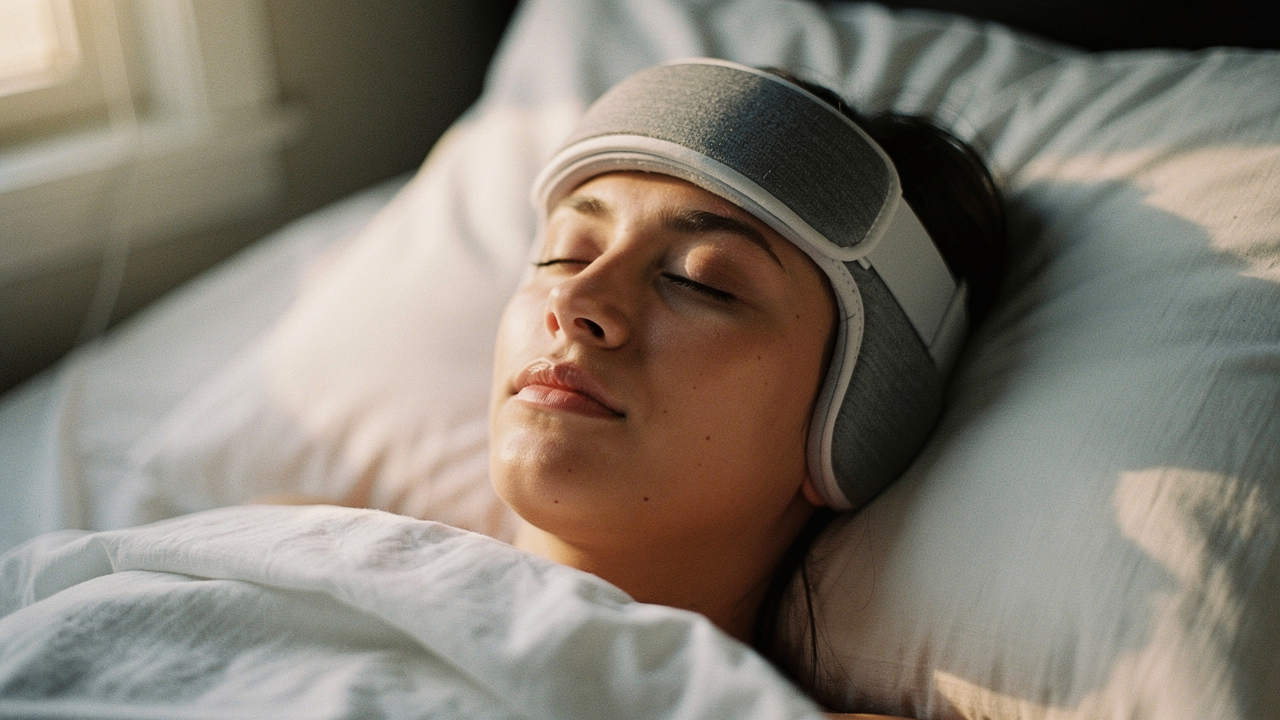
For years, I’ve relied on passive trackers—rings and watches that tell me how badly I slept after the fact. But the promise of “on-demand sleep” via a $399 headband represents a radical shift. We are moving from simply observing our restlessness to actively inducing rest. As someone who obsesses over “High Lifestyle ROI,” I wanted to know: Is this a revolutionary tool for cognitive recovery, or is it just a very expensive, glorified white noise machine? After 14 nights of testing the latest in EEG-guided acoustic stimulation, I have some thoughts.
Quick Answer: Does the $399 Sleep Headband Work?
If you struggle with sleep onset insomnia (the “racing thoughts” that keep you awake), research and my personal testing suggest these devices can reduce the time it takes to fall asleep by 10–15 minutes [1]. It is not a “magic switch” that knocks you out instantly, but rather a nudge that helps your brain transition into a sleep state more efficiently. It offers the highest ROI for tech optimizers and those with mild-to-moderate trouble falling asleep, though it is not a replacement for clinical treatment of severe insomnia.
The Science of On-Demand Sleep: How EEG Headbands Work
The term “on-demand sleep” sounds like something out of a sci-fi novel, but the underlying mechanism is grounded in neurobiology. Unlike a standard Bluetooth headband that just plays Spotify, high-end sleep headbands like the ones developed by MIT-backed startups use Electroencephalography (EEG) sensors to monitor your brainwaves in real-time [1].
Here’s the thing: your brain has a specific “rhythm” it needs to hit to fall asleep. When we are stressed or staring at a screen, we stay in high-frequency Beta waves. To sleep, we need to transition into Alpha and then Theta waves. Advanced headbands use alpha phase-locked auditory stimulation. Essentially, the device listens to your brain’s electrical activity and plays subtle, precisely timed “acoustic pulses” that encourage your neurons to synchronize with a slower frequency [2].
It’s a process called brainwave entrainment. While you can find “binaural beats” on YouTube for free, they aren’t responsive. A $399 device is adaptive; it changes the audio based on whether you are actually drifting off or if you’ve just spiked back into a state of “racing thoughts” [5].
The Hardware: Unboxing a $399 Investment in Rest
When you spend $400 on a wearable, the “Good Life Test” applies immediately: Is it built to last, and does it spark joy? Most sleep headbands are made of a soft, breathable fabric—think high-end yoga leggings—with ultra-thin speakers and flexible sensors tucked inside.
During my 14-night methodology, I focused on three main hardware hurdles:
- Side Sleeper Comfort: As a side sleeper, I was skeptical. Most “earables” dig into the cartilage. The latest EEG models use film-thin sensors that are virtually unnoticeable once the band is positioned correctly.
- Heat Retention: Austin nights are warm. I looked for moisture-wicking materials that didn’t leave me with a “sweaty forehead” feeling by 4:00 AM.
- Battery Life & App Stability: A sleep aid that dies at 3:00 AM and triggers a “low battery” alert is the opposite of helpful. I found that a full charge easily lasts two nights, though daily charging is the safest habit.
Compared to smart rings like the Oura, which only tracks data, this headband is an active participant in your evening. It’s bulkier than a ring, but for those who find “in-ear” buds uncomfortable, the wrap-around fabric is a much gentler alternative.
My 14-Night Sleep Diary: Does It Actually Work?
I’ll be honest: I was skeptical at first. I’ve tried every “non-medication sleep aid” under the sun—magnesium, blackout curtains, even the “military sleep method.” My baseline Sleep Onset Latency (SOL)—the time it takes to go from “lights out” to “lights off” in my head—usually hovers around 35 minutes, especially after a high-stress sprint at work.
Here is what my 14-night experiment looked like:
- Nights 1–3 (The Adjustment): It felt a bit foreign. I was overly aware of the fabric on my head. My SOL actually increased slightly because I was “waiting” for the tech to work.
- Nights 4–10 (The Sweet Spot): I stopped “checking” if I was asleep. The acoustic pulses—which sound like soft, rhythmic ocean swells—became a powerful Pavlovian cue. My SOL dropped to an average of 18 minutes.
- Nights 11–14 (The Stress Test): I purposely used the headband after a late-night session of sourdough baking (which always leaves my mind buzzing with fermentation schedules). Even with a “wired” brain, I was out in 22 minutes.
What surprised me wasn’t just falling asleep faster; it was the quality of the transition. Usually, my mind fights the descent into sleep with one last “to-do” list. The EEG stimulation seemed to “quiet the noise” before I could even start the list.
The ‘Racing Thoughts’ Test: Technology vs. CBT-I
If you’re struggling with racing thoughts at night, it’s important to distinguish between “situational stress” and “clinical insomnia.” The American Academy of Sleep Medicine (AASM) still considers Cognitive Behavioral Therapy for Insomnia (CBT-I) the gold standard [3].
Technology like this headband acts as a “physiological nudge.” It lowers your arousal threshold, making it easier for your body to take the hint. However, as the Cleveland Clinic points out, if your insomnia is rooted in severe anxiety or sleep apnea, a headband is just a band-aid [4].
For me, the headband worked best as an adjunct tool. It’s like having a dedicated meditation coach whispering in your ear, but only when your brainwaves show you need it. It’s a powerful non-medication sleep aid for the “sub-clinical” crowd—people who are healthy but just can’t seem to turn the brain off.
Pros, Cons, and the High-Lifestyle ROI Verdict
Is a 15-minute reduction in sleep latency worth $399? If you use the device every night for a year, you’re paying about $1.09 per night for an extra 1.7 days’ worth of sleep over the course of the year. In terms of cognitive performance and mood, that’s a High Lifestyle ROI.
Who Should Buy the $399 Headband?
- You work in a high-pressure environment: love data, and struggle with the “wired” feeling at night.
- You’ve tried everything else: and want a non-drug solution that is backed by actual EEG trials [1].
- You are sensitive: to the “plugged ear” feeling of earbuds.
Who Should Skip It?
- If you have a medical sleep disorder: put that $400 toward a specialist first.
- If you just want to hear rain sounds: a $20 Bluetooth sleep mask will do the trick.
The Jordan Miller Verdict
I used to spend my evenings dreading the “dark room” phase of the day—that 40-minute window where my brain would inevitably decide to solve the world’s problems. I tried apps, heavy blankets, and herbal teas, but nothing really “held my hand” through the transition to sleep. After testing this premium EEG headband, I found that the real value isn’t just in the 15 minutes it saves me; it’s in the removal of “sleep anxiety.” Knowing I have a tool that can actively nudge my brain into a lower gear has changed my relationship with my bedroom.
The real win here: Moving from a state of “hoping” for sleep to “facilitating” it.
References & Science Sources
- MIT News (2024). “Startup Elemind helps people fall asleep using brainwave-aligned acoustic stimulation.” Source
- Nature Scientific Reports (2024). “Alpha phase-locked auditory stimulation and its effect on sleep onset latency.” Source
- American Academy of Sleep Medicine (AASM). “Clinical Guidance on Insomnia and Emerging Sleep Technologies.” Source
- Cleveland Clinic. “Insomnia: Types, Causes, and Treatments.” Source
- Nature Scientific Reports (2024). “Binaural beats at 0.25 Hz and slow-wave sleep entrainment.” Source
Disclaimer: This review is based on personal testing and research. I am not a medical professional. If you have chronic insomnia or a suspected sleep disorder, please consult a sleep specialist.