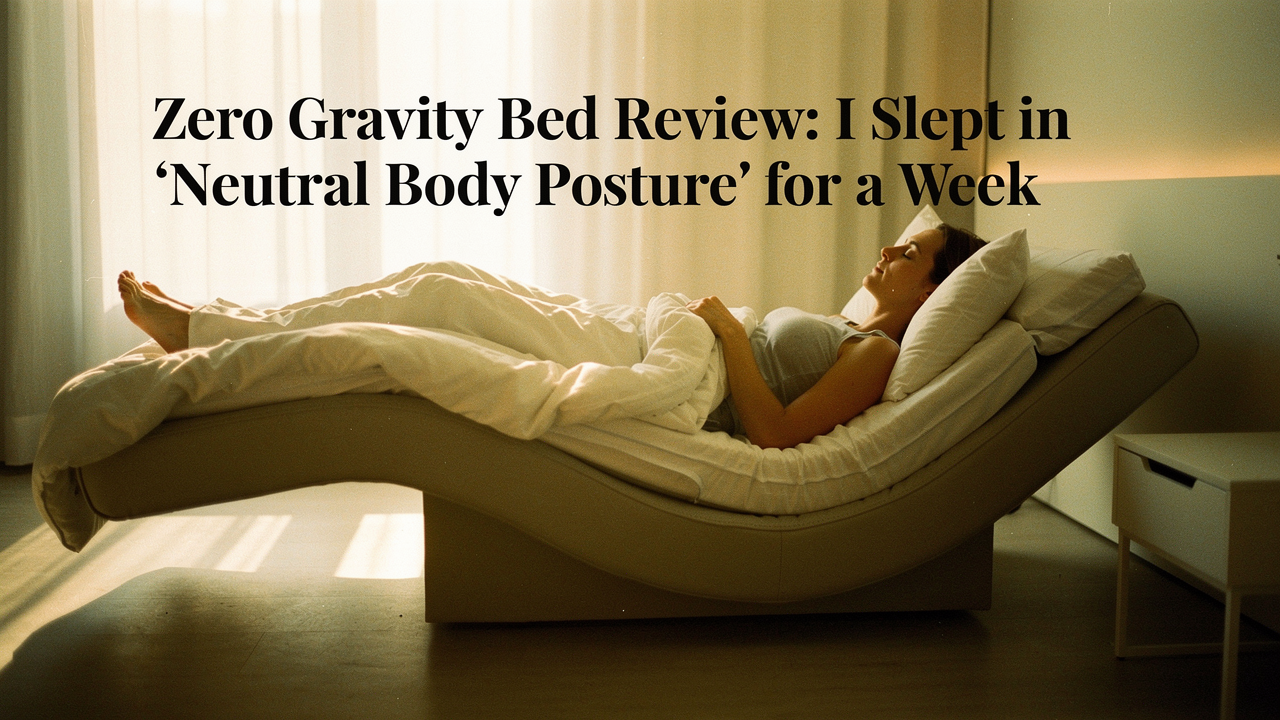
Recently, while researching home optimization tools with a High Lifestyle ROI, I kept running into the term “Zero Gravity.” It sounds like something out of a SpaceX press release, but it’s actually a standard preset on most modern adjustable bed frames. The claim? That by mimicking the posture astronauts assume during liftoff, you can virtually eliminate pressure point pain and revolutionize your sleep quality.
I’m a skeptic by nature, especially when marketing terms borrow from NASA, but the biomechanics peaked my interest. I decided to swap my standard platform bed for an adjustable base and commit to seven nights of sleeping exclusively in the “Zero-G” position. Here is what happened when I stopped fighting gravity and started working with it.
The Science of Zero Gravity: More Than Just a Marketing Button
Before I pressed the button on my remote, I wanted to know if this was just a fancy way to sit up in bed. It turns out “Zero Gravity” is rooted in NASA’s research into Neutral Body Posture (NBP) [1]. When NASA scientists observed how the human body naturally positions itself in microgravity—specifically during the Skylab missions—they found that the body doesn’t stay flat. Instead, the joints naturally migrate to a mid-range position where the muscles are at their most relaxed.
In a bed, the Zero-G position aims to replicate this by elevating the head and the knees slightly above the heart level. This creates an approximate 120-degree angle at the hips. Biomechanically, this does something fascinating: it redistributes your weight across the entire surface of the mattress rather than concentrating it on your hips and shoulders [2]. By offloading the spine and allowing the heart to pump blood more easily to the extremities, you’re essentially giving your nervous system a “reset” signal.
My 7-Day Zero Gravity Experiment: The Log
To keep this experiment grounded, I tracked my sleep using my wearable data (Oura) and kept a subjective journal of my morning “stiffness score” on a scale of 1 to 10.
Nights 1-3: The Adjustment Phase
I’ll be honest: the first night was bizarre. As a lifelong side sleeper, being forced onto my back felt vulnerable and unnatural. I felt like I was sleeping in a very expensive lounge chair. However, about twenty minutes in, I felt a distinct “release” in my lumbar spine. It’s a sensation I usually only get during a long Savasana in yoga class.
The challenge was the habit of turning. I woke up twice on Night 2 trying to roll onto my side, only to realize my knees were elevated, making side-sleeping impossible. By Night 3, however, the “sleep discomfort” of being on my back started to fade as my body realized it didn’t need to move to find a comfortable spot.
Nights 4-7: The Breakthrough
By the fourth morning, I noticed something significant: my “stiffness score” dropped from a 6 to a 2. Usually, after a trail run, I spend the first ten minutes of my day doing cat-cow stretches just to feel human. On Day 5, I rolled out of bed and went straight to the kitchen to make coffee without a single “ugh” from my lower back.
What surprised me most was my sleep efficiency. My wearable data showed a 15% decrease in “wake after sleep onset” (WASO). Because the position was preventing me from tossing and turning, I was staying in deep sleep stages longer. By the final night, the Zero-G position didn’t feel like a medical setting—it felt like a weightless cocoon.
Who is Zero-G Actually For? (Problem-Solution Map)
While I loved it for recovery, Zero-G isn’t a one-size-fits-all miracle. Based on my research and experience, it serves very specific needs.
For the Back Pain Sufferer
If you struggle with lower back stiffness or sciatica, the flat-bed life is likely your enemy. Sleeping flat causes the hip flexors to pull on the lumbar spine, creating an arch that leads to morning pain. By elevating the knees, you flatten that arch against the mattress. Johns Hopkins Medicine emphasizes that non-surgical back pain management often starts with these types of postural adjustments to reduce spinal loading [3].
For the “Acid Reflux” and Snorer Crowd
If you or your partner sounds like a freight train at 2 AM, this feature is a game-changer. Elevating the head keeps the airway open and uses gravity to keep stomach acid where it belongs. The Mayo Clinic specifically suggests a 6-inch head elevation for managing GERD [4], and many find that the Zero-G preset hits this mark perfectly.
A Note on Sleep Apnea: While elevation helps with simple snoring, it is not a cure for Obstructive Sleep Apnea. If you’re gasping for air at night, please consult a sleep specialist—an adjustable bed is a comfort tool, not a replacement for a CPAP machine [6].
The Adjustable Bed Frame Buyer’s Checklist
If you’re ready to stop stacking pillows and start using a motor, here’s how to ensure you get a High Lifestyle ROI on your purchase.
I spent years thinking my mattress was the problem, but it was actually the flat foundation underneath it that was failing me. When I finally decided to upgrade, I looked for something that felt like a piece of furniture, not a hospital bed. I discovered the Saatva Adjustable Base Plus after a lot of late-night forum reading, and it immediately stood out because it didn’t just move up and down—it had a “wall-hugging” feature that kept my nightstand within reach even when the head was elevated. The motor is whisper-quiet, which was a huge relief because I didn’t want to wake up the whole house just to adjust my posture at 3 AM.
Micro-Verdict: The ultimate luxury upgrade for those who want professional-grade recovery without the “medical” aesthetic.
On the other hand, I know that for many of my friends in Austin, dropping several thousand dollars on a bed frame feels like a stretch when you’re also trying to save for a house. I started looking for a “entry-level” option that still offered a dedicated Zero-G button, which led me to the Nectar model. It’s a more straightforward, “no-frills” design, but the build quality surprised me; it’s sturdy enough to handle two people and a 70-pound Golden Retriever without creaking. It proves you don’t need a five-figure budget to stop waking up with a sore neck.
Micro-Verdict: The best value-for-money entry point into the world of weightless sleep.
Persona Loadout: Which Setup Do You Need?
- The Athlete Recovery Setup: An adjustable base with massage features (to boost circulation) paired with a high-density copper-infused memory foam mattress.
- The “Reflux Relief” Minimalist: A basic adjustable frame with a dedicated 6-inch head tilt and a hybrid mattress that offers edge support.
- The Luxury Suite: A split-king adjustable base (so you and your partner can choose different angles) with integrated under-bed lighting and USB ports.
Wait, Will My Current Mattress Work?
Here’s the thing: not all mattresses are built for “the bend.”
- Memory Foam: These are the gold standard for adjustable beds. They are naturally flexible and maintain their integrity when folded.
- Hybrids: Most modern hybrids with pocketed coils work beautifully.
- Traditional Innerspring: Be careful here. Old-school “interconnected” coils can’t bend and will likely be ruined if you try to use them on an adjustable base.
The Drawbacks: It’s Not All Weightless Bliss
I want to be honest with you—this isn’t a perfect solution for everyone. Here are the “hidden” annoyances I discovered during my week:
- The Side-Sleeper Struggle: If you absolutely cannot fall asleep on your back, Zero-G will feel like a cage. While you can use the head-tilt alone for side sleeping, the full Zero-G position is strictly for back sleepers.
- The Bedding Battle: When the bed articulates, your fitted sheets will want to pop off the corners. You’ll need to invest in “deep pocket” sheets or sheet suspenders.
- The “Wall-Hugging” Issue: Lower-end frames often move you away from your nightstand as they lift you up. If you like to reach for your water or a book, make sure you look for a “wall-hugger” design.
The Final Verdict
Is an adjustable bed with Zero-G a High Lifestyle ROI purchase? For me, the answer is a resounding yes. While it didn’t “cure” my life, it fundamentally changed the way I recover from my active days in Austin.
The real win isn’t the fancy motor; it’s the fact that I no longer wake up at 4 AM to fight with my pillows. If you’re tired of the “morning gears” and want a science-backed way to offload your spine, this is one of the most impactful home upgrades you can make. Just be prepared to become a back-sleeper—the weightlessness is worth the transition.
Disclaimer: I am an optimization enthusiast and lifestyle curator, not a medical professional. The information in this article is based on my personal experience and research. Always consult with a physician or physical therapist before making significant changes to your sleep environment to treat medical conditions like chronic back pain or sleep apnea.
References & Research
- NASA (2024). The Concept of Neutral Body Posture (NBP). NASA Technical Reports Server.
- UCLA Health (2025). How Microgravity and Simulated Positions Affect Spinal Load. UCLA Health Science Review.
- Johns Hopkins Medicine (2025). 7 Ways to Treat Chronic Back Pain Without Surgery. [3]
- Mayo Clinic (2024). GERD Management: Lifestyle and Home Remedies. [4]
- Cleveland Clinic (2025). Edema and Circulation: The Role of Elevation. [5]
- American Academy of Sleep Medicine (AASM) (2025). Positioning and Sleep Apnea: What Patients Need to Know. [6]