=
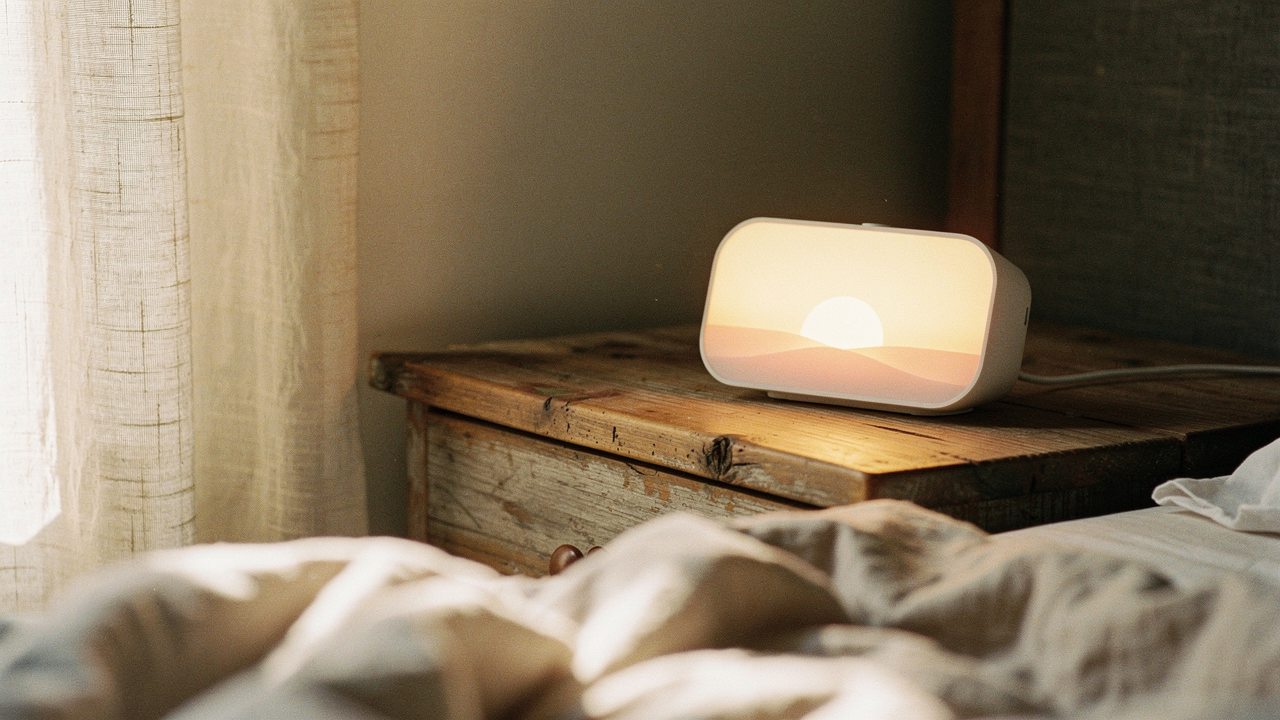
We often think of that grogginess as a personal failing or a lack of caffeine. But in the sleep science world, it has a name: sleep inertia. It’s that heavy, disoriented feeling that occurs during the transition from sleep to wakefulness, and for many of us, it can linger for hours, sabotaging our focus before the workday even begins [1].
I realized that if I wanted a high “lifestyle ROI”—where my environment actually supports my goals—I had to stop treating my wake-up call like an emergency. I needed a “Smart Sleep Hub.” Over the last year, I’ve swapped the phone-induced panic for a protocol rooted in light, sound, and intentional routines. Here is how you can use a smart alarm clock to bridge the gap between restorative rest and peak daytime focus.
The Biology of the ‘Morning Fog’: Why Traditional Alarms Fail
If you struggle to peel yourself off the mattress, you’re in good company. A National Sleep Foundation survey found that 35% of American adults rate their sleep quality as “poor” or “fair” [2]. But the problem often isn’t just the quantity of sleep; it’s the method of waking.
Traditional alarms are designed to be intrusive. They disrupt your sleep cycle mid-stream, often pulling you out of a deep REM state. This sudden shift triggers a stress response, but it does nothing to clear the adenosine—the chemical responsible for sleep pressure—from your brain. This is why you can sleep for eight hours and still feel like you’ve been hit by a truck.
Harvard Health notes that chronic sleep disruption doesn’t just make you grumpy; it’s linked to long-term health issues like hypertension and metabolic dysfunction [3]. When we use our phones as alarms, we compound this biological stress with a psychological one.
The Phone Trap: Why Your Bedside Device is Killing Your Rest
I used to justify having my phone on the nightstand because “I need the alarm.” But here’s the thing: your phone is a slot machine, not a wellness tool.
The blue light emitted by screens suppresses melatonin production, making it harder to fall into that deep, restorative sleep in the first place. More importantly, checking your notifications the second you wake up forces your brain to skip the “theta” (creative/relaxed) and “alpha” (focused/calm) states, jumping straight into high-beta stress. By the time you’ve finished your first cup of coffee, your mental energy is already depleted from reacting to everyone else’s priorities.
The Solution: Dawn Simulation and the Science of Gentle Waking
The game changed for me when I discovered dawn simulation. Instead of a sudden noise, a wake-up light gradually increases in intensity over 20 to 30 minutes before your alarm goes off.
This mimics a natural sunrise, sending a signal through your eyelids to your brain’s suprachiasmatic nucleus (the master clock) that it’s time to start suppressed melatonin and start producing cortisol. Research shows that gradual light exposure can significantly reduce the duration and severity of sleep inertia [4].
Furthermore, the type of sound matters. Studies suggest that low-pitch, melodic alarms or gradual nature sounds are far more effective at aiding a full awakening than high-frequency “beeps” which can actually worsen that initial grogginess.
Protocol: How to Configure Your Sunrise Lamp
I’ve experimented with dozens of settings, and here is my personal “Austin Sunrise” protocol for maximum ROI:
- Duration: Set your light ramp-up for 30 minutes. This gives your body enough time to transition through sleep stages.
- Starting Intensity: If your clock allows it, start at 5% or 10% brightness with a warm red/amber hue. This is less jarring than a bright white light hitting you at 0 minutes.
- The “Safety” Sound: Set a gentle bird chirp or soft piano melody to reach its peak volume right at your official “must-be-up” time.
Beyond Waking: Using Light Therapy for Daytime Focus
The benefits of a smart alarm shouldn’t stop once you’ve kicked off the covers. There is a profound link between morning light exposure and how well you can concentrate at 2:00 PM.
While a sunrise alarm uses lower lux levels (typically 300-500) to wake you up, clinical light therapy usually requires about 10,000 lux to treat things like Seasonal Affective Disorder (SAD) or significant circadian misalignments. However, even the “softer” light from a smart clock helps set your clock for the next night.
A 2024 meta-analysis published in Nature Scientific Reports found that consistent light therapy protocols improved total sleep time by an average of 32 minutes in shift workers [5]. When you sleep better and wake up more naturally, your prefrontal cortex—the part of the brain responsible for “deep work” and focus—is significantly more resilient against distractions throughout the day.
Note: If you have bipolar disorder or certain eye conditions, please consult a doctor before starting a high-intensity light therapy regimen, as bright light can occasionally trigger manic episodes or eye strain.
The Best Smart Alarm Clocks for Every Persona
Choosing the right device depends on your specific struggle. Do you need sound masking to drown out street noise? Or are you a digital minimalist who wants to banish screens entirely?
The All-Rounder: Hatch Restore 2
I’ll be honest: I was skeptical about the “wellness lamp” hype until I actually used the Hatch. I struggled for years with a “racing mind” at night, and what finally clicked for me wasn’t just the wake-up light, but the “Wind Down” routine. It walks you through a customized sequence—like a rain soundscape followed by a guided breathing exercise—that signals to your brain that the day is over. The aesthetic is beautiful (it looks like a linen-covered pebble), and the sunrise colors are the most realistic I’ve tested.
Micro-Verdict: The ultimate “Sleep Hub” for anyone who needs a structured routine to shut their brain off.

The Minimalist: Loftie Clock
Here’s the thing about Loftie: it doesn’t have a sunrise light. For a long time, I thought that was a dealbreaker. But what I found was that for people who are genuinely addicted to their phones, Loftie is the “rehab” they need. It uses a two-phase alarm system: a gentle “wake-up” sound to nudge you out of sleep, followed by a “get-up” sound nine minutes later. The focus here is on high-quality audio, including some of the best white noise and focus soundscapes I’ve ever heard from a small speaker.
Micro-Verdict: Best for the digital minimalist who wants to leave their phone in the kitchen and never look back.

The Budget Pick: Dreamegg Sunrise 1
You know that feeling when you want the benefits of a sunrise alarm but don’t want to spend $200? I discovered the Dreamegg when I was looking for a solution for a friend living in a noisy downtown apartment. What surprised me was the sheer variety of sounds—29 different options, including excellent white and brown noise for masking traffic. It’s a bit more “plastic” than the Hatch, but the functionality is surprisingly robust for the price.
Micro-Verdict: The best value for apartment dwellers who need both light therapy and heavy-duty sound masking.

Persona Loadouts: Which Stack is Yours?
To help you decide, here is how I’d build the perfect bedside setup based on your lifestyle:
The High-Performance Professional
You have a demanding job and need your brain to be “on” from the moment you hit your desk.
- Essential: Hatch Restore 2 (set for a 30-minute sunrise)
- Essential: A “No Phones in Bedroom” policy
- Pro Upgrade: 10 minutes of direct sunlight exposure within 30 minutes of waking
The Apartment Dweller / Light Sleeper
You’re frequently woken up by neighbors, sirens, or the early Austin sun.
- Essential: Dreamegg Sunrise 1 for consistent sound masking
- Essential: Blackout curtains (paired with the sunrise alarm to control your “sun”)
- Pro Upgrade: A weighted eye mask for the middle of the night
The Digital Minimalist
You feel overwhelmed by apps and want a bedroom that feels like a sanctuary.
- Essential: Loftie Clock for phone-free alarms
- Essential: An analog journal on the nightstand
- Pro Upgrade: A dimmable amber reading light (no blue light)
The ‘Focus Stack’: Integrating Soundscapes into Your Workday
What surprised me most about these smart clocks was how the sounds I used to fall asleep could be repurposed for productivity.
Many of these devices (especially the Loftie and Hatch) offer generative soundscapes. Unlike a static white noise loop, these sounds shift subtly over time, which prevents the brain from “tuning them out.” There is some fascinating research from companies like Endel suggesting that personalized soundscapes can lead to a significant increase in sustained focus [6].
While I’m always a bit of a “skeptical geek” when it comes to “7x focus” claims, I can tell you from my own experience: using a consistent “Focus Sound” (like brown noise or a deep forest soundscape) creates a Pavlovian response. When I hear that specific frequency, my brain knows it’s time to write, not to scroll.
Reclaiming Your First Hour
The “High Lifestyle ROI” of a smart alarm clock isn’t just about waking up; it’s about what you do with the time you’ve reclaimed. When you eliminate the 45-minute “snooze and scroll” cycle, you gain nearly five hours of focused time back every single week.
My advice? Pick one device that fits your budget and your biggest pain point. Commit to leaving your phone in another room for just seven days. Use the dawn simulation to wake up, and spend those first ten minutes in the “natural” light of your clock rather than the “artificial” stress of your inbox.
Better focus doesn’t start with a new app or a third cup of coffee. It starts the night before, with a space that actually supports the life you’re trying to build.
Join my newsletter for more ‘High Lifestyle ROI’ gear tests and Austin-based wellness tips.
Disclaimers:
This review includes affiliate links; I may earn a small commission if you purchase through them at no extra cost to you. I am not a medical professional; these devices are lifestyle tools designed for sleep hygiene and are not intended to diagnose or treat medical conditions like sleep apnea or clinical insomnia.
Scientific References & Sources
- Sleep Foundation (2023). “Sleep Inertia: Symptoms, Causes, and Tips.” https://www.sleepfoundation.org/how-sleep-works/sleep-inertia
- National Sleep Foundation (2014). “Sleep Quality in America: Survey Results.”
- Harvard Health Publishing (2021). “8 Reasons Why You’re Not Sleeping.” https://www.health.harvard.edu/sleep/8-reasons-why-youre-not-sleeping
- Chang, A. M., et al. (2012). “Human responses to bright light of different durations.” Journal of Physiology.
- Nature Scientific Reports (2024). “Light therapy for shift workers’ sleep: A systematic review and meta-analysis.” https://www.nature.com/articles/s41598-024-83789-3
- Harvard Health (2018). “Focus on concentration: Mindfulness and attention.” https://www.health.harvard.edu/mind-and-mood/focus-on-concentration