=
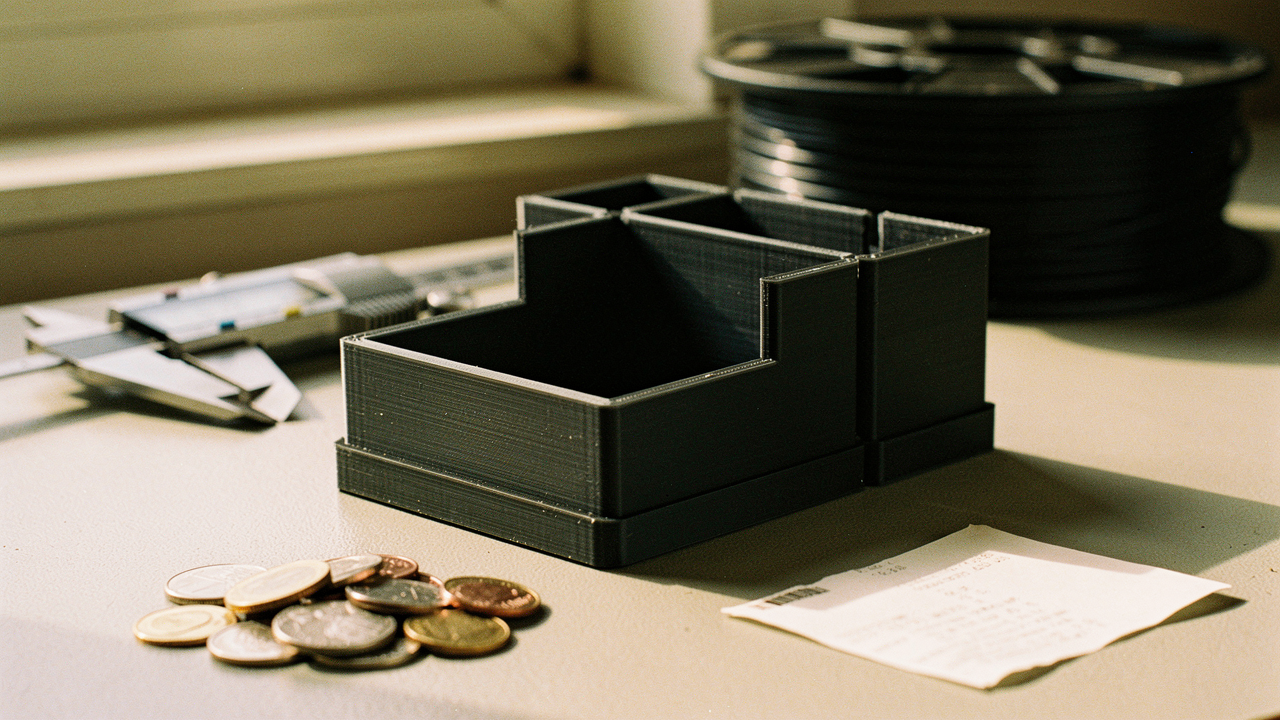
That’s when I turned to my 3D printer. What started as a Saturday afternoon experiment turned into a complete workspace overhaul that saved me exactly $62.40 compared to my Amazon wishlist. More importantly, it gave me a desk that finally feels intentional.
Quick Answer: Is 3D printing desk organizers worth it?
Yes. While a store-bought desk set can cost between $40 and $80, a custom 3D-printed system costs roughly $5 to $10 in filament. By using open-source ecosystems like Gridfinity, you gain a professional, modular setup that fits your specific tools (and your specific desk) for about 10% of the retail price.
The Real Cost of Desk Organization: Why Retail Plastic Fails
Here’s the thing about store-bought organizers: they are designed for the “average” person, but none of us have an average life. My desk has to hold everything from sourdough scoring knives to my trail running GPS, and standard dividers just don’t have a spot for those specific items.
Beyond the fit, the price of these items is often inflated. Research into office supply pricing shows that individual trays and specialized organizers at major retailers like Target or Staples can range from $5 to $50 per piece [5]. When you need five or six pieces to truly tidy a drawer, you’re looking at a $100 bill for what is essentially molded plastic. Architectural Digest often highlights how “custom” organization is the gold standard for a calm environment, but those solutions usually involve high-end designer fees or bespoke carpentry [1].
The ‘Amazon-Target’ Trap: When $10 Add-Ons Add Up
I used to justify these purchases by saying, “It’s only ten dollars.” But those “ten dollars” happen five times.
- The Pen Cup: $8.00 at retail vs. $0.60 in filament
- The Drawer Divider Set: $24.00 at retail vs. $2.10 in filament
- The Cable Management Box: $18.00 at retail vs. $1.80 in filament
- The Phone Stand: $12.00 at retail vs. $0.45 in filament
When I tallied up the “pro-grade” versions of what I wanted, the total was hovering near $80. In my Austin tech-garage mindset, that’s a low-ROI move. I knew I could do better.
The $60 Savings Math: 3D Printing ROI Explained
To understand the savings, we have to look at the “ROI of the Maker.” If you already own a 3D printer, your only recurring cost is filament. A standard 1kg spool of PLA (the most common 3D printing plastic) costs about $20.
Using the Markforged ROI framework—which is typically used for industrial manufacturing but works beautifully for home optimization—we see that 3D printing becomes incredibly cost-effective as the number of distinct parts increases [3]. Instead of paying for a company’s shipping, marketing, and retail markup, you are only paying for the raw material.
For example, a standard 3D-printed pen holder uses about 50g of filament. At $20 a spool, that holder costs you exactly $1.00. Compare that to a $12 mesh cup from a big-box store, and you’ve already “earned” back $11 of your printer’s cost. SlashGear identifies drawer organizers and cable clips as some of the highest-return items you can print because they use so little material but carry high retail markups [10].
The Best 3D Printed Systems: Finding Your Perfect Ecosystem
What surprised me most was that I didn’t have to design everything myself. The 3D printing community has created entire “ecosystems” that work like Lego sets for adults.
Gridfinity: The Ultimate Drawer Logic
The real game-changer for me was Gridfinity. Created by Zack Freedman, this is a community-validated modular standard where everything sits on a baseplate grid. If you move to a new desk, you just move the bins. If you get a new camera, you print a bin specifically for those batteries. It turns your drawer into a high-efficiency machine where nothing slides around.
Honeycomb Storage Walls: Taking Organization Vertical
If your desk surface is small, you have to go up. The Honeycomb Storage Wall (HSW) is a modular system that mounts to your wall. XDA Developers noted in a recent case study that vertical storage like this is what finally solved their “desk chaos” by keeping gadgets off the workspace but within arm’s reach [2].
The Minimalist Remote Worker (Small Spaces)
If you’re working from a corner of your living room, you need high-impact, low-footprint items:
- Essential: A Gridfinity 4×4 baseplate for your most-used pens and SD cards
- Essential: An under-desk “hidden” drawer for your hard drive
- Essential: A vertical laptop stand to save 60% of your desk real estate
- Pro Upgrade: A custom-printed mount for your specific USB-C hub
Step-by-Step: Printing Your Way to a Tidy Desk
I’ll admit, I was skeptical about the “plastic” look at first. I didn’t want my office to look like a science lab. What finally clicked for me was discovering matte filaments. They give the prints a soft, designer aesthetic that hides the 3D-printed layer lines and looks much more like high-end boutique decor than cheap plastic.
Let me be honest: the secret to these organizers lasting is in the settings. For items like monitor risers or headphone hooks, I’ve found that using a 15-20% Gyroid infill is the sweet spot. It provides incredible structural strength without wasting filament.
Here’s the thing about 3D printing: the first layer is everything. I struggled with my prints peeling off the bed until I started using a simple brim on larger, flat pieces like drawer trays. All3DP recommends this specifically for organizers to ensure the corners don’t warp during the long print times [4].
I ignored the “clutter” in my tech drawer for years because the thought of buying 20 different little boxes was exhausting. But once I found the right tool, it became a fun weekend project rather than a chore.
What sold me on this specific printer was the “set it and forget it” reliability. I don’t have time to tinker for hours; I just want my organizers to exist. It’s compact enough for an Austin apartment but fast enough to knock out a whole drawer’s worth of Gridfinity bins in a single evening.
Micro-Verdict: The ultimate high-ROI tool for anyone who values a perfectly tailored, organized workspace.


Retail vs. 3D Printed: A Side-by-Side Comparison
To give you a clear picture of the “Good Life Test” applied to these items, I’ve broken down the costs of a typical setup.
| Item | Retail Price (Approx.) | Filament Cost | Savings | Customization |
|---|---|---|---|---|
| Large Drawer Divider Set | $25.00 | $2.50 | $22.50 | Perfect fit to drawer mm |
| Headphone Desk Hook | $15.00 | $0.80 | $14.20 | Matches desk thickness |
| Cable Management Clips (10pk) | $10.00 | $0.30 | $9.70 | Fits specific cable widths |
| Phone/Tablet Stand | $12.00 | $0.60 | $11.40 | Specific angle for your eye level |
| Total | $62.00 | $4.20 | $57.80 | — |
Note: Electricity costs average roughly $0.15 per 10-hour print, which I’ve factored into the “Filament Cost” logic.
Making Every Day a Little Better
At the end of the day, saving $60 is great, but the real win is the feeling of sitting down at a desk that was built for you. When my environment supports me—when I know exactly where my sourdough thermometer is and where my favorite pen lives—everything else in my day just flows better.
If you’re feeling overwhelmed by the mess, don’t try to print the whole world in one day. Start with one drawer. Download a baseplate, print three bins, and see how it feels. I think you’ll find, like I did, that the “High Lifestyle ROI” of a custom space is worth every second of print time.
Disclaimer: This post contains affiliate links for 3D printers and materials I personally use in my Austin home office. These recommendations help support “Best Goods for Good Life” at no extra cost to you.
References
- Architectural Digest. (2024). Desk Organization Ideas: How to Maximize Your Workspace. https://www.architecturaldigest.com/story/desk-organization-ideas
- XDA Developers. (2023). 3D Printed Organizers That Actually Solved My Desk Chaos. https://www.xda-developers.com/3d-printed-organizers-that-actually-solved-my-desk-chaos/
- Markforged. (2022). The Economics of 3D Printing: ROI Frameworks. https://markforged.com/resources/blog/economics-of-3d-printing
- All3DP. (2024). Best 3D Printed Desk Organizers: 2024 Guide. https://all3dp.com/2/3d-printed-desk-organizers/
- Target. (2024). Desk Accessories & Office Supplies Collection. https://www.target.com/c/desk-accessories-office-supplies-school/-/N-5xtnz
- SlashGear. (2023). 10 Things 3D Printing Can Save You Money On. https://www.slashgear.com/2086064/3d-print-things-can-save-money/