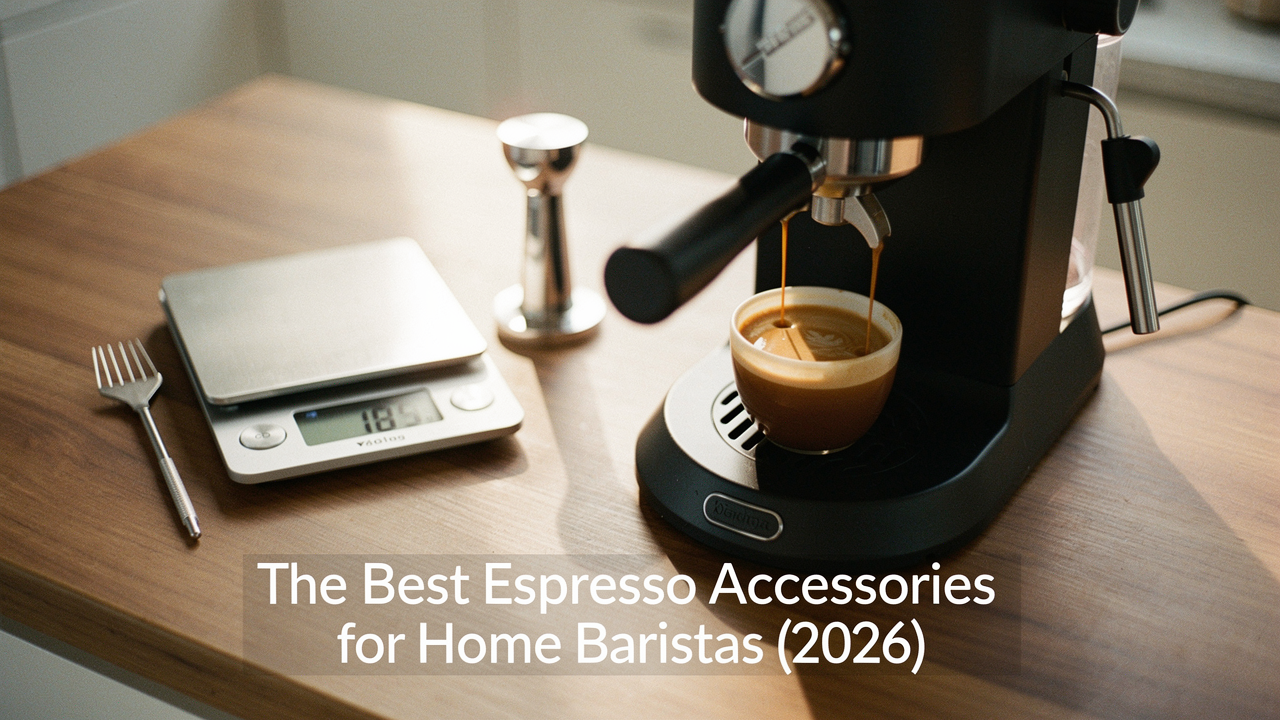
Here’s the thing: your machine is the heart of the operation, but it’s the “support staff”—the accessories—that actually determine the quality of your life (and your caffeine). I spent years thinking I needed a better grinder or a $5,000 dual-boiler to fix my shots. What I actually needed was a repeatable workflow.
In this guide, we’re going to look at the high lifestyle ROI tools that bridge the gap between “frustrated beginner” and “neighborhood legend.” These are the precision instruments that turn coffee making from a guessing game into a ritual of pure joy.
The Consistency Crisis: Why Your Espresso Varies Daily
If you feel like you’re playing a game of Russian Roulette with your portafilter, you aren’t alone. Espresso is a game of variables. The Specialty Coffee Association (SCA) defines a balanced extraction as one that yields between 18% and 22% of the coffee’s soluble solids [1]. If you’re off by even a tiny margin in your dose or your tamping, you slide right out of that “sweet spot” and into the land of “too sour to drink.”
Most home baristas struggle with inconsistent espresso shots because they aren’t controlling the three pillars of extraction:
- Dose: Exactly how much coffee goes into the basket.
- Yield: Exactly how much liquid comes out.
- Distribution: How evenly the water flows through those grounds.
Without the right home barista equipment, you’re basically throwing darts in the dark. We use a 1:2 brew ratio as our “Gold Standard”—for every 18 grams of coffee in, we want 36 grams of espresso out in about 25–30 seconds. To hit that every single morning, we need precision.
The Puck Prep Revolution: Precision Tools for Better Extraction
Let’s talk about “Channeling.” It sounds like something from a sci-fi movie, but it’s actually the enemy of every home barista. Water is lazy; it wants to find the path of least resistance. If your coffee puck has tiny clumps or air pockets, the water will blast through those “channels,” leaving the rest of the coffee under-extracted [2]. The result? A shot that is somehow both bitter and sour at the same time.
WDT Tools & Dosing Funnels: The Mess-Free Secret
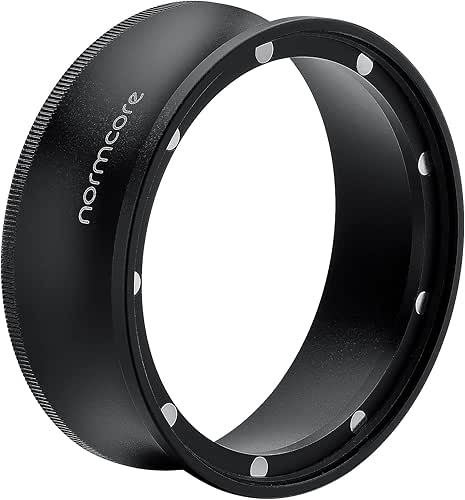
I used to start my mornings by wiping coffee grounds off every square inch of my counter. I thought a little mess was just the price of admission for “real” espresso. I tried tapping the portafilter, using my finger to level things out—it was messy, and my shots were still spraying everywhere. Then I discovered the “Weiss Distribution Technique” (WDT) and a simple magnetic funnel.
By using a tool with thin needles to stir the grounds before tamping, you break up every clump and ensure the density is uniform throughout the basket. It felt like a “pro” step I didn’t have time for, until I realized it actually saved me minutes of cleanup and the heartache of a wasted shot.
Micro-Verdict: The easiest way to stop “spraying” and start pulling beautiful, tiger-striped shots.

Precision Filter Baskets: Is the Upgrade Worth It?
What surprised me most in my journey was realizing that the basket that comes with your machine is likely its weakest link. Standard baskets often have inconsistent hole sizes—some are slightly larger, some are smaller—which creates an uneven flow of water.
I was skeptical that a piece of metal could make a $30 difference until I saw the technical documentation from VST. Their baskets are manufactured with a tolerance of ±0.02 mm [3]. When I finally swapped my stock basket for a precision one, the “blonding” (that pale, watery stream at the end of a shot) happened much later, and the sweetness of my Austin-roasted beans finally came through.
Micro-Verdict: A precision basket is the single most cost-effective hardware upgrade you can make for flavor clarity.
Weight Matters: The Case for 0.1g Accuracy
In the world of professional barista competitions, using a scale isn’t optional—it’s a requirement for every single shot [4]. At home, we often try to “eye it.” We think, “That looks like about two ounces.” But crema is deceptive; it’s mostly air.
Here’s the reality: a 0.5g variance in your dose can change a shot from “sweet and syrupy” to “tastes like vinegar.” To get a High Lifestyle ROI, you need a scale that responds instantly.
Best Budget Scale:
2026年8月29日 7:41 PM
-
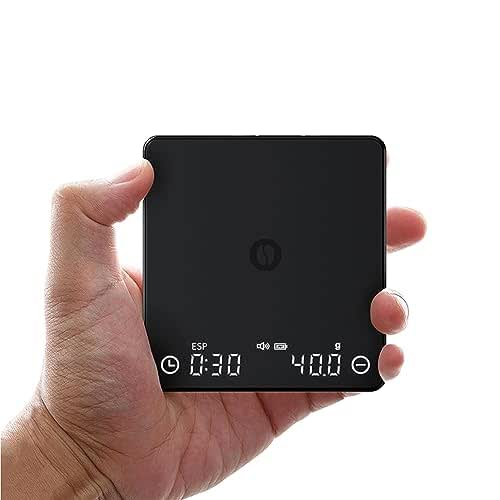
I’ll be honest: I ignored the need for a dedicated espresso scale for a long time, using a bulky kitchen scale that didn’t even fit under my portafilter. It was slow, and I’d often overshoot my yield by 5 or 6 grams before the display updated. I finally tried this compact, high-speed scale, and it changed my workflow overnight. It’s small enough to fit on the drip tray of even the tiniest machines and fast enough to catch the shot at the exact second it hits your target weight.
Micro-Verdict: High-end precision at a fraction of the cost of pro-sumer brands.
The Pro Pick:
If you’re the type of person who wants to buy the “forever” version of a tool, this is it. I’ve seen these scales survive being completely submerged in water and still function perfectly. What sold me wasn’t just the water resistance, but the flow-rate indicator. It shows you exactly how fast the espresso is flowing in real-time, which is the ultimate diagnostic tool for spotting channeling before you even taste the coffee.
Micro-Verdict: The gold standard for durability and data-driven espresso perfection.
Mastering the Steam: Professional Milk Tools
If your lattes look more like “soapy bubbles on top of coffee,” you’re likely struggling with difficult milk frothing. Getting that wet-paint microfoam texture requires two things: technique and the right geometry.
Barista Hustle teaches that milk steaming happens in two phases: “stretching” (adding air) and “texturing” (the whirlpool that integrates the bubbles) [2]. If your pitcher is the wrong shape, that whirlpool never happens, and you’re left with “stiff” foam that’s impossible to pour into a heart.
Pitcher Geometry: Why Spout Shape Matters
I struggled for years to pour a decent rosetta, blaming my hands and my machine’s steam power. I was using a cheap, blunt-spouted pitcher I found at a big-box store. When I switched to a pitcher with a tapered, sharp spout, I realized the tool was holding me back. The way the milk flows over the spout determines how much control you have over the design. This specific pitcher has a unique “rib” design that helps guide the milk into a perfect vortex, even on lower-power home machines.
Micro-Verdict: The “cheat code” for achieving professional-level latte art at home.
The 2026 Home Barista Upgrade Roadmap
You don’t need to buy everything at once. In fact, I recommend a tiered approach so you can actually taste the difference each tool makes.
The “Essentials” Kit (Under $150)
For the beginner who just bought their first machine and wants to stop pulling bad shots immediately.
- 0.1g Digital Scale: Essential for hitting your 1:2 brew ratio every time.
- Calibrated Tamper: Ensures you apply a consistent 30lbs of pressure without guessing.
- WDT Tool: The most affordable way to eliminate channeling and “spraying” shots.
- Dosing Funnel: Keeps your counter clean and ensures 100% of your dose actually makes it into the basket.
The “Prosumer” Setup
For the enthusiast who has the basics down and is looking for that extra 10% of flavor clarity and “God-shot” consistency.
- Precision Filter Basket (VST/IMS): Unlocks nuances in light-roast coffees that stock baskets miss.
- Acaia Lunar Scale: For water-resistant durability and flow-rate monitoring.
- Puck Screen: Keeps your group head clean and helps distribute water more gently across the puck.
- Professional Milk Pitcher: Specifically a sharp-spout version for detailed latte art.
Creating a space that supports your morning ritual is one of the best investments you can make. When your environment—and your tools—work with you, the coffee just tastes better. Start with a scale and a precision basket; they offer the highest “Lifestyle ROI” you’ll find in the world of espresso.
Stay caffeinated, and keep choosing better over more.
Affiliate Disclosure: I only recommend gear I’ve actually tested on my own Austin counter. If you buy through these links, I may earn a small commission at no extra cost to you. High lifestyle ROI, guaranteed.
References & Expert Sources
- Specialty Coffee Association (SCA). (2025). Espresso Brewing Standards and Extraction Guidelines. https://sca.coffee/research/coffee-standards
- Barista Hustle. (2024). The Physics of Channeling and Milk Texturing Science. https://www.baristahustle.com/education/
- VST Inc. (2023). Precision Filter Basket Technical Specifications and Flow Uniformity Study. https://store.vstapps.com/collections/vst-precision-filter-baskets
- World Barista Championship (WBC). (2025). Official Rules and Regulations: Equipment and Preparation Standards. https://worldbaristachampionship.org/rules/