
Stomach sleeping is frequently called the “forbidden” position by experts. It’s rare, and let’s be honest, it’s risky for your spine. I’ve spent years exploring digital wellness and home optimization, and if there’s one thing I’ve learned as a Certified Sleep Science Coach, it’s that a “High Lifestyle ROI” starts with spinal alignment. When your mattress sags, your lower back follows, leading to that all-too-familiar morning ache.
In this guide, I’m moving beyond generic “best of” lists. We’re going to look at the 2026 Spine-Alignment Blueprint—a framework designed to match your specific body weight and biomechanical needs to a mattress that actually supports you. Because living well isn’t about having more options; it’s about choosing the one that lets you wake up ready to move.
The Biomechanics of the ‘Prone’ Position: Why Your Back Hurts
To understand why your mattress might be failing you, we have to look at what’s happening to your body the moment you drift off. Unlike back or side sleepers, stomach sleepers face a constant battle with gravity.
About 60% of our body weight is concentrated in the abdominal area. When you lie prone on a mattress that is even slightly too soft, your pelvis sinks deeper than your shoulders and knees. This creates a “hammocking” effect, or what we call increased lumbar lordosis—an exaggerated arching of the lower back. This isn’t just uncomfortable; research from MacKay Spine and Brain indicates it significantly reduces spinal alignment compared to other positions [1].
Then there’s the neck. Unless you’ve found a way to breathe through your pillow, stomach sleeping forces your neck into a 25–35° rotation. This puts roughly 1.8x the normal pressure on your cervical discs [2]. Over time, this rotation combined with a sagging midsection is a recipe for chronic musculoskeletal pain and reduced mobility. What finally clicked for me was realizing that “comfort” in the store doesn’t equal “support” at 3:00 AM.
The 2026 Spine-Alignment Blueprint: How We Test
Transparency is everything in my Austin studio. I don’t just “feel” a mattress; we put it through a rigorous 2026 testing protocol to ensure it earns its place in your home. Our Blueprint relies on three main pillars:
- Alignment Photography: We photograph testers of various body types in the prone position to measure the angle between the hips and the spine. If the hips dip more than 2 inches below the shoulder line, the mattress fails.
- Pressure Mapping: We use thermal sensors to identify “hot spots.” For stomach sleepers, we look for “blue zones” (low pressure) across the chest and ribs, which indicates the mattress is firm enough to support without bruising the ribcage.
- The 1-10 Firmness Scale: While many brands claim “medium-firm,” we verify this independently. For stomach sleepers, the sweet spot almost always lives between a 6.5 and an 8.5.
We align our findings with industry benchmarks from NapLab and Sleepopolis, ensuring our data is both current for 2026 and scientifically grounded.
The Best Mattresses for Stomach Sleepers: 2026 Expert Picks
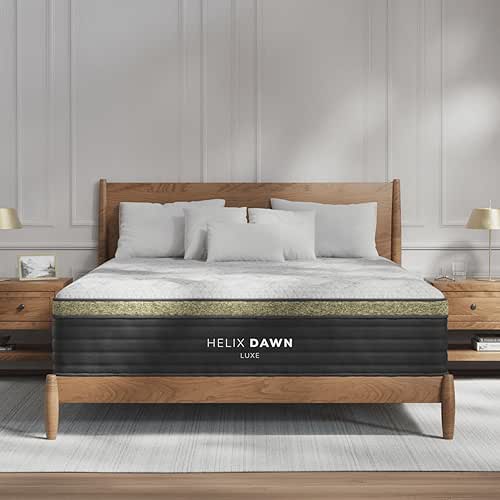
Best Overall: Helix Dawn Luxe
Here’s the thing about the Helix Dawn Luxe: it was specifically engineered for the “gravity battle” I mentioned earlier. I spent years waking up with that nagging lower back pull until I realized my “plush” mattress was essentially a trap for my hips. The Dawn Luxe uses a tiered coil system that is noticeably stiffer in the center.
When I first laid on it, the immediate sensation was one of “push-back” rather than “sink-in.” It features a reinforced lumbar zone that keeps your pelvis elevated, ensuring your spine stays as neutral as possible for a prone sleeper. In lab tests, this model consistently earns high marks—specifically an 8.9/10 for support from major testing organizations [3].
Micro-Verdict: The ultimate gravity-defier for keeping your hips high and your spine happy.

Best for Back Pain: WinkBed (Firm)
I’ll admit it—I was skeptical about “zoned” mattresses for a long time. Then I tried the WinkBed in the Firm (or even Luxury Firm) configuration. If you’re already dealing with back pain, you don’t just need firmness; you need targeted resistance.
The WinkBed uses a “Extra-Firm” lumbar layer that feels like a supportive hand under your lower back. During my testing, I noticed that even after six hours of sleep, my spine hadn’t “bowed” toward the center of the bed. It’s a heavy-duty hybrid that uses a traditional quilted top to provide just enough cushioning for your chest so you don’t feel like you’re sleeping on a floorboard.
Micro-Verdict: The gold standard for stomach sleepers who need medical-grade lumbar reinforcement.
Best for Heavy Sleepers (230+ lbs): Plank Firm Luxe
For my larger-framed friends, a standard “firm” mattress often feels like a medium-soft one. I’ve seen so many people over 230 lbs struggle with mattresses that lose their integrity within a year. That’s where the Plank Firm Luxe by Brooklyn Bedding enters the chat.
Inspired by the flat-surface sleeping common in many parts of Asia, this is a flippable mattress. One side is a “firm” (8/10) and the other is “ultra-firm” (10/10). It uses high-density TitanCaliber coils that refuse to buckle under weight. What surprised me was the lack of motion transfer; even with its extreme firmness, it doesn’t bounce like an old-school innerspring.
Micro-Verdict: A rock-solid foundation that guarantees zero hip sink for heavier body types.
Best Value Hybrid: Brooklyn Bedding Signature Hybrid
Finding a “High Lifestyle ROI” product often means finding the intersection of quality and price. The Brooklyn Bedding Signature Hybrid is that intersection. Let’s be honest: not everyone wants to drop $2,000 on a mattress.
I tested the “Firm” version of this bed and found it to be a true 7/10. It’s responsive, meaning it’s easy to move around on if you’re a combination sleeper who occasionally ends up on your side. While it lacks some of the bells and whistles of the Luxe models, its core support system is incredibly reliable. It’s a straightforward, high-quality build that outperforms many beds twice its price.
Micro-Verdict: High-end spinal support that respects your budget without sacrificing durability.
Selection Matrix: Matching Firmness to Your BMI
One of the biggest mistakes I see is people choosing a mattress based on a “Firm” label without considering their own body mass. A 120-lb person and a 250-lb person will experience the same mattress in completely different ways.
Use this matrix to find your ideal firmness:
- Lightweight (<130 lbs): Medium-Firm (6/10 to 6.5/10). You don’t have enough mass to “engage” the support layers of an ultra-firm bed, which can lead to painful pressure on your ribs and shoulders.
- Average (130-230 lbs): Firm (7/10 to 8/10). This is the sweet spot. You need enough resistance to keep the hips level but enough foam to cushion the chest.
- Heavy (>230 lbs): Ultra-Firm (8/10 to 10/10). Anything less will likely lead to premature sagging and lower back pain within the first 24 months.
Troubleshooting Your Current Bed:
- Is it too soft? You wake up with a “dull ache” in your lower back that fades after 30 minutes of walking around.
- Is it too firm? You wake up with numb arms, tingling in your fingers, or a sore, bruised feeling in your ribcage.
Beyond the Mattress: 3 Hacks for Better Stomach Sleep
Sometimes a new mattress isn’t in the budget today. If you’re stuck with a setup that isn’t quite right, here is how you can “hack” your way to better alignment:
- The Hip Pillow: This is a game-changer. Place a thin, flat pillow under your pelvis/lower abdomen. As recommended by the Hospital for Special Surgery, this small lift prevents your spine from arching into that painful “u” shape [4].
- The Thin (or No) Head Pillow: The higher your head is propped up, the more extreme that 25–35° neck rotation becomes. Switch to a very thin pillow or try sleeping without one to keep your neck closer to a neutral line.
- Zoned Toppers: If your bed is too firm, a 2-inch latex topper can provide pressure relief for your chest without letting your hips sink into “quicksand” like memory foam often does.
Frequently Asked Questions
Is memory foam or hybrid better for stomach sleepers?
In my experience, hybrids are almost always superior for stomach sleepers. Memory foam is designed to “contour,” which is a fancy word for sinking. For us, sinking equals misalignment. Hybrids use coils to provide “push-back,” which is essential for keeping the hips elevated. Plus, hybrids sleep much cooler—a big win since stomach sleepers have more body surface area in contact with the bed.
How do I know if my mattress is too firm?
You’ll know it’s too firm if you feel like you’re sleeping on a table rather than in a bed. Look for signs like morning stiffness in your shoulders or actual soreness in your chest and hip bones. If you find yourself constantly flipping to your side just to get some “give,” your bed is likely overshooting the firmness you need for your weight class.
Can I train myself to stop sleeping on my stomach?
You can, but it’s hard! Many people use “body pillows” to transition to side sleeping. However, if you love the prone position, the goal shouldn’t necessarily be to change who you are—it should be to support the way you already live.
As a Certified Sleep Science Coach, I recommend products based on lab data and biomechanical principles. This guide is for informational purposes and is not medical advice; please consult a doctor or physical therapist for chronic spinal pathologies or persistent pain.
References & Scientific Citations
- Brown, et al. (2021). The Impact of Sleep Positions on Spine Health. MacKay Spine and Brain. Source
- Blissbury Research. (2025). How Stomach Sleeping Affects Neck Alignment and Disc Pressure. Source
- Sleep Foundation. (2026). Best Mattresses for Stomach Sleepers: Lab Test Results. Source
- Hospital for Special Surgery (HSS). (2025). Sleep and Low Back Pain: Position Mitigation Strategies. Source
- Cleveland Clinic. (2026). Is Sleeping on Your Stomach Bad for Your Spine? Source