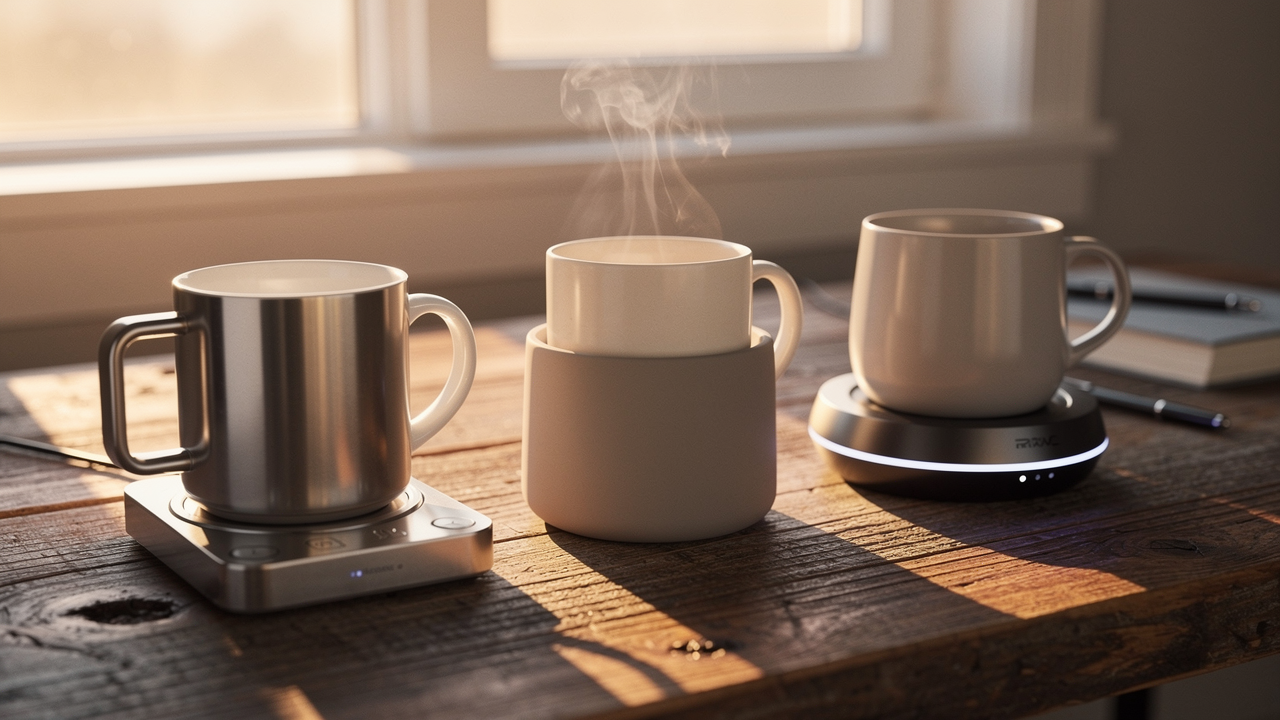
For years, I thought the only solution to this “Cold Coffee Crisis” was to drop $150 on a status-symbol smart mug that required a firmware update just to keep my liquid warm. But as a lifestyle curator, my goal is always “High Lifestyle ROI.” Does a product genuinely improve your day, or is it just another battery to charge?
After weeks of testing with digital thermometers and enough caffeine to power the entire Zilker Park area, I’ve found that the answer isn’t always the most expensive one. In fact, many of the best mug warmers of 2026 outperform the big-name brands for a fraction of the cost.
The Physics of the Chill: Why Your Coffee Dies So Fast
We’ve all been there: you pour a fresh cup at a steaming 157°F, get distracted by one single email, and suddenly you’re sipping tepid brown water. This isn’t just bad luck; it’s the “Coffee Cooling Paradox.” According to thermal testing by Serious Eats, coffee can drop a staggering 32°F in just the first 10 minutes [1].
Most of that heat escapes through evaporation and convection. If you’re using a wide-mouthed ceramic mug, you’re basically inviting the heat to leave. But the temperature drop doesn’t just affect how “hot” the drink feels; it changes the chemical profile. Volcanica Coffee’s director often refers to the “thirty-minute pleasure trip” of flavor evolution [2]. As coffee cools, different notes of sweetness and acidity emerge, but once you slip below 120°F, most of us perceive the drink as “dead.”
The 140°F Sweet Spot: Why Temperature Matters
Through my research, I’ve found that 140°F is the gold standard. It’s hot enough to feel cozy and intentional, but not so hot that it scalds your palate or masks the subtle notes of your beans. Most people prefer their coffee between 130°F and 145°F, while tea drinkers often look for a slightly punchier 150°F [3]. The problem is that without an active heating element, staying in that window for more than fifteen minutes is scientifically impossible in a standard room.
The 3 Best Mug Warmers of 2026: Our Top Picks
I didn’t want to just give you a list of whatever was on the front page of a retail site. I wanted devices that solve the problem of “limited temperature control” while being safe enough to leave on my walnut desk all day. Here are the three that actually passed the Good Life Test.
The 2026 Persona Loadouts
- The Minimalist Remote Worker: A Thermacup V2 for cord-free roaming around the house.
- The Desk-Bound Optimizer: A Cosori Original Plate for precise, all-day heat at a fixed station.
- The Budget Enthusiast: A Mr. Coffee Warmer paired with a silicone lid for maximum heat retention under $25.
1. Best Overall: Thermacup V2 (The Ember Slayer)
I’ll be honest: I was skeptical about “smart mugs” for a long time. My first experience with a high-end self-heating mug involved a frustrating afternoon trying to pair my drink with my Bluetooth settings. I just wanted hot coffee, not a tech support ticket. That frustration led me to the Thermacup V2, which has become my daily driver during my Sunday reset rituals.
What surprised me was the sheer simplicity. It offers the sleek, premium feel of an expensive smart mug but ditches the buggy app in favor of intuitive on-mug controls. During my testing, it held a steady 135°F for nearly three hours on a single charge. It solves the “roaming problem”—I can take it from my office to the kitchen without losing a single degree of warmth. CNN Underscored recently noted it as a top performer for 2026, and after living with it, I have to agree [4].
Micro-Verdict: The perfect blend of premium aesthetics and app-free reliability for people who value their time.


2. Best Value Plate: Cosori Original Coffee Warmer
Here’s the thing about desk setups: sometimes you don’t need a fancy new mug; you just need your favorite handmade ceramic mug to stay hot. I ignored plate-style warmers for years because I thought they looked clunky, but the Cosori Original changed my mind. It’s designed for the person who wants to “set it and forget it” while they deep-work for four hours.
In my thermometer tests, I found a clear “plate-to-liquid gap.” While the Cosori plate can reach a scorching 230°F, the actual liquid in my mug stayed at a perfect, stable 140°F [5]. It offers a massive range of settings, which is a win for me because I like my coffee at 135°F but my herbal tea at 155°F. It’s an optimization geek’s dream without the three-figure price tag.
Micro-Verdict: Unbeatable temperature precision for the dedicated desk worker who already has a favorite mug.
3. Best Budget Icon: Mr. Coffee Mug Warmer
You know that feeling when a classic just works? I’ve seen this little $20 workhorse on desks for a decade, and in 2026, it’s still the most efficient way to solve the cold coffee problem on a budget. I tried several “unbranded” cheap warmers from big-box retailers, and most of them either smelled like burning plastic or barely reached lukewarm.
The Mr. Coffee is different. Wirecutter has famously endorsed this plate for its ability to maintain a consistent 129°F, which is just enough to keep a drink pleasant [6]. It doesn’t have bells and whistles. It doesn’t have a timer. But it is incredibly reliable. I keep one in my guest room for friends who visit; it’s simple, effective, and takes up almost no space.
Micro-Verdict: A no-frills, sub-$25 essential that does exactly what it promises without the fluff.
Mug Warmer vs. Ember Mug: Is the Premium Price Worth It?
This is the question I get asked most often at the farmers market: “Jordan, should I just buy the Ember?”
If we look at “Lifestyle ROI,” the math is tricky. An Ember Mug² typically retails around $150. A high-quality plate like the Cosori is about $24. When Wirecutter tested them head-to-head, they found that a $21 plate can actually match the Ember’s heat maintenance over a two-hour period [6].
The Ember wins on “cool factor” and the ability to walk away from your desk. But the Thermacup V2 (our “Ember Slayer”) offers that same portability for significantly less money and without the app-pairing headaches that Coywolf and other testers have highlighted [7]. For most of us, spending $150 on a mug that might have firmware issues feels like the opposite of a “good life” choice. I’d rather spend that extra $120 on a few months of high-end, locally roasted beans.
How to Choose: The ‘Mug Compatibility’ Checklist
I’ve learned the hard way that a mug warmer is only as good as the mug you put on it. If you’re using the wrong vessel, you’re basically fighting against the laws of thermodynamics.
The Ultimate Compatibility Checklist
- Flat Bottoms Only: Check the bottom of your mug. Is it perfectly flat or does it have a concave “rim”? Concave bottoms create an air gap that acts as insulation, preventing the heat from reaching your coffee.
- Material Matters: Single-walled ceramic and glass conduct heat the best. Avoid double-walled or vacuum-insulated mugs on a warmer plate; they are designed to block heat transfer, meaning the plate will stay hot but your coffee will stay cold.
- The 30°F Rule: Remember that liquid temperature is usually 30°F lower than the plate temperature [5]. If you want 140°F coffee, set your plate to 170°F.
- Use a Lid: This is my #1 pro-tip. Using a simple silicone lid can increase heat retention by up to 25%, as it stops evaporation—the primary cause of cooling.
Wait, My Mug Doesn’t Work? (Flat vs. Concave Bottoms)
It’s a common frustration: “I bought the warmer, but my coffee is still cold!” More often than not, the culprit is that beautiful, artisanal mug with the recessed bottom. NASA’s research into thermal control highlights that “conductive heat transfer” requires direct surface contact [8]. If only 10% of your mug’s bottom is touching the plate, you’re only getting 10% of the efficiency. For the best results, look for “diner style” mugs or glass mugs with a wide, flat base.
Safety & Longevity: Don’t Burn Your Desk Down
Since these devices involve a heating element on your desk, safety isn’t something to gloss over. I always look for a “UL Listing” or similar certification, which ensures the device has been tested for electrical safety.
One feature I consider mandatory is the auto-shutoff timer. We’ve all had those days where we rush out the door for a meeting and forget to click “off.” Brands like LIFESMART have set a benchmark with 8-hour automatic shutdown windows, which provides incredible peace of mind [3]. If you’re using the Mr. Coffee (which lacks a timer), I highly recommend plugging it into a $10 smart plug so you can set an automatic “off” time from your phone. As West Control Solutions points out, “limit devices” are essential for preventing over-temperature hazards in any heating application [9].
The Verdict: Making Your Mornings Better
At the end of the day, living well isn’t about owning the most expensive gadget on the market. It’s about finding the tools that remove friction from your life. For me, that means a cup of coffee that stays exactly 140°F until the very last drop.
If you want the absolute best experience without the “luxury tax,” go for the Thermacup V2. If you’re a desk-bound pro who wants total control, the Cosori Original is your best friend. And if you just want to solve the problem for the price of a few lattes, the Mr. Coffee remains an undefeated classic.
Life is too short for lukewarm coffee and rushed mornings. Choose the warmer that fits your flow, grab a lid, and enjoy that “thirty-minute pleasure trip” every single day.
References
- Serious Eats (2024), “The Science of Coffee Cooling”
- Southern Living (2025), “How to Keep Coffee Warm Longer”
- Roast Love (2026), “10 Best Coffee Mug Warmers for 2026”
- CNN Underscored (2026), “The Best Mug Warmers We Tested”
- Allrecipes (2025), “Cosori Mug Warmer Review: Tested and Ranked”
- NYTimes Wirecutter (2025), “The Best Mug Warmers”
- Coywolf (2025), “Self-Heating Mugs vs. Mug Warmers”
- NASA (2024), “Thermal Control Systems for Small Spacecraft”
- West Control Solutions (2024), “Why Use Limit Devices in Temperature Control”
Disclaimer: This article contains affiliate links. If you purchase through these links, I may earn a small commission at no extra cost to you. All products were selected based on independent testing and research.