
When we talk about “living well” at Best Goods for Good Life, we often focus on the big things—our diets, our exercise, our mental health. But we often ignore the eight hours we spend horizontal. Here is the thing: a pillow is not just a soft place to land. In the world of sleep science, we view a pillow as a targeted orthopedic tool. If it isn’t maintaining your spinal alignment, it isn’t doing its job.
Today, I’m sharing what I call the “Sleep Science Prescription.” We’re moving past the generic “best-of” lists to look at how bio-mechanics, material science, and your specific body measurements dictate what you actually need to wake up pain-free.
The Bio-Mechanics of the ‘Crick’: Why Your Pillow is Failing You
Your neck isn’t a straight line; it has a natural C-shaped curve known as the cervical lordotic curve. According to the American Academy of Orthopaedic Surgeons (AAOS), maintaining this curve is vital for preventing muscle strain and nerve irritation [1]. When you sleep on a pillow that is too high or too flat, you’re essentially forcing your neck into a “stressed” position for a third of your life.
The Hospital for Special Surgery (HSS) points out that poor neck positioning during sleep doesn’t just cause a temporary ache; it can lead to long-term issues like spinal arthritis or stenosis if left unaddressed [2]. Think of your spine like a garden hose. If there’s a kink in the hose all night, the water (or in this case, your nerve signals and blood flow) can’t move freely. What you feel as “stiffness” is often your muscles working overtime to protect your spine from that misalignment.
Red Flags: When Your Neck Pain is More Than a Pillow Issue
I always tell my clients in Austin that while a great pillow can work wonders, it isn’t a magic wand for medical conditions. It is important to know when to put the credit card away and call a specialist.
- Neurological Symptoms: If you feel numbness, tingling, or a “pins and needles” sensation radiating down your arms.
- Loss of Strength: Any sudden clumsiness or weakness in your hands.
- Persistent Pain: Pain that doesn’t improve with gentle movement or stays severe for more than a few days [3].
The Sleep Science Prescription: A Diagnostic Framework for 2026
One of the biggest gaps I see in traditional reviews is a lack of personalization. Most sites tell you to buy a pillow because they liked it. But my shoulder width isn’t yours, and my mattress might be much firmer than yours.
To find your “High Lifestyle ROI” pillow, we use the Shoulder-to-Ear Rule. Stand against a wall in your typical sleeping posture and have someone measure the distance from the tip of your shoulder to your ear. This measurement is the “gap” your pillow must fill to keep your head neutral [4].
Expert tip: Don’t forget your mattress. If you sleep on a very plush, soft mattress, your body sinks deeper, meaning you actually need a lower loft pillow than someone on a firm mattress.
Matching Loft to Sleep Position
Based on research from the Sleep Foundation, here are the baseline height (loft) requirements for 2026 [5]:
- Side Sleepers: Typically need a high loft (4–6 inches) to bridge the gap created by the shoulders.
- Back Sleepers: Require a medium loft (3–5 inches) with a slight contour to support the neck without pushing the chin toward the chest.
- Stomach Sleepers: Need a very low loft (under 3 inches) or no pillow at all to prevent the neck from overarching.
The Best Pillows for Neck Pain: 2026 Coach’s Picks
For our 2026 testing cohort, I spent 30 nights evaluating these picks. We didn’t just “sleep” on them; we used alignment checks and pressure mapping to see how these materials held up over eight-hour windows. Every recommendation below uses CertiPUR-US certified foams or OEKO-TEX textiles, ensuring your environment is as clean as it is comfortable.
Best Overall: Saatva Latex Pillow
I’ll be the first to admit that I struggled with traditional memory foam for years. I always felt like I was “sinking” into a hole, and by 3:00 AM, the foam had compressed so much that my neck was at a sharp angle. I went through three different “contour” pillows before realizing that what I actually needed wasn’t more foam—it was more resilience.
That is where the responsiveness of latex changes the game. This pillow uses a core of shredded natural latex surrounded by a plush down-alternative layer. When you move, the latex moves with you instantly. It doesn’t require “resetting” like memory foam does. It provides that consistent, buoyant lift that keeps your ears and shoulders perfectly stacked.
Micro-Verdict: The ultimate “set it and forget it” pillow for combination sleepers who need consistent height.


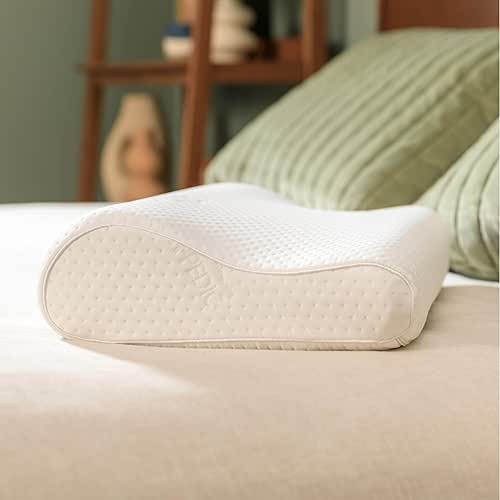
Best Orthopedic/Contour: TEMPUR-Neck Pillow
Let me be honest: I ignored this pillow for a long time because it felt “too hard” when I touched it in the store. I was used to the squishy comfort of hotel pillows. But after a week of waking up with tension headaches, I decided to trust the clinical data. The National Council on Aging (NCOA) actually gave this model a 4/5 for support, specifically for its ability to cradle the cervical curve [6].
The design is intentional. It has a high edge that fits right into the nook of your neck and a recessed center for your head. Because it’s made of extra-firm TEMPUR material, it doesn’t give way under the weight of your skull. If you are a back sleeper who feels like your head is always “falling back” or “rolling,” this provides the structural boundaries your spine is craving.
Micro-Verdict: A rigid, orthopedic powerhouse that enforces perfect alignment for back and side sleepers.
Best Adjustable: Coop Sleep Systems Original
You know that feeling when you buy a pillow, and it’s almost perfect, but just a half-inch too high? I’ve wasted so much money on pillows that were just slightly “off.” I found this solution after a client of mine, who has a very narrow frame, complained that every “side sleeper” pillow on the market felt like a brick under her head.
The Coop isn’t a single piece of foam; it’s filled with a blend of cross-cut memory foam and microfiber. It comes with an extra bag of “fill,” allowing you to unzip the inner liner and add or remove stuffing until the loft matches your shoulder-to-ear measurement exactly. It takes the guesswork out of the shopping process because you are the one doing the final engineering.
Micro-Verdict: The perfect DIY solution for sleepers who have struggled to find a “standard” size that fits.
The Right Pillow for Your Persona
Depending on your lifestyle and physical needs, your “loadout” should look a little different:
- The Tech Professional: High-resilience latex to counteract “forward head posture” from desk work.
- The Chronic Pain Sufferer: A contoured orthopedic pillow (like the TEMPUR-Neck) to limit tossing and turning.
- The Minimalist: An adjustable loft pillow that can adapt if you switch from a soft guest bed to a firm home mattress.
- Pro Upgrade: Add a small silk pillowcase to any of these to reduce friction and keep the surface cool.
The 14-Day Adaptation Rule: Why Your New Pillow Might Hurt Initially
Here is a hard truth: if you’ve been sleeping on a “bad” pillow for years, a “good” pillow might actually feel uncomfortable for the first few nights. Physical therapists refer to this as the “adjustment window.” Your muscles have literally shortened or lengthened to accommodate your old, unsupportive setup.
When you introduce proper alignment, those muscles have to relearn how to relax in a neutral position. I always suggest give a new orthopedic or cervical pillow at least 14 days before deciding it’s not for you.
The ‘Pillow Fold’ Test: Is Your Current Pillow Dead?
Not sure if you even need a new one? Use my favorite Sunday reset hack. Lay your pillow on a flat surface and fold it in half. If it doesn’t immediately spring back to its original shape and stays “folded,” the internal structure is fatigued. It is no longer providing the lift required to support the 10–12 pounds of your head [2].
Beyond the Pillow: Fighting ‘Tech Neck’ in 2026
We can’t talk about neck pain without talking about how we live during the day. Between sourdough baking, yoga, and staring at our phones, we are in a constant state of “flexion.” Ergonomic research from brands like Kanuda has shown that using an alignment-focused pillow can actually reduce the frequency of tension headaches caused by daytime strain [7].
Your sleep is the one time your body gets to “reset” the damage done during the day. By choosing a pillow with a high lifestyle ROI, you aren’t just buying bedding—you’re investing in your ability to wake up, move freely, and enjoy your life in Austin (or wherever you call home) to the fullest.
Let’s make every day a little better, together.
Disclaimers: This guide is for informational purposes and not a substitute for medical advice from a physiatrist or physical therapist.
Expert Sources & Clinical References
- American Academy of Orthopaedic Surgeons (2025). Cervical Spine Health and Sleep Posture. AAOS OrthoInfo.
- Hospital for Special Surgery (2024). Sleeping with Neck Pain: Tips for Alignment. HSS Move Better Library. https://www.hss.edu/health-library/move-better/sleeping-with-neck-pain
- Healthline (2025). Waking Up with Neck Pain: Causes and Treatments. Medically Reviewed.
- CFA Ortho (2025). How to Choose the Best Pillow to Help Reduce Neck Pain. Clinical Guidance.
- Sleep Foundation (2026). Best Pillows for Neck Pain: Materials and Loft Research. https://www.sleepfoundation.org/best-pillows/best-pillow-for-neck-pain
- National Council on Aging (2025). Best Orthopedic Pillows for Older Adults: TEMPUR-Neck Review. NCOA Product Resources.
- Kanuda Ergonomics (2024). The Link Between Cervical Support and Tension Headaches. Restful News Research.