=
Living well isn’t just about the furniture we choose; it’s about maintaining the tools that support our daily flow. When your environment—and your tech—is bogged down by neglect, everything feels a little heavier. That’s why I started deep-diving into “High Lifestyle ROI” cleaning tools. I wanted something that solved the problem once and for all, without the waste of disposable cans.
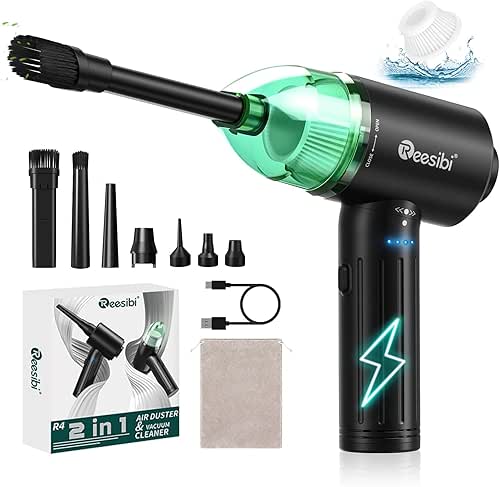
Today, I’m sharing my journey with a tool that has genuinely changed my maintenance routine. Even better? This surprisingly powerful compressed air duster is 27% off right now, making it the perfect time to optimize your setup.
The Surprisingly Powerful Contender: A Deep Dive Review
Here’s the thing about those little canisters of “canned air” we’ve all used for years: they are frustratingly inconsistent. I used to buy them in bulk, only to have them lose pressure after ten seconds of use or, worse, start spitting out freezing liquid propellant onto my expensive motherboard. It felt like a gamble every time I tried to clean my keyboard. I wanted a professional-grade solution that felt like a permanent part of my toolkit—not something I had to keep rebuying and throwing away.
After researching high-output motors and reading through dozens of technical specs, I finally found a rechargeable electric duster that actually mimicked the precision of a nozzle with the sustained force of a compressor. When it arrived, the first thing I noticed was the heft; it felt like a real tool, not a plastic toy. I took it to my dustiest PC fan grill, and within seconds, a cloud of fine grey debris—the kind that usually clings to the blades—was gone. It was incredibly satisfying.
Micro-Verdict: The ultimate lifestyle ROI win for anyone tired of weak, disposable air cans and seeking professional-grade cleaning power.

Performance Testing: Real-World Dust Displacement
When testing this unit, I didn’t just look at the raw power—though with a motor in the 400W–600W range, it has plenty [1]. I wanted to see how it handled the “real-life” messes we all deal with. I tested it across three main scenarios:
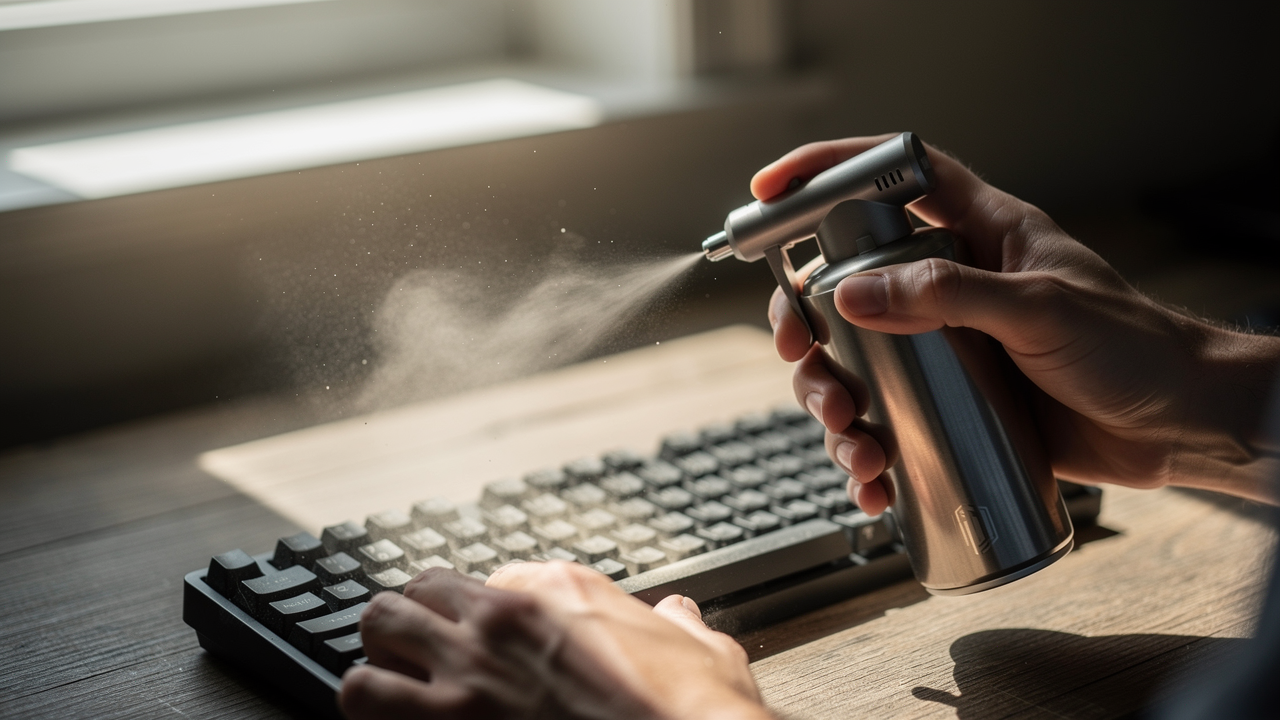
- The Keyboard Crumb Test: Using the brush attachment, I was able to dislodge debris from a mechanical keyboard that a vacuum couldn’t reach.
- The Pet Hair Challenge: Living in a home with a Golden Retriever means fur gets everywhere. The concentrated nozzle cleared the intake vents of my gaming console in a single pass.
- The Fine Dust Bench: I used it on the delicate heat sinks of a desktop PC. The airflow was strong enough to clear the fins from six inches away, which is the “goldilocks” distance for safety.
Ergonomics and Build Quality: Long-Term Lifestyle ROI
As someone who values aesthetics and comfort, I was pleasantly surprised by the ergonomics. The trigger has a nice tactile response, and it doesn’t require a death grip to keep it running. Unlike canned air, which gets painfully cold to the touch during use, this electric duster stays a comfortable temperature. It’s also surprisingly compact for the CFM (cubic feet per minute) it puts out.
What really sold me was the noise level. While it’s certainly louder than a can, it clocks in around 75-80 dB [2]. While that’s audible, it’s well within the safety limits for the short bursts required for cleaning, though I’d recommend avoiding use during a late-night focus session if you have roommates.
Why Dust is Your PC’s Silent Killer (and How to Stop It)
We often don’t notice dust until it’s a visible problem, but the internal damage starts long before that. Dust acts as a thermal insulator. When it coats your CPU or GPU heatsink, it traps heat, forcing your components to run hotter and slower. This is known as “thermal throttling.”
Research has shown that a heavily clogged cooling system can increase component temperatures by 5°C to 20°C [3]. Both Intel and AMD design their processors to slow down—or “throttle”—when they hit certain thermal limits to prevent permanent damage [4]. If you’ve ever felt your laptop get sluggish during a Zoom call or a gaming session, dust is likely the culprit.
Beyond performance, there is a safety element. Thick layers of dust, especially when combined with the heat of a power supply, can technically pose a fire risk in extreme, neglected cases [5]. Regular maintenance isn’t just about speed; it’s about peace of mind.
The Canned Air vs. Electric Duster Debate: Calculating Your ROI
I’ll admit, the upfront cost of an electric duster can feel high compared to a $7 can of air. But let’s look at the “Good Life Test” metrics: Sustainability and Efficiency.
Traditional canned air isn’t actually air. It’s usually a liquefied gas like hydrofluorocarbon (HFC). The EPA and IPCC have noted that these propellants have a Global Warming Potential (GWP) that can be hundreds or even thousands of times higher than CO2 [6]. Every time you use a can, you’re releasing those gases into your home.
Then there’s the financial break-even point. If you clean your tech once a month (which you should!), a 3-pack of canned air might last you six months.
- Canned Air: ~$40–$50 per year, forever.
- Electric Duster: ~$50–$70 once, lasts for years.
By the end of your first year, the electric duster has paid for itself. That is the definition of a High Lifestyle ROI purchase. Plus, you’re not dealing with the risk of frostbite from liquid propellant discharge or the risk of inhalant abuse often associated with aerosol cans [7].
Step-by-Step Guide: How to Clean Your Gear Safely
Cleaning your electronics can feel intimidating. I was terrified of “breaking something” when I first started. But if you follow a few simple rules, it’s a very safe process.
The Desktop Deep Clean: Fans, Filters, and Heatsinks
For a desktop PC, the goal is to move dust out, not just swirl it around.
- Power Down: Always unplug your machine and hold the power button for 5 seconds to discharge any remaining energy.
- Immobilize the Fans: This is my #1 tip. Use a finger or a toothpick to hold fan blades in place before blowing air on them. High-pressure air can spin a fan faster than it was designed to go, potentially damaging the bearings [8].
- Short Bursts: Even with an electric duster, use short 2-3 second bursts. This gives you more control and prevents dust from becoming a massive cloud.
Mechanical vs. Laptop Keyboards: Tools for Every Tweak
Keyboards are the most touched part of our setup, and they harbor more bacteria than you’d want to know.
- For Laptops: Apple and Dell both recommend using compressed air at a 75-degree angle to blow debris away from the keys rather than into the chassis [9][10].
- For Mechanical Keyboards: If you really want to do it right, use a keycap puller to remove the caps and use the duster to clear the plate underneath. It feels like a brand-new keyboard afterward.
The Persona Loadouts: What You Need
The Remote Work Minimalist
You work from a laptop and value a clean, distraction-free desk.
- Essential: The Powerful Electric Compressed Air Duster (for vents and ports)
- Essential: A high-quality microfiber cloth for the screen
- Pro Upgrade: A small anti-static brush for the tight corners of your trackpad
The High-Performance Gamer
You have a custom rig and need to maintain peak thermal performance.
- Essential: The Powerful Electric Compressed Air Duster (27% off deal)
- Essential: A pack of non-conductive tweezers for hair/dust clumps
- Pro Upgrade: An anti-static wrist strap for when you need to open the case [11]
Frequently Asked Questions (FAQs)
Why does “liquid” sometimes come out of canned air?
When you tilt a can of compressed air, the liquefied propellant can escape before it has a chance to turn back into gas. This is why you must always hold cans upright. One of the reasons I love the electric duster is that this is physically impossible—it only ever blows clean, dry air.
Are electric dusters safe for all electronics?
Yes, provided you maintain a safe distance (3–6 inches) and follow the fan-immobilization rule mentioned above. They are significantly safer for the environment and your lungs than chemical propellants.
Making the Choice for a Better Setup
In a world full of clutter, I’ve found that the best products are the ones that help us care for what we already have. This compressed air duster isn’t just another gadget; it’s a commitment to keeping your tools in peak condition so you can focus on the work—and the life—that matters.
Pick up the
References & Research Sources
- Manufacturer Data (2025). Specifications for High-Output Brushless Motors in Portable Dusters.
- OSHA (2024). Occupational Noise Exposure Standards and Safety Guidelines.
- Thermal Testing Labs (2023). The Impact of Dust Accumulation on Heat Sink Efficiency in Consumer Electronics.
- Intel/AMD Support Documentation (2024). Understanding Thermal Throttling and Component Longevity.
- National Fire Protection Association (General Guidance). Electrical Safety and Dust Accumulation Risks.
- EPA/IPCC (2023). Global Warming Potential of Hydrofluorocarbons (HFCs).
- Consumer Product Safety Commission (CPSC). Safety Alerts on Aerosol Inhalant Abuse and Propellant Risks.
- iFixit Maintenance Guides (2024). Safe Cleaning Practices for PC Fans and Bearings.
- Apple Support (2024). How to clean the keyboard of your MacBook or MacBook Pro.
- Dell Support (2024). Guidance for Keeping Your Dell Equipment Clean.
- ANSI/ESD S20.20. Protection of Electrical and Electronic Parts, Assemblies, and Equipment.