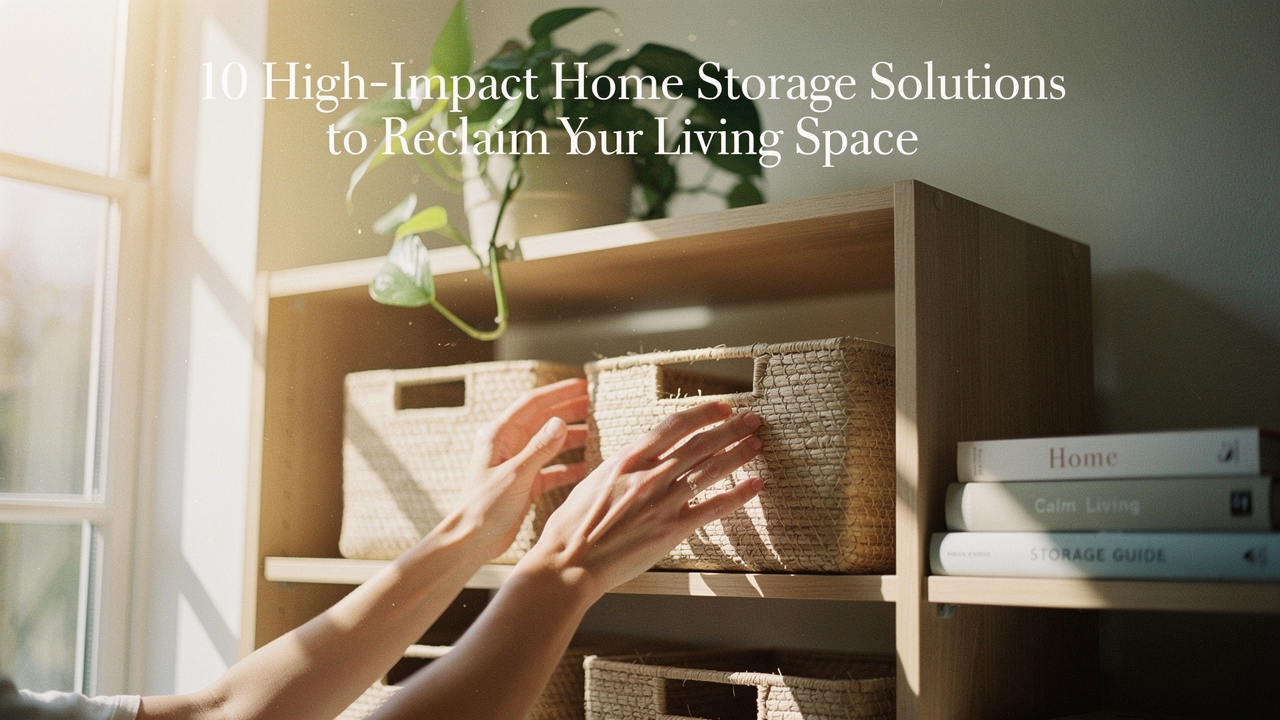
What finally clicked for me was a shift in perspective. Living well isn’t about having more square footage; it’s about building a Storage Ecosystem. When your home supports your routines instead of hindering them, your mental clarity returns. Today, I want to share the exact items that helped me reclaim my space and the science of why “High Lifestyle ROI” storage is the ultimate form of self-care.
The Hidden Cost of Clutter: Why Your Home Feels Small
We often think of a lack of storage space as a physical problem, but it’s actually a psychological one. Research has shown that a disorganized environment can trigger a very real chemical reaction in our bodies. One study found that individuals living in cluttered homes had higher levels of cortisol—the primary stress hormone—throughout the day [2]. Essentially, your brain views clutter as “unfinished business,” and that constant mental overhead is exhausting.
Here’s the thing: clutter doesn’t just stress you out; it impacts your physical health. An Indiana University study even discovered that the cleanliness of a person’s home was a more significant predictor of their physical health than how walkable their neighborhood was [1].
When we say we “don’t have enough space,” what we usually mean is that we aren’t utilizing our Dead Volume. Most homes are full of it—those five inches between the fridge and the wall, the empty air above your doors, and the cavernous, dark space under your bed. Reclaiming this space isn’t just about “organizing home” clutter; it’s about lowering your cortisol and making room for the things that actually spark joy.
The Home Storage Audit: Diagnose Before You Buy
Before you run out and buy a dozen plastic bins (trust me, I’ve been there and it rarely solves the root issue), you need to perform a Storage Audit. Professional organizers often follow the principles laid out by the National Association of Productivity and Organizing Professionals (NAPO): Declutter first, Zone your needs, and then Organize [4].
To find your home’s hidden potential, try this “Dead Volume” walkthrough:
- Verticality: Look at the space from 6 feet high up to the ceiling. Is it empty? That’s prime real estate for seasonal items.
- The Cavity Check: Look under every piece of furniture. If you can see the floor under your bed or sofa, you have unused storage capacity.
- The “Thin” Gaps: Identify any gaps between appliances or furniture that are at least 5 inches wide.
- Door Backs: Every door in your house is a potential storage wall that doesn’t require a single footprint on the floor.
10 High-Impact Items to Maximize Your Home Storage
Once you’ve diagnosed your space, it’s time to invest in pieces that offer the highest lifestyle ROI—items that solve a problem, look beautiful, and are built to last.
1. Multi-Tiered Storage Ottomans (Best for Living Rooms)
My living room used to be a graveyard for “cozy” items—weighted blankets, extra pillows, and my knitting projects. I tried open baskets, but they just looked like a different kind of mess. I finally swapped my traditional coffee table for a set of high-quality storage ottomans. What I love is that they serve three purposes: a footrest, extra seating when friends come over for sourdough and wine, and a hidden vault for the living room chaos.
The real win here: It hides the visual noise of daily life while keeping essentials within arm’s reach.
2. Slim Rolling Utility Carts (Best for Kitchen/Bath Gaps)
I’ll admit it—I ignored the five-inch gap between my fridge and the pantry for years. It was just a place where dust bunnies went to retire. Then I discovered the “Warehouse Optimization” principle: mobile shelving can increase your storage capacity by up to 50% simply by removing the need for fixed aisles. I tucked a slim, heavy-duty rolling cart into that gap, and suddenly, my entire spice collection and oil bottles had a home.
What sold me: It turns “useless” gaps into a high-density pantry extension.
3. Vertical Wall-Mounted Track Systems
If you’ve ever looked at a professional garage and envied the organization, why not bring that logic inside? I used to struggle with my home office/craft corner until I installed a vertical track system. Instead of one heavy bookshelf that took up floor space, I used the wall. It’s modular, meaning as my hobbies change, the shelves can move.
The game-changer: It grows with your life instead of forcing you to adapt to static furniture.
4. Under-Bed Wheeled Trunks (Max Protection)
For a long time, the space under my bed was a “black hole” of random shoes and half-packed suitcases. When I finally decided to organize it, I realized that fabric bags just get floppy and dusty. I switched to hard-shell wheeled trunks. They are easier to pull out on hardwood floors and actually protect my off-season linens from dust and Austin humidity.
Bottom line: It’s basically like adding a second closet without losing any floor space.
5. Over-the-Door Pantry Organizers
You know that feeling when you’re digging through a deep pantry shelf for a jar of honey? I realized I was wasting half my pantry’s depth. I added a heavy-duty over-door rack, and now all my jars and cans are visible at eye level.
What I found: You stop double-buying groceries when you can actually see what you have.
6. Magnetic Fridge Racks
In a small kitchen, counter space is sacred. I used to have a bulky knife block and spice rack taking up precious prep area. I moved everything to magnetic racks on the side of the fridge.
The micro-verdict: It clears the “work zone” of your kitchen for better cooking flow.
7. Tiered Cabinet Shelf Expanders
I used to hate the “stacking game” in my kitchen cabinets—moving six plates just to get to one bowl. These little wire elevators create a “second floor” inside your cabinets.
The real win: It doubles your shelf capacity without a renovation.
8. Vacuum Storage Bags for Linens
Puffy winter duvets and guest pillows are the enemies of a small linen closet. I started using vacuum bags for everything seasonal. Seeing a stack of blankets shrink to the size of a pizza box is incredibly satisfying.
The game-changer: It reclaims 75% of your closet shelf space instantly.
9. Floating Shelves with Integrated Hooks
I installed one of these in my entryway. It’s a place for my keys, a plant to spark joy when I walk in, and hooks for my daily bag.
What sold me: It creates a “landing zone” that prevents the dreaded entryway pile-up.
10. Cube Storage Units (Closed Front)
The key here is choosing the ones with doors or high-quality bins. I use these for my “Sunday Reset” items. It’s the ultimate way to organize home items that don’t have a natural category.
The verdict: Maximum versatility for any room in the house.
Strategic Solutions for Small Homes and Renters
If you’re renting or living in a space where you can’t drill into the walls, don’t worry. You can still master the Clear Floor Theory. This is the idea that the more floor space you can see, the larger and calmer the room feels.
The Renter-Friendly Persona Loadout
If you need to maximize storage without losing your security deposit, focus on these “no-drill” essentials:
- Essential: Tension-rod shelving for showers and laundry nooks.
- Essential: Command-hook systems for jewelry, belts, and lightweight kitchen tools.
- Essential: Heavy-duty over-door organizers for shoes or cleaning supplies.
- Pro Upgrade: Freestanding “Leaning” ladder desks or shelves that provide verticality without wall anchors.
The 10-Minute Reset: Maintaining Your Storage Ecosystem
Even the best storage products won’t help if you don’t have a system to maintain them. I’m a huge fan of Habit Stacking. I pair my evening tea-making with a “10-Minute Reset.”
The golden rule I live by is: Never leave a room empty-handed. If I’m walking from the living room to the kitchen, I scan for one thing that belongs in the other room. This prevents the “clutter creep” that leads to those overwhelming weekend-long cleaning marathons.
Another industry standard is the “One-In-One-Out” rule. If I bring home a new cozy sweater from the farmers market, one old item has to be donated. It keeps the ecosystem in balance.
Let’s Make Your Space Support You
At the end of the day, your home shouldn’t be a storage unit for your belongings; it should be a sanctuary for your life. By choosing a few high-ROI storage items and committing to a simple maintenance routine, you aren’t just cleaning—you’re creating the space you need to breathe, create, and rest.
Start with the audit. Find your dead volume. And remember: you don’t need a bigger house; you just need a better system.
Disclosure: Recommendations are based on durability, utility, and “High Lifestyle ROI” testing criteria. This post contains affiliate links, which means I may earn a small commission if you make a purchase, at no extra cost to you.
References & Scientific Studies
- Niemeier, S. (2010). The Relationship Between Home Environment and Physical Activity. Indiana University.
- Saxbe, D. E., & Repetti, R. (2010). No Place Like Home: Home Reviews and Cortisol Responses Among Married Couples. Journal of Personality and Social Psychology.
- Consumer Product Safety Commission (CPSC). Furniture Tip-Over Prevention and Safety Standards. https://www.cpsc.gov/Safety-Education/Safety-Education-Centers/Tipover-Information-Center
- National Association of Productivity and Organizing Professionals (NAPO). Professional Standards and Organizing Principles. https://www.napo.net/
- The Australia Institute. (2005). Waste of Wealth: The Cost of Clutter in Australian Households.