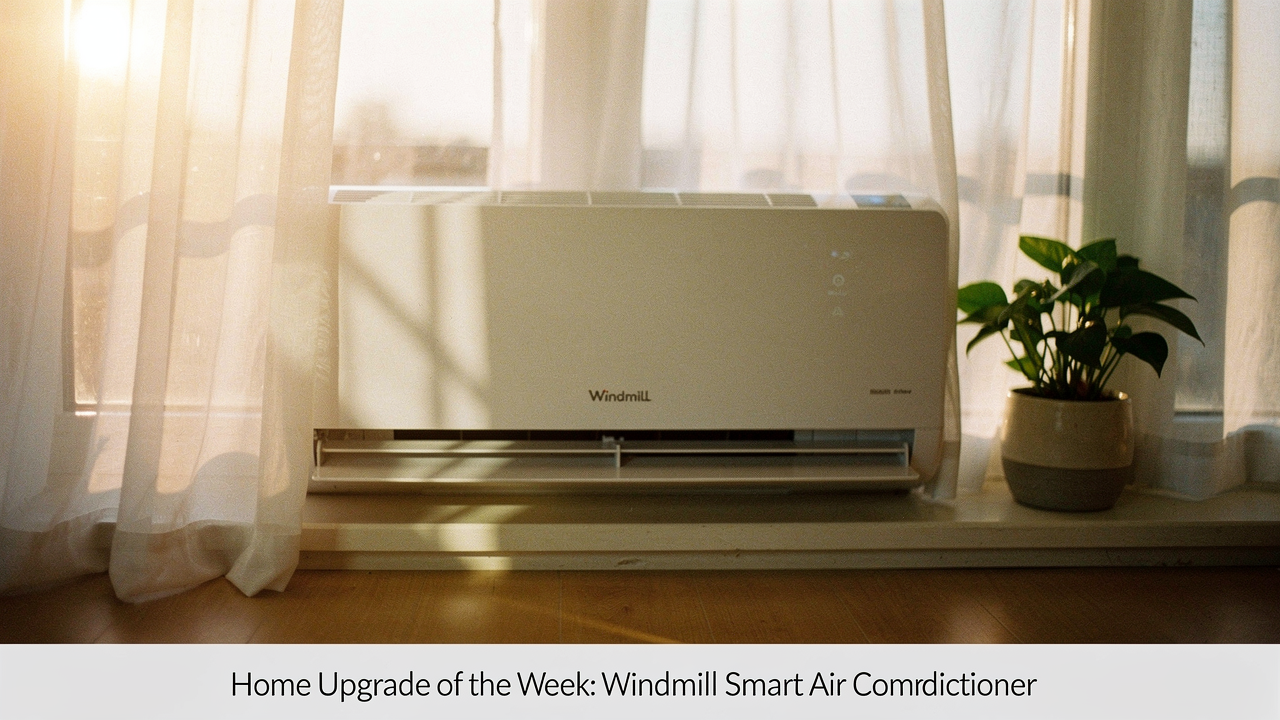
Here’s the thing: I’m a firm believer that your space should support your life, not drain your energy (or your wallet). This summer, I finally decided to stop settling for “fine” and went on a hunt for a solution with high lifestyle ROI. I wanted something quiet enough for my morning yoga, smart enough to cool the house before I got back from the farmers market, and—let’s be honest—pretty enough that it didn’t ruin my living room aesthetic.
That journey led me to the Windmill Smart Air Conditioner. After living with it for a full month of triple-digit heat, I’m ready to share why it’s officially my “Home Upgrade of the Week.”
The Problem: Why Your Outdated Air Conditioner Is Ruining Your Summer
Let’s be real for a second: most of us ignore our AC until it stops working. But an outdated air conditioner is often a silent thief in your home. According to the U.S. Department of Energy, cooling and heating typically account for a staggering 40% to 50% of a home’s total energy use [1]. If your unit is more than a decade old, you’re likely dealing with inefficient home cooling that is driving up high energy bills without actually keeping you comfortable.
The industry standard from ASHRAE suggests that window units have a lifespan of about 10 years [3]. If yours is pushing that limit, it’s not just “vintage”—it’s probably costing you money every single hour it runs. ENERGY STAR certified room ACs use about 10% less energy on average than non-certified models [2], which is why moving toward a smart air conditioner isn’t just about the tech; it’s a strategic move for your monthly budget.
The Ghost in the Machine: Signs Your AC is EOL
I knew it was time for a change when I realized I was subconsciously avoiding my living room because it was always five degrees warmer than the rest of the house. If you’re seeing these signs, your unit is likely at its “End of Life” (EOL):
- The “Sticker Shock” Bill: Your electric bill spikes significantly higher than the previous summer without a change in usage.
- Industrial Noise: You have to turn up the TV or shout over the fan.
- The Humidity Trap: The air feels cold but “heavy” or damp, a sign the compressor isn’t effectively dehumidifying.
- Aesthetic Friction: It’s an eyesore that you try to hide behind plants or curtains (guilty!).
Unboxing the Windmill: First Impressions of a Design-First AC
I’ll admit it—I was skeptical at first. Can a windmill air conditioner really be that much better than the ones I see at big-box stores? Most window units look like they were designed in 1985 and never updated. Windmill, however, felt like a true home upgrade from the moment the box arrived.
The packaging is mostly eco-friendly, and they even include a carbon offset for the initial footprint of the unit, which aligns perfectly with my “Best Goods for Good Life” philosophy. When I finally pulled the unit out, I was struck by the curved edges and the minimalist white fabric-like front. It doesn’t look like an appliance; it looks like a piece of modern furniture.
The Renter’s Dream: A Pain-Free Smart AC Installation
If you’ve ever struggled with those accordion-style side panels that never quite seal right, you know the frustration of smart ac installation. I used to spend hours with duct tape and foam strips trying to keep the Austin bugs out and the cold air in.
What surprised me about the Windmill was the pre-assembled installation kit. It comes with a frame already attached to the unit, and the side panels are much sturdier than the flimsy plastic ones I’m used to. They even include “cosmetic panels”—sleek white covers that snap over the side wings to hide the “accordion” look entirely. It took me about 45 minutes from unboxing to cooling, and for a renter, the fact that it’s so secure and well-sealed is a massive win for both safety and efficiency.
Performance Deep Dive: Does it Actually Cool?
A pretty face is great, but in a 100-degree heatwave, I need energy efficient cooling. I conducted a few “Jordan-style” tests to see if this smart air conditioner lived up to the hype.
First, the noise. I used a decibel meter app, and on “WhisperTech” mode, it registered around 42dB. To give you context, that’s quieter than a library. I can finally record a voice note or hop on a Zoom call without sounding like I’m at an airport.
Second, the cooling speed. Following the Energy.gov rule of thumb—about 20 BTU per square foot of living space [4]—I installed the 8,000 BTU unit in my 350-square-foot living/dining area. It dropped the temperature from a stagnant 82 degrees to a crisp 72 in less than 20 minutes.
More importantly, it’s about the smart savings. A study from Lawrence Berkeley National Laboratory (LBNL) found that using connected controls for AC can lead to energy savings of 8% to 20% by leveraging scheduling and geofencing [5]. I’ve noticed that by letting the app manage the temperature based on my location, the unit isn’t running full-blast while I’m out for a hike at Lady Bird Lake.
The ‘Smart’ Factor: App UX and Automation
Finding the best smart air conditioner for home use really comes down to the app. I’ve tried “smart” devices before that felt more like a chore than a convenience.
Setting up the Windmill app was surprisingly seamless, though a quick tip: ensure your phone is on a 2.4GHz Wi-Fi band during the initial pairing, as 5GHz can sometimes cause a hiccup. Once it’s connected, you can upgrade home with smart ac routines that actually change your day.
My favorite? The geofencing. I have it set to “Auto-Cool” whenever I am within two miles of home. There is no better feeling than walking into a perfectly chilled apartment after being out in the Texas sun. It also integrates perfectly with my Alexa, so I can just say, “Alexa, set the AC to 70,” while I’m wrist-deep in sourdough starter.
The High Lifestyle ROI Verdict: Is Windmill Worth the Premium?
Here is the thing about a home comfort upgrade: you have to weigh the upfront cost against the daily joy it brings. The Windmill is more expensive than a basic unit from a hardware store, but the “Lifestyle ROI” is undeniable.
While something like the Midea U-shaped unit might offer slightly better raw efficiency due to its design, the Windmill wins on sheer aesthetics and ease of use. It feels like it was made for someone who cares about their environment.
Persona Loadout: Who is this for?
- The Design-Obsessed Renter: If you hate the look of traditional ACs and want something that blends into a modern aesthetic, this is your winner.
- The Light Sleeper: If every click and hum of a compressor wakes you up, the “Whisper” mode on this unit will be a game-changer.
- The Tech-Optimist: For those who want their home to “just work” through geofencing and voice commands.
Honest Drawbacks
It’s not perfect. The price is a hurdle if you’re on a strict budget. Also, if you have very wide windows (over 37 inches), you might need to buy additional side panels. Lastly, the app can occasionally be a bit slow to send the “filter needs cleaning” notification, so I’ve found it’s better to just set a calendar reminder to rinse the filter every few weeks.
At the end of the day, the Windmill isn’t just an appliance; it’s a quality-of-life win. It has turned my living room from a place I avoided in the afternoon into a sanctuary where I can work, move, and breathe. If you value sleep, style, and a lower electric bill, it’s a journey worth taking.
Check the latest price for the
and start your cooling upgrade today.Affiliate Disclosure: I may earn a commission if you purchase through my links. This unit was purchased by me for personal use.
References & Resources
- U.S. Department of Energy (2024). Cooling Your Home. Energy.gov. https://www.energy.gov/energysaver/cooling-your-home
- ENERGY STAR (2024). Room Air Conditioners Key Product Criteria. Energystar.gov. https://www.energystar.gov/products/heating_cooling/air_conditioning_room
- ASHRAE (2023). Service Life and Maintenance Cost Database. Ashrae.org.
- U.S. Department of Energy (2024). Properly Sizing Your Air Conditioner. Energy.gov.
- Lawrence Berkeley National Laboratory (2022). The Impact of Connected Thermostats and Controls on Residential Energy Use. LBNL Research.