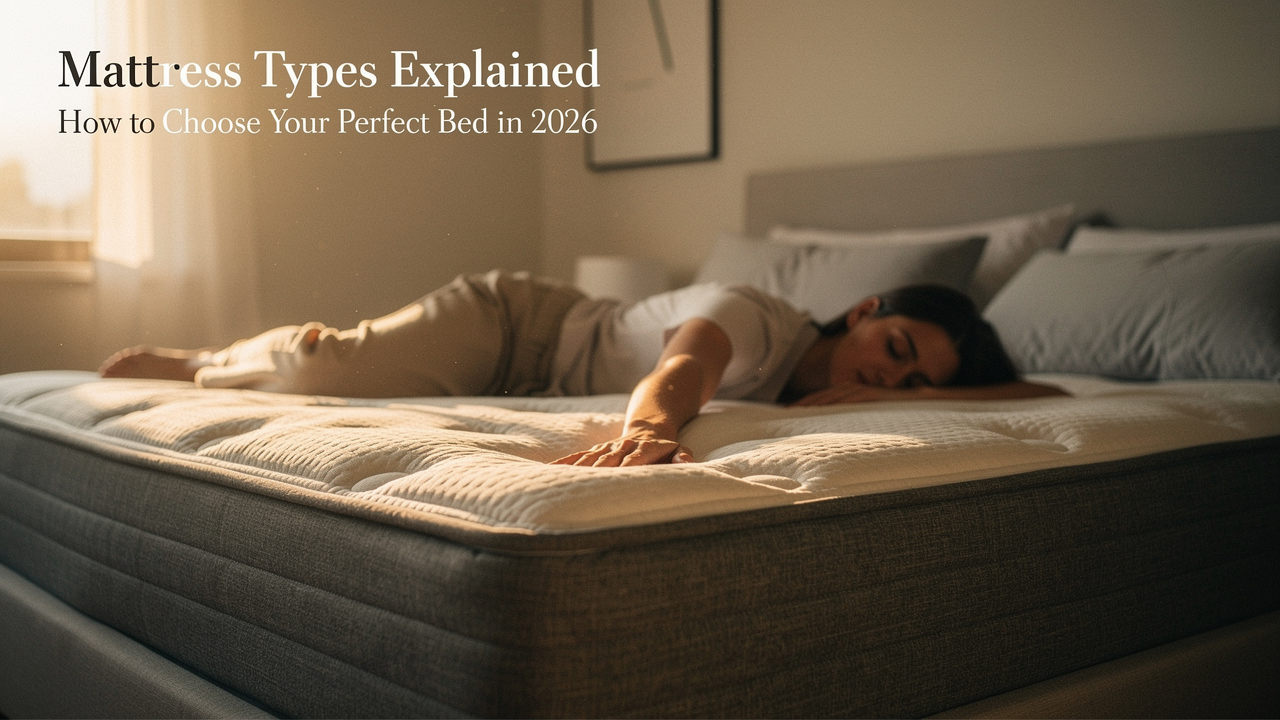
If you’re feeling that same "mattress overwhelm" right now, I get it. Buying a bed in 2026 is high-stakes. It’s an investment in your health, your mood, and your productivity. In my Austin home, I treat my bedroom as a sanctuary because I know that sleep is the ultimate performance multiplier. But with the sheer number of options available—from AI-driven smart beds to eco-friendly latex—it’s easy to get paralyzed.
Here’s the thing: we’re not just looking for a "good" mattress. We’re looking for a High Lifestyle ROI mattress—one that solves your specific sleep problems and is built to last. Let’s cut through the jargon and find your 1-in-100 match.
The Decision Fatigue Problem: Why You Can’t Find the Perfect Bed
Let’s be honest: choosing a mattress is stressful because a $1,500 mistake is hard to live with—literally. Because we only replace our beds every 7 to 10 years, the perceived risk is massive [3]. You aren’t just buying a product; you’re committing to a decade-long relationship.
The confusion usually starts with the reviews. You’ll see one person claiming a mattress saved their spine, while the next person says it felt like sleeping on a concrete slab. Consumer data shows that this mix of 5-star and 1-star reviews is exactly what leads to decision paralysis [3]. Marketing terms like "ultra-plush" or "luxury-firm" don’t help either, because they have no industry-standard definition. What feels "firm" to a 120-pound side sleeper will feel like a "marshmallow" to a 250-pound back sleeper.
To find your match, we have to stop looking at the mattress and start looking at you.
The 2026 Persona Framework: What’s Your Sleep Profile?
Before you click "add to cart," you need to build your sleep profile. This isn’t about what’s trending on social media; it’s about spinal alignment and pressure distribution [2]. According to the National Sleep Foundation, your mattress should support your body’s natural curves while keeping your spine in a neutral, straight line [2].
Side Sleepers: The Shoulder & Hip Relief Equation
Side sleeping is the most common position for adults, but it’s also the toughest on your joints [1]. When you’re on your side, your shoulders and hips create intense pressure points. If your mattress is too firm, those points won’t sink in, and your spine will bow upward like a rainbow.
Physical therapists generally recommend that side sleepers look for mattresses with at least 3 to 4 inches of dedicated "comfort layers" (the soft stuff on top) to allow for that necessary sinkage.
Back and Stomach Sleepers: The Support Core
If you sleep on your back, you’re in luck—this is generally the best position for spinal health. However, you need a mattress that prevents your hips from dipping too low. If your midsection sinks, it creates a "U-shape" in your spine, which is a one-way ticket to lower back pain [6]. Stomach sleepers need even more firmness to keep the hips level with the rest of the body.
Decoding the Tech: Mattress Types Explained
When we talk about "High Lifestyle ROI," we’re looking for durability vs. cost. A cheap innerspring might last five years, but a high-quality latex or hybrid could easily serve you for over a decade.
1. Memory Foam: For the ‘Hugging’ Sensation
Memory foam is famous for that "sinking in" feeling. It’s incredible for pressure relief and motion isolation—if your partner tosses and turns, you won’t feel a thing. In 2026, many of the old complaints about foam (like "sleeping hot") have been solved by advanced gel infusions and open-cell structures.
What to look for: Always check for CertiPUR-US certification [5]. This ensures the foam is made without ozone depleters and has low VOC emissions for indoor air quality.
2. Hybrid: The 2026 Market Leader
Hybrids are currently the most popular choice because they offer a "best of both worlds" experience. They combine a supportive coil base with several inches of foam or latex on top. You get the airflow and "bounce" of springs with the pressure relief of foam. Most major direct-to-consumer brands shifted their focus almost entirely to hybrids in 2026 because they cater to the widest variety of body types.
3. Latex: The Eco-Friendly Durability King
If you’re a minimalist who hates the idea of replacing a bed every few years, latex is your winner. It’s naturally cooling, incredibly bouncy (you don’t feel "stuck"), and is the most durable material on the market, often lasting 12+ years [3].
The Good Life Test: Look for GOLS (Global Organic Latex Standard) or OEKO-TEX Standard 100 to ensure your bed is free from harmful chemicals [5].
4. Smart Beds & AI-Adjustability
The newest frontier in 2026 is the AI-adjustable bed. These mattresses use sensors to detect your movements and automatically adjust the firmness of the air chambers throughout the night. While the American Academy of Sleep Medicine (AASM) notes that sleep tracking accuracy varies, the ability to change your bed’s firmness on the fly is a game-changer for people with fluctuating pain [1].
The "Best Mattress 2026" Shortlist
Finding "the one" often comes down to matching your specific struggle with a proven solution. Here are my top picks based on the personas we’ve discussed.
For the Side Sleeper with Joint Pain
I’ll be the first to admit that for years, I woke up with a nagging ache in my left shoulder. I thought it was my yoga practice, but it was actually my "extra-firm" mattress. I researched everything from specialized pillows to physical therapy until I realized my shoulder simply had nowhere to go when I laid down. I finally made the switch to a hybrid that actually prioritized "give" in the top layers while keeping the support underneath.
Micro-Verdict: The ultimate relief for side sleepers who need a soft landing without losing spinal support.
For the "I Wake Up Stiff" Back Sleeper
There is nothing worse than dreading the first five minutes of your morning because your back feels like it’s made of dry twigs. I spent months testing different foam densities to find something that didn’t let my lower back sag into a "U" shape by 3:00 AM. This specific model uses zoned support—meaning it’s firmer under your hips and softer under your shoulders—to keep everything perfectly aligned.
Micro-Verdict: A dream for back pain sufferers who need clinical-grade support that still feels cozy.


For the Chronic Hot Sleeper
If you’ve ever woken up in a sweat and had to flip your pillow three times, you know that temperature is the biggest enemy of deep sleep. I used to think foam was off-limits for me until I found construction that used perforated latex and copper-infused coils. The airflow is night and day compared to traditional builds.
Micro-Verdict: The best choice for anyone who prioritizes a cool, crisp sleeping environment.

For the Savvy Budget-Hunter
Let’s be real—not everyone wants to drop three grand on a mattress. When I was furnishing my first guest room here in Austin, I wanted something that felt high-end but stayed under $800. I found an essential innerspring that doesn’t skimp on the coil gauge, providing a traditional "bouncy" feel that guests actually rave about.
Micro-Verdict: High Lifestyle ROI for guest rooms or first-time buyers who want quality without the premium price tag.
The Buying Strategy: Trials, Warranties, and Triage
Even with all this research, you never truly know a bed until you sleep on it. This is why I always advocate for the "30-Night Rule."
Jordan’s 30-Night Rule
Your body needs time to adjust to a new alignment. Most people hate their new mattress on Night One because their muscles are literally relearning how to relax. Give it at least 30 nights before you even think about a return.
What to Look for in the Fine Print
- The Trial: Ensure you have at least 100 nights. Some 2026 brands now offer a full year.
- The Warranty: Check the "sagging threshold." Federal Trade Commission (FTC) guidelines are there to protect you, but many warranties only kick in if the sag is 1.5 inches or deeper [7].
- The Foundation: Make sure your bed frame is compatible. Putting a heavy hybrid on old, wide slats will void your warranty and cause the bed to fail early.
The Persona Loadout: Choosing Your Setup
Whether you’re a minimalist or a power sleeper, your "setup" matters as much as the mattress itself.
The Minimalist (Small Spaces)
You want high quality with zero clutter. Focus on materials that do the work of three.
- Essential: An all-latex mattress that doesn’t require a bulky box spring.
- Essential: A low-profile platform bed frame for under-bed storage.
- Pro Upgrade: A single, high-quality wool topper for natural temperature regulation.
The Performance Sleeper (The Tech Enthusiast)
You view sleep as a tool for recovery and want every advantage 2026 technology offers.
- Essential: An AI-adjustable smart mattress with dual-zone firmness.
- Essential: An adjustable base to alleviate snoring and improve circulation.
- Pro Upgrade: Integrated sleep sensors that sync with your home lighting for a "circadian wake-up" routine.
At the end of the day, "perfect" is a process, not just a product. Don’t let the fear of a bad choice keep you on a worn-out mattress that’s draining your energy. Start with your persona, trust the science of spinal alignment, and use that trial period to its full advantage.
You deserve to wake up feeling like the best version of yourself. Let’s make that happen.
Affiliate disclosure: We may earn a commission from links on this page. Health disclosure: Please consult a physical therapist or chiropractor for chronic spinal issues or severe pain.
References & Research
- American Academy of Sleep Medicine (AASM), (2025). Sleep Position and Its Impact on Health.
- National Sleep Foundation, (2025). Choosing the Right Mattress for Spinal Alignment. SleepFoundation.org
- Consumer Reports, (2025). Mattress Reliability and Owner Satisfaction Study.
- The Lancet, (2023). Effect of Mattress Firmness on Chronic Low Back Pain: A Randomized Trial.
- CertiPUR-US & OEKO-TEX, (2026). Standard 100: Safety and Emission Guidelines for Bedding Materials.
- Spine-Health, (2025). Orthopedic Guidelines for Lumbar Support.
- Federal Trade Commission (FTC), (2024). Consumer Guide to Mattress Warranties.