=
But let’s be honest: lately, that magic has felt a bit like a well-rehearsed play. I love the classics, but once you’ve saved Hyrule a dozen times, the “High Lifestyle ROI” starts to dip. If I’m going to spend my precious weekend hours on a game, I want it to surprise me. I want the exploration to feel earned, not just followed.
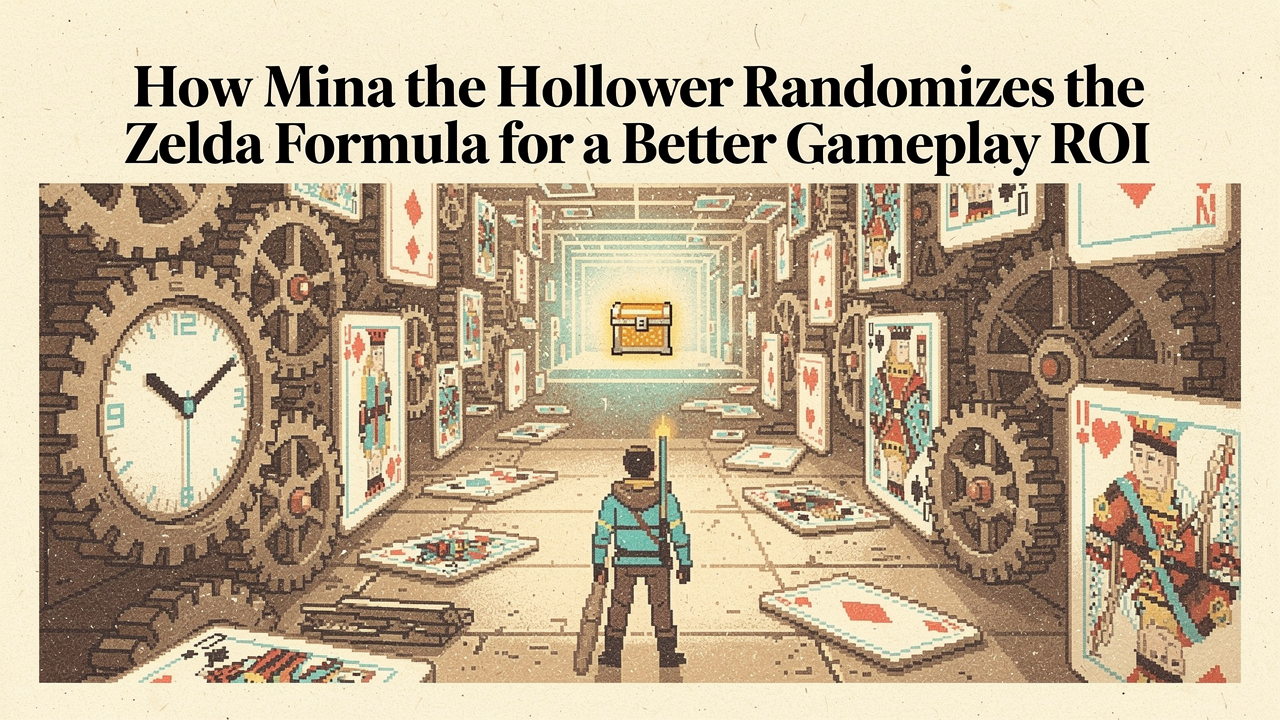
That’s where Mina the Hollower comes in. Developed by the retro-masters at Yacht Club Games, this title isn’t just a love letter to the Game Boy Color era; it’s a systemic reboot of the top-down adventure. By injecting randomization and high-speed movement into the rigid “Zelda formula,” it solves the one problem traditional adventure games have struggled with for decades: predictability.
The Anatomy of the ‘Zelda Formula’ (And Why It Feels Stale)
To understand why Mina feels so fresh, we have to look at the bones of the genre. For over thirty years, the “Zelda formula” has relied on a very specific loop: explore an overworld, find a themed dungeon, obtain a specific item, use that item to beat the boss, and then use that same item to unlock the next part of the overworld.
In the early days, this was revolutionary. It provided a sense of “Zelda-ness”—a term Nintendo developers have often used to describe the balance of exploration and puzzle-solving [1]. However, by the time we reached Skyward Sword, critics and fans alike were starting to feel the weight of that predictability. The game felt less like an adventure and more like a checklist.
The market shifted because we, as players, grew up. When Nintendo released Breath of the Wild, which sold over 30 million copies, they effectively proved that players were hungry to break away from linear constraints [2]. We don’t just want to be told where to go; we want to discover it. Yet, in the 2D space, many “Zelda-likes” still cling to that old, predictable script, leading to what I call “formula fatigue.”
Mina the Hollower: A High-Speed, Horror-Infused Solution
Here’s the thing about Yacht Club Games: they don’t just “do” retro; they optimize it. After seeing the Shovel Knight series sell over 2 million copies by perfecting the NES platformer [4], they turned their attention to the 8-bit adventure.
I remember when the Mina the Hollower Kickstarter launched. It was funded within 24 hours [5], and I think that’s because we all felt that same itch. We wanted that Link’s Awakening aesthetic, but with a darker, “Gothic Horror” edge that felt more like Castlevania or Bloodborne.
I’ll admit, I was skeptical at first. Could you really capture the soul of a handcrafted adventure while making it feel modern? But the moment I saw Mina move, I realized this wasn’t just a clone. It was an evolution.
The game trades the slow, methodical pace of Link for a frantic, kinetic energy. It replaces the bright fields of Hyrule with the brooding, Victorian-inspired Tenebrous Isle. It’s a game that respects your time by ensuring that every screen feels dangerous and every discovery feels like a genuine win.
Micro-Verdict: The ultimate cure for ‘Zelda fatigue’ that prioritizes speed and surprise.
The Burrow-Dash: How a New ‘Verb’ Changes Navigation
In game design, we talk a lot about “verbs”—the primary actions the player takes. Link’s primary verbs are usually “swing,” “block,” and “use item.” They are static. Mina, however, introduces a game-changing verb: Burrow.
This isn’t just a cosmetic choice. Burrowing allows Mina to dive underground, dodging attacks and crossing gaps with incredible speed. In traditional 2D Zelda games, movement is often a means to an end—walking from point A to point B. In Mina, movement is the gameplay.
- Invincibility Frames: Much like a dodge-roll in an action game, burrowing gives Mina a window of invulnerability, allowing you to move through enemy hitboxes [6].
- Terrain Interaction: You can’t just burrow everywhere; you have to manage your momentum and the type of ground you’re on, adding a layer of skill to simple navigation.
- Verticality: Even in a top-down perspective, the ability to go “under” obstacles creates a sense of 3D space that classic 2D titles lacked.
Compared to the relatively slow movement in the Link’s Awakening remake on Switch, Mina feels like a lightning bolt. It transforms the dungeon experience from a slow crawl into a high-stakes dance.
Randomized Zelda Mechanics: Shuffling the Deck Without Breaking the Game
This is where Mina truly earns its “Lifestyle ROI” for me. One of the biggest complaints about adventure games is their lack of replayability. Once you know the solution to a puzzle, the “Aha!” moment is gone forever.
Yacht Club solved this by introducing “randomization layers.” Instead of making the entire game a procedurally generated mess (which often ruins the “handcrafted” feel of a good puzzle), they use a hybrid approach.
I’ve spent quite a bit of time following the “A Link to the Past Randomizer” (ALttPR) community [7]. That community proved that you can shuffle items and dungeon entrances and still have a perfectly playable, incredibly fun game—as long as there is “logic” behind the randomness. Mina takes this concept and bakes it into the core design.
The game uses room permutations. This means the overall “shape” of a dungeon might remain consistent to preserve the narrative, but the internal layout, enemy configurations, and even certain puzzle elements can shift between runs. It’s the “Spectrum of Procedural Generation” in action—a design philosophy championed by developers like Derek Yu of Spelunky fame [8]. It ensures that your second or third trip through a dungeon doesn’t feel like a chore, but a fresh challenge.
Replayability ROI: Lessons for Future Adventure Games
At the end of the day, why does this matter? It matters because our time is the most valuable resource we have. When a game offers “High Replayability ROI,” it means the value of that purchase grows every time you pick it up.
Psychology tells us that “Surprise and Curiosity” are the primary drivers of engagement in gaming [9]. When an adventure game is too predictable, our curiosity dies. By adding unpredictability—not through chaos, but through smart, randomized systems—Mina the Hollower keeps the player in a state of constant discovery.
If you’re someone who values a well-curated gaming setup, here is what I’d call the “Modern Retro Loadout” for experiencing a game like this:
- Essential: A high-quality controller with a tactile D-pad (essential for those burrow-dashes).
- Essential: A pair of open-back headphones to capture the moody, Gothic soundtrack.
- Pro Upgrade: An OLED screen to make those Game Boy Color–style neon purples and deep blacks truly pop.
- Lifestyle Bonus: A dedicated “Sunday Reset” playlist and a fresh bag of Austin-roasted coffee.
Mina the Hollower isn’t just another indie game; it’s a blueprint for how we can keep the genres we love from becoming museum pieces. It proves that you can respect the past while refusing to be trapped by it.
If you’re tired of the same old dungeons and want a game that respects your intelligence and your time, keep your eyes on this one. It’s a masterclass in how to make the old feel brand new again.
To stay updated on the launch and catch my full review when the final build drops, follow Yacht Club Games or sign up for their newsletter. Let’s make our gaming time count for more.
***
References & Resources
- Nintendo Co., Ltd. (2011). Iwata Asks: The Legend of Zelda: Skyward Sword. [Official Interview Archive].
- Nintendo Co., Ltd. (2024). Earnings Release: Fiscal Year Ending March 2024. [Financial Report].
- IGN. (2011). The Legend of Zelda: Skyward Sword Review. [Critical Analysis].
- Yacht Club Games. (2019). Five Years of Shovel Knight: Sales and Success. [Developer Blog].
- Kickstarter. (2022). Mina the Hollower by Yacht Club Games. [Crowdfunding Project Page].
- Polygon. (2022). Mina the Hollower Hands-on Preview: Faster, Darker, Deeper. [Gaming News].
- ALttPR Team. (2023). A Link to the Past Randomizer: Logic and Design. [Official Documentation].
- Yu, D. (2016). Spelunky (Boss Fight Books). [Game Design Analysis].
- Game Studies Journal. (2020). The Role of Uncertainty and Surprise in Player Engagement. [Academic Paper].