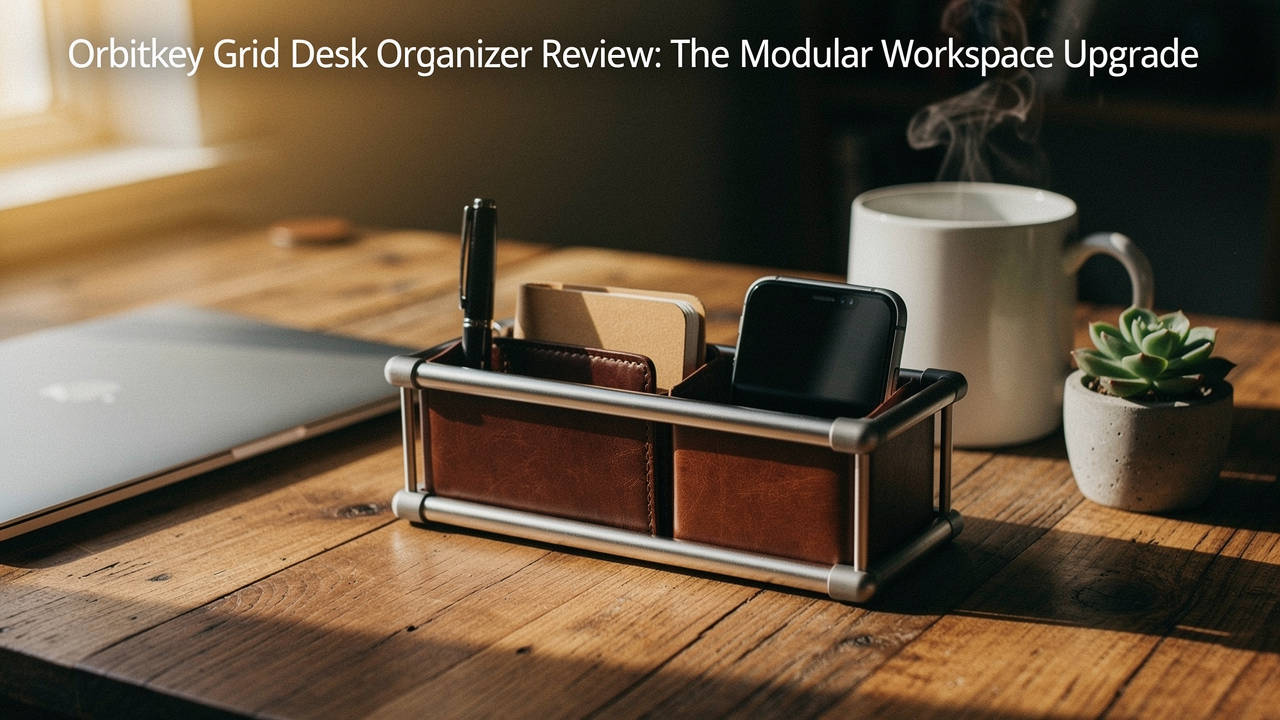
I’ve always believed that our environment is the silent partner in our productivity. When your space is a mess, your brain spends extra cycles just trying to ignore the chaos. I’ve tried the cheap plastic bins and the aesthetic wooden trays, but they always felt like a temporary Band-Aid. What I really needed was a system that could grow and change as my workday did.
That’s what led me to the Orbitkey Grid Desk Organizer. It’s not just a tray; it’s a modular ecosystem designed for those of us who view our desks as a high-performance command center. After a month of daily use, I’m ready to share if this “High Lifestyle ROI” item actually lives up to the hype.
The Problem: Why ‘Flat’ Desks Lead to Cognitive Load
We’ve all been there: you’re in the middle of a deep work session, you reach for a pen, and you end up knocking over a stack of mail or tangling your fingers in a charging cord. It’s a micro-frustration, but those moments add up.
Environmental psychology research suggests that visual clutter isn’t just an eyesore—it’s a cognitive drain. Studies published in Environment and Behavior have shown that physical clutter in your surroundings competes for your attention, leading to increased stress and decreased focus [1]. In fact, some workplace surveys indicate that the average professional loses up to 4.3 hours a week just searching for items in a disorganized workspace [2].
The real issue with traditional “flat” desks is that they lack intentional zones. Without a designated home for your “everyday carry” items, they naturally migrate toward the center of your workspace. A simple desk mat provides a surface, but it doesn’t provide discipline. This is where the concept of a grid-based system changes the game.
Orbitkey Grid Desk Organizer: First Impressions and Build Quality
I’ll admit it—I was skeptical at first. I’ve seen plenty of “modular” systems that felt flimsy or looked like they belonged in a garage workshop. But Orbitkey has a reputation for combining utility with a very specific, refined aesthetic that fits perfectly into a modern home.
When I unboxed the Grid Desk Organizer, the first thing I noticed was the weight. It feels substantial. The base is crafted from a combination of vegan leather and recycled PET felt, giving it a tactile, premium feel that doesn’t slide around when you’re reaching for a tool.
The “Bridge” to the Grid: Here’s the thing about my desk: it’s a revolving door of gear. One hour I’m sketching out ideas with a fountain pen, the next I’m editing photos with a card reader and two external drives. I used to use a standard wooden desk caddy, but it was too rigid; I couldn’t fit my larger items, and the small ones got lost at the bottom. I found myself constantly rearranging the “clutter” rather than actually organizing it. The Orbitkey Grid caught my eye because it promised a way to lock items into place while still being completely reconfigurable.
Micro-Verdict: The ultimate “set it and forget it” solution for people who hate static organizers.
The Grid System: How Modularity Actually Works
The magic of this system lies in the base plate. It features a subtle, recessed grid pattern that allows you to “snap” various modules into place. Unlike magnetic systems that can sometimes shift, these modules feel locked in.
In industrial design, we often talk about “Reach Zones.” Your primary reach zone is the area you can access without moving your torso. By using a grid, you can place your most-used items (like a pen or a phone charger) exactly within that ergonomic sweet spot.
Cable Management: Solving the ‘Spaghetti’ Problem
Cable management is usually the biggest hurdle to a clean desk. The Orbitkey Grid approaches this by treating cables as part of the layout rather than something to be hidden. The dedicated cable holders slide into the grid, allowing you to route your laptop or phone charger exactly where you need it. No more diving under the desk to find a dropped USB-C head.
Real-World Performance: 30 Days on the Desk
After 30 days of testing, I’ve noticed a significant shift in my “Sunday Reset” ritual. Usually, I spend twenty minutes clearing off my desk for the week ahead. With the Grid, I don’t have to. Everything has a dedicated coordinate.
Miller’s Lab Note: I was worried the felt would attract dust or that the vegan leather would show “rings” from my coffee mug. Surprisingly, the materials are incredibly resilient. A quick wipe with a damp cloth kept the leather looking new, and the felt base is dense enough that it doesn’t “pill” like cheaper alternatives. I did notice that if you leave a very heavy item (like the Orbitkey Nest) in one spot for weeks, it leaves a slight impression in the felt, but it usually bounces back once moved.
The ‘Miller Method’ Layouts: Pro Setup Blueprints
One size never fits all. Depending on what your “Good Life” looks like, you should configure your grid differently. Here are two layouts I’ve found most effective:
The Deep Work Setup (Minimalist)
This layout is for the days when I’m writing or doing deep research. It’s about removing every possible distraction.
- Essential: Single pen holder located in the top-right grid.
- Essential: Small tray for a single notebook or a stack of 3×5 index cards.
- Essential: One dedicated cable routing point for a laptop charger.
- Pro Upgrade: A single “catch-all” module for a pair of blue-light glasses.
The Creator’s Command Center
When I’m in editing mode, my gear needs change. This layout maximizes utility for peripherals.
- Essential: Large modular tray for an external SSD and SD card reader.
- Essential: Dual cable holders to manage both a tablet and a phone charger.
- Essential: Vertical stand module for a stylus or Apple Pencil.
- Pro Upgrade: The Orbitkey Nest integrated at the top for hidden storage of dongles.
Pros, Cons, and the Competition
No product is perfect, and the Orbitkey Grid is definitely a premium investment.
Pros:
- Incredible build quality with sustainable materials.
- Highly adaptable; it evolves with your hardware.
- Superior cable management compared to standard trays.
- Aesthetic fits both corporate and “warm” home offices.
Cons:
- Higher price point than basic organizers.
- Requires a certain amount of desk depth to fit comfortably.
- The “ecosystem” effect: you’ll likely want to buy more modules over time.
The Competition: If you prefer a natural, organic look, Grovemade offers stunning wooden desk organizers. However, they are static—once you buy a tray with three slots, you are stuck with those three slots. On the other end of the spectrum, the IKEA SKÅDIS system is great for vertical storage, but it lacks the tactile, premium “on-desk” feel that the Orbitkey Grid provides.
Frequently Asked Questions
Is the Orbitkey Grid compatible with other brands?
While the grid spacing is proprietary to Orbitkey modules, the flat surfaces are generous. I’ve successfully used third-party magnetic cable clips on the leather portions, though they won’t “lock” into the grid like the official accessories.
How do you clean the felt and vegan leather?
I recommend a microfiber cloth and a gentle, alcohol-free cleaner for the leather. For the felt, a simple lint roller once a week keeps it looking pristine. Avoid using heavy chemicals, as they can break down the recycled fibers over time.
Final Verdict: Is it a High ROI Lifestyle Purchase?
If you are someone who spends 8+ hours a day at your desk, the answer is a resounding yes. The Orbitkey Grid Desk Organizer isn’t just about “tidying up”—it’s about creating a launchpad for your best work. By reducing the visual noise and giving your tools a permanent, flexible home, you’re reclaiming the mental energy usually lost to clutter.
It passes the Good Life Test: it solves the real problem of workspace chaos, it’s built from sustainable, high-quality materials, and it genuinely makes the start of my workday feel more intentional.
Check out the Orbitkey Grid Desk Organizer
and let me know: what’s the one piece of clutter on your desk you just can’t seem to conquer?Affiliate Disclaimer: Best Goods for Good Life may earn a commission on purchases made through links in this article. This product was provided for review by Orbitkey, but all opinions and “Miller Method” layouts are my own.
Resources & Methodology
- McMains, S., & Kastner, S. (2011). Interactions of top-down and bottom-up mechanisms in human visual cortex. The Journal of Neuroscience. [Study on how clutter competes for attention].
- National Association of Productivity and Organizing Professionals (NAPO). (2023). Workplace Productivity Statistics and Search Time Data.
- Orbitkey. (2024). Grid Desk Organizer Technical Specifications and Material Sustainability Report. [Official Documentation].
- Steelcase Workplace Research. (2022). The Psychology of the Desk: How Environment Impacts Focus.