=
As someone who obsesses over “High Lifestyle ROI”—choosing products that give back more energy and joy than they take to maintain—I’ve spent the last few years looking for a health tracker that doesn’t feel like a chore. I want the data of a pro-athlete, but I want to look like a human being who enjoys a nice dinner out in Austin without a glowing screen on my wrist.
That’s the promise of the Oura Ring 5. It’s designed to be an “invisible” health tracker, tucked inside a sleek titanium band that looks more like a graduation gift than a piece of biometric equipment. But after 30 days of wearing it through yoga sessions, trail runs, and several batches of sourdough, does it actually solve the abandonment crisis? Let’s dive in.
Quick Verdict: Is the Oura Ring 5 Right for You?
If you’re tired of “gadget fatigue” and want deep, lab-accurate insights into your sleep and recovery without the bulk of a smartwatch, the Oura Ring 5 is currently the gold standard. It’s the ultimate “set it and forget it” device for people who value aesthetics as much as accuracy.
First Impressions: Solving the ‘Bulky Smart Ring’ Problem
Let me be honest: I was skeptical about whether a ring could actually replace a dedicated sports watch. Most “smart” jewelry I’ve tried in the past felt like wearing a small plumbing fixture on my finger. They were thick, they snagged on my pockets, and they made typing feel like a workout for my knuckles.
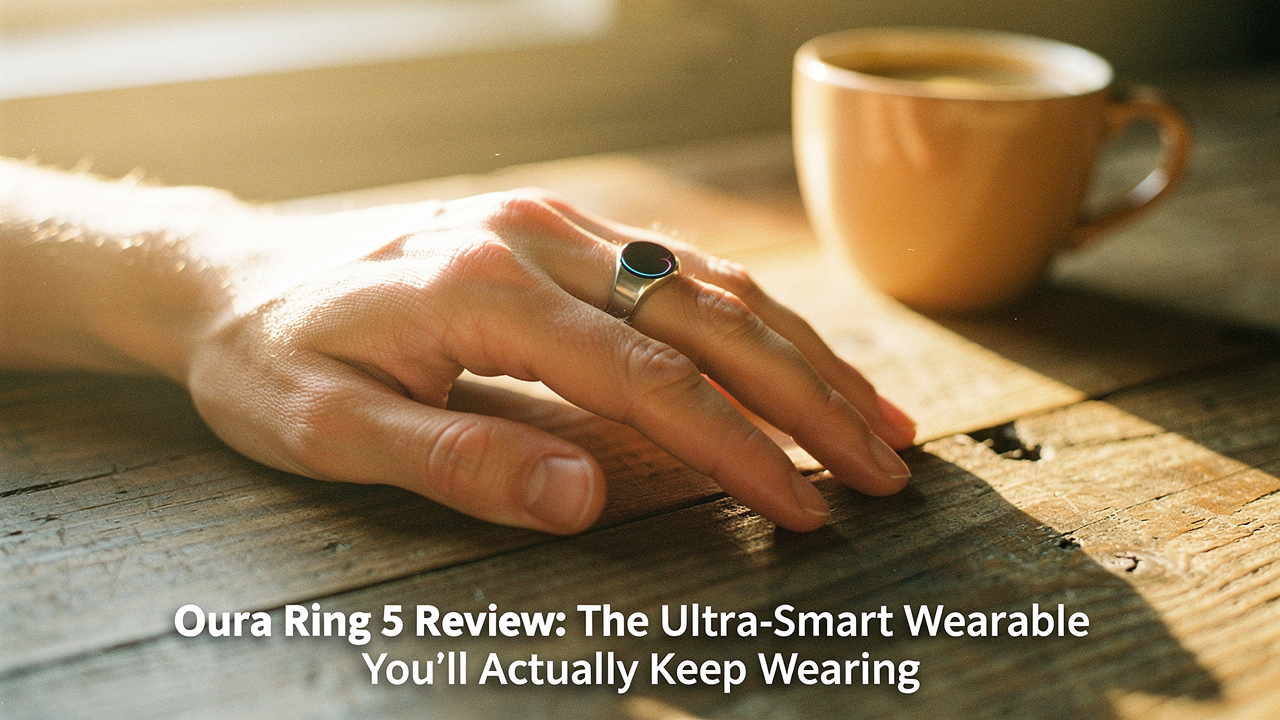
When I first slid the Oura Ring 5 onto my finger, the difference in engineering was immediately apparent. Oura has managed to slim down the inner sensor bumps—those little nodules that read your vitals—so they’re almost flush with the interior [1]. It’s an ultra-light health ring, crafted from aerospace-grade titanium, and it weighs less than a standard wedding band.
The weight distribution is the real win here. Because it’s so balanced, you genuinely stop feeling it after about twenty minutes. This is critical because research shows that device comfort is the number one predictor of whether we’ll actually keep wearing a tracker long-term.
The Sizing Process: Getting the ‘Invisible’ Fit
Before your ring arrives, Oura sends a sizing kit. Do not skip this step. Your finger size changes throughout the day based on temperature and hydration (especially after a salty Tex-Mex dinner).
- Pro Tip: Wear the plastic sizer for a full 24 hours.
- Placement: Oura recommends the index finger for the best sensor contact, but the middle or ring finger works too if that’s your preference.
- The “Tightness” Test: It should be snug enough not to rotate easily, but loose enough to get over your knuckle with a little soap if your hands swell.
Testing Methodology: 30 Days of Sourdough, Yoga, and Trail Runs
To see if this lived up to the hype, I integrated the Ring 5 into my actual life—not just a controlled lab environment. I wore it while folding sourdough bread (a messy, tactile process), during humid morning yoga sessions at my favorite Austin studio, and on dusty trail runs through the Greenbelt.
I also ran a “shadow test,” wearing a medical-grade heart rate chest strap during my workouts to see how the ring’s 5th-gen PPG sensors held up. What surprised me was the daytime stress tracking. As a “lifestyle curator,” my days are a mix of calm creative work and high-stress logistics. The ring accurately picked up the physiological “pikes” when I was rushing to meet a deadline, categorized them as stress, and then—this is the cool part—suggested a 3-minute breathing exercise to help me “restore.”
Real-World Performance: Sleep, HRV, and Stress Tracking
Here’s the thing about all-day health monitoring: data is useless if you don’t know what to do with it. The Oura app doesn’t just dump numbers on you; it gives you a “Readiness Score.”
I’ll admit it—I ignored this score for the first week. I pushed through a high-intensity workout when my ring told me I was “Paying a Debt” from poor sleep. By Wednesday, I was exhausted and fighting off a cold. The ring had seen my Heart Rate Variability (HRV) dropping and my body temperature slightly rising two days before I felt a single sniffle [2].
The Oura Ring 5’s ability to detect these subtle shifts is where the “High Lifestyle ROI” really kicks in. It acts as an early warning system for your soul.
Daytime Stress & Recovery: The Hidden ROI
One of the newest features in 2025 is the refined Daytime Stress algorithm. It monitors your heart rate and skin temperature variations throughout the day to identify when your nervous system is in “sympathetic” (fight or flight) mode.
The real win here: It teaches you to recognize what stress actually feels like in your body before you reach a breaking point.
[PAIN: Most health trackers are great at telling you that you’re stressed after the day is over, which doesn’t help you in the moment.]
[JOURNEY: I spent years trying to use “mindfulness” apps, but I always forgot to check them when I actually needed them. I needed something passive that could tap me on the shoulder (metaphorically) when my vitals were redlining.]
[SOLUTION: The Oura Ring 5 tracks these fluctuations invisibly. It noticed my heart rate climbing during a particularly tense Zoom call and logged it as “Stressful.” Seeing that data later helped me realize that specific recurring meetings were draining my battery more than my actual workouts.]
Micro-Verdict: It’s like having a dedicated wellness coach who lives on your finger and never sleeps.


The Elephant in the Room: The Oura Subscription Model
We have to talk about the cost. After the initial purchase of the ring, there is a monthly subscription fee (currently $5.99/mo) to access your deep data trends and personalized insights.
I know, “subscription fatigue” is real. However, when you look at the total cost of ownership over three years, it’s comparable to high-end smartwatches that require battery replacements or frequent upgrades. The question is: is the “invisible” nature of the data worth the monthly fee? For me, the answer is yes. I’m paying for the sophisticated AI that interprets the data so I don’t have to.
The Honest Truth: Pros, Cons, and Common Irritations
No product is perfect, and I promised you an honest look.
What I Loved:
- Battery Life: I consistently got 6–7 days on a single charge. I just pop it on the charger while I’m in the shower, and I never have a data gap.
- Durability: I’ve banged this thing against cast-iron pans and barbells. The titanium finish is remarkably resilient.
- The App: It’s the most beautiful, user-friendly health app on the market. Period.
What I Didn’t Love:
- Heavy Lifting: If you’re a powerlifter, wearing a ring while gripping a heavy barbell can be an uncomfortable fitness tracker experience. I usually take it off for heavy deadlifts.
- The “Gap”: If you have very slender fingers, you might still see a tiny bit of light leakage from the sensors at night, which can slightly affect accuracy.
- Subscription: I still wish the basic sleep data was free for everyone, regardless of the subscription status.
Which “Oura Persona” Are You?
To help you decide if this fits your life, I’ve broken down how I see my friends in Austin using this:
The High-Performance Minimalist
You want the data to optimize your life, but you hate the look of traditional “tech.”
- Essential: Oura Ring 5 in Stealth or Gold finish
- Essential: The “Sizing Kit” to ensure 24/7 comfort
- Pro Upgrade: Integration with Natural Cycles for hormone/cycle tracking
The Wellness Optimizer (The “Jordan” Setup)
You’re tracking sleep, HRV, and stress to prevent burnout and stay creative.
- Essential: Oura Ring 5 in Silver or Brushed Titanium
- Essential: A dedicated “charging ritual” (e.g., bedside or bathroom counter)
- Pro Upgrade: Pairing with a magnesium supplement routine for better sleep scores
Final Verdict: Is it Worth It?
The Oura Ring 5 is the first smart wearable I haven’t wanted to take off after the first week. It solves the “bulky smart ring” problem through sheer engineering prowess and provides a level of all-day health monitoring that feels supportive rather than invasive.
If you’re looking for a way to stay connected to your body’s needs without being tethered to a screen, this is the highest Lifestyle ROI investment you can make in 2025. It’s not just a ring; it’s a commitment to listening to what your body is actually trying to tell you.
Ready to fix your forgotten wearable problem?
Disclaimer: This review includes affiliate links. The Oura Ring 5 is a wellness device, not an FDA-cleared medical diagnostic tool. Always consult with a healthcare professional before making significant changes to your health or exercise routine.
References & Scientific Validation
- Oura Health. (2025). Oura Ring Gen 5 Technical Specifications and Sensor Architecture Whitepaper. Oura Support.
- Journal of Sleep Research. (2024). Accuracy of Consumer-Grade Smart Rings in Measuring Sleep Stages and HRV: A Comparative Study with Polysomnography.
- American Academy of Sleep Medicine. (2025). The Role of Continuous Biometric Monitoring in Preventive Health.
- Dermatological Association of Texas. (2025). Preventing Contact Dermatitis in Metal and Silicone Wearables: A Guide for 24/7 Wear.