=
I’ll be honest, I was skeptical. I take my supplements, I eat well, and I spend time outdoors. But here’s the thing—modern life is designed to keep us behind glass. Whether it’s the office, the car, or even your sun-drenched living room, the specific wavelengths our bodies need to produce “the sunshine vitamin” are being filtered out before they ever touch our skin.
What finally clicked for me was realizing we’ve been limited to three options for Vitamin D: the sun (unreliable and risky), diet (insufficient), or pills (often poorly absorbed). Recently, a fourth option emerged: targeted, at-home UVB therapy. Today, I’m diving into the Solius Pro, the first-ever FDA-cleared, over-the-counter UVB panel designed specifically to help your body produce its own Vitamin D. Is it a high lifestyle ROI investment, or just another expensive gadget? Let’s look at the science.
The Vitamin D Gap: Why Sunlight and Pills Sometimes Fail
We’ve been told for decades that 15 minutes of sun is all we need, but the reality is more nuanced. Historically, about 80% to 90% of human Vitamin D was synthesized through the skin [1]. However, our indoor-centric lifestyles have created a massive gap.
Inadequate Vitamin D from indoor living isn’t just about lack of time outside; it’s about the physics of light. Glass windows are excellent at letting in light, but they are nearly 100% effective at blocking UVB radiation in the 290–315 nm range—the exact “Vitamin D window” required for cutaneous synthesis [2]. If you’re sitting by a window all day, you might get a tan from UVA rays (which cause aging), but you aren’t making any Vitamin D.
Then there’s the pill problem. While oral supplements are the go-to Vitamin D deficiency solution for most, they aren’t a perfect fix. For many of my friends in the wellness community who struggle with GI issues like Celiac or Crohn’s, or those who have had bariatric surgery, malabsorption makes oral pills incredibly inefficient [3]. This “pill fatigue”—the daily grind of taking capsules that might not even be moving the needle—is exactly why a device like the Solius Pro caught my attention.
What is Solius Pro? Decoding the First OTC Home UVB Panel
I’ll admit, I was nervous when I first heard “UVB panel.” My mind immediately went to the orange-tinted tanning beds of the early 2000s. But Solius Pro is fundamentally different. This isn’t a cosmetic device; it’s a targeted photobiological tool.
While a tanning bed uses broad-spectrum UVA to darken the skin, the Solius Pro utilizes a very narrow, specific band of UVB light—specifically between 295 and 300 nm. This is the “sweet spot” identified by researchers as the most efficient range for triggering Vitamin D3 synthesis in the skin with the least amount of energy [4].
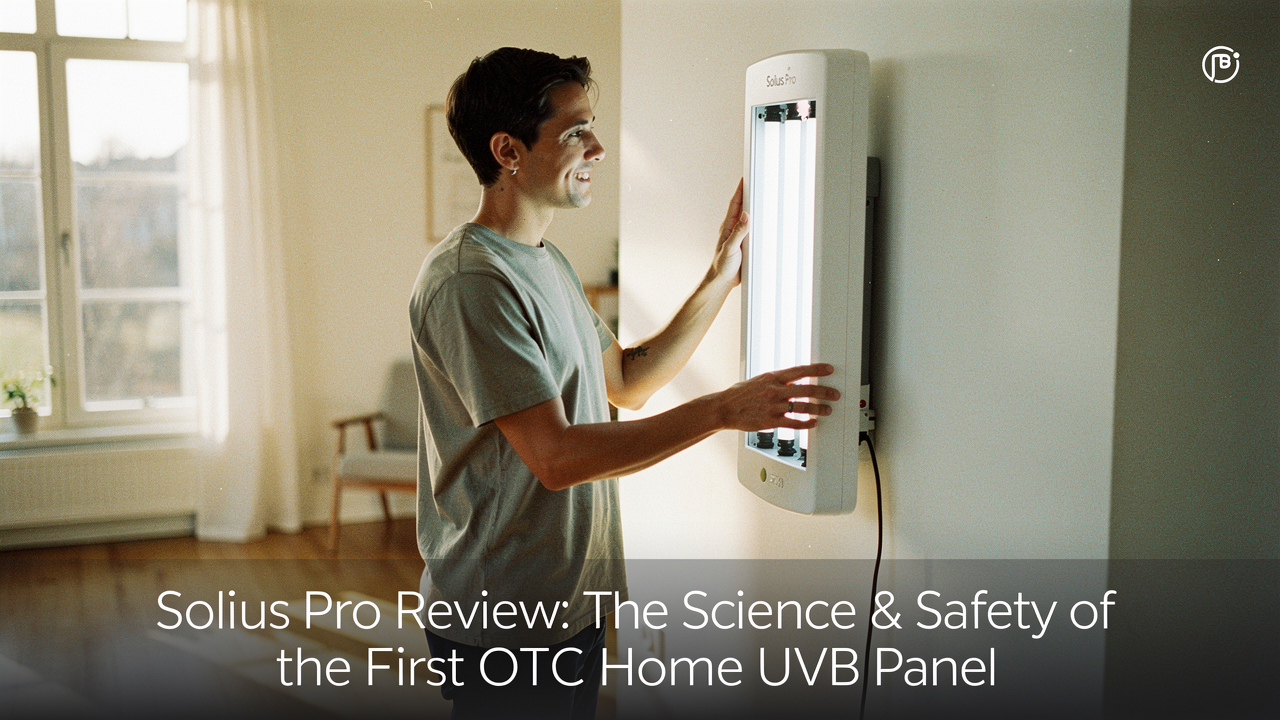
The device itself is a sleek, vertical panel that looks more like a piece of high-end home gym equipment than a medical tool. It uses specialized LED or fluorescent emitters (depending on the model) to deliver a measured “dose” of light. Unlike the sun, which changes intensity based on the time of day, your latitude, and the clouds, the Solius Pro provides a consistent, measurable output every single time.
The Regulatory Truth: What “FDA Cleared” Actually Means
When we talk about health tech, the term “FDA” gets thrown around a lot, often incorrectly. Solius Pro is FDA-cleared, not “approved.” In the world of medical devices, “approval” is typically reserved for high-risk, life-sustaining equipment.
Solius Pro went through the De Novo classification pathway. This is used for novel, moderate-risk devices that don’t have a “predicate” (something similar already on the market). By granting this clearance, the FDA has acknowledged that the device is safe and effective for its intended use—which, in this case, is helping the body produce Vitamin D—when used as directed [5].
This is a massive deal because it’s the first over-the-counter UVB panel for Vitamin D to receive this level of regulatory scrutiny. It moves the conversation from “wellness gadget” to “validated medical tool,” giving us a level of confidence that the cheaper, unbranded “Vitamin D lamps” on Amazon simply can’t match.
Safety & The Fitzpatrick Scale: Can You Overdo It?
The biggest question I get when I mention UVB therapy is: What about skin cancer? It’s a valid concern. Any UV exposure carries a risk of photoaging and DNA damage. However, the philosophy behind Solius Pro is “minimum effective dose.”
Because the device is so targeted (295–300 nm), you can stimulate Vitamin D synthesis with a tiny fraction of the UV energy you’d get from standing outside. To keep things safe, the device uses the Fitzpatrick Scale to determine your exposure time.
- Fitzpatrick Type I-II: Fair skin that burns easily. These users require very short sessions (often under 2 minutes).
- Fitzpatrick Type III-IV: Medium skin that tans. These users need slightly longer sessions to overcome the natural UV protection of their melanin.
- Fitzpatrick Type V-VI: Dark skin. Because melanin blocks UVB, these individuals often need 3 to 10 times more exposure than Type I to produce the same amount of Vitamin D [1].
The Solius Pro system calculates your dose in millijoules (mJ/cm²), ensuring you get enough light to trigger the “D” response without reaching the “erythema” (sunburn) threshold. And yes, you absolutely have to wear the included eye protection to prevent photokeratitis.
Comparison: Solius Pro vs. Traditional Supplements
I used to think of Vitamin D as just a pill I tossed back with my morning coffee. But I’ve learned that when your body makes its own Vitamin D through the skin, it’s a more “balanced” process.
The ‘Pill Fatigue’ Factor
Here’s the thing about at-home Vitamin D treatment: adherence is everything. I’ve gone through phases where I just can’t look at another supplement bottle. This is where the Solius Pro really shines. It turns a chore into a ritual. Instead of a pill, it’s a two-minute “light break” twice a week.
What surprised me was the physiological difference. When you take a pill, you risk “hypervitaminosis” (too much Vitamin D) if you overdo it. However, the skin has a built-in safety mechanism. Once you’ve synthesized enough Vitamin D, your skin naturally starts breaking down any excess, making it virtually impossible to reach toxic levels through light alone [6].
Micro-Verdict: The Solius Pro offers a self-limiting, bio-identical way to maintain Vitamin D levels that bypasses the gut entirely.

Personal Testing Protocol: How to Use Solius Pro Effectively
If you decide to invest in a home UVB panel, you can’t just “wing it.” You need to treat it with the same respect you’d give a prescription. Based on my research and discussions with experts, here is the most effective way to integrate it into your life:
- Step 1: Baseline Testing. Before you even turn the panel on, get a 25(OH)D blood test. You need to know your starting point.
- Step 2: Skin Typing. Honestly assess your Fitzpatrick skin type. If you aren’t sure, err on the side of a shorter session.
- Step 3: Consistency over Intensity. Use the device as recommended—typically 2 sessions per week. Don’t try to “batch” your light by doing one long session.
- Step 4: The 12-Week Check. It takes time for serum levels to shift. Retest your blood levels after 3 months of consistent use.
I also recommend a “Dermatologist’s Corner” approach: even if you’re using an OTC device, keep up with your annual skin checks. It’s about being proactive, not reckless.
Pros, Cons, and The “High Lifestyle ROI” Verdict
Is the Solius Pro for everyone? No. It’s a significant financial investment, often costing over $1,000. But for the right person, the ROI is undeniable.
Best for: The Optimization Geek & The Malabsorber
- The Malabsorber: If you have GI issues that make supplements useless, this is a legitimate medical lifeline.
- The Optimization Geek: For those of us in Austin (or anywhere!) who want the most “natural” version of every nutrient, skin-synthesized Vitamin D is the gold standard.
- The Northern Dweller: If you live in a latitude where the “Vitamin D winter” lasts six months, this device is a game-changer.
Skip it if: The Budget Conscious
If you’re healthy, your gut works perfectly, and you have no problem taking a $0.10 Vitamin D softgel every morning, the Solius Pro is a luxury you probably don’t need.
References
- Holick, M. F. (2007). Vitamin D deficiency. New England Journal of Medicine.
- Tuchinda, C., et al. (2006). Photoprotection by window glass, automobile glass, and plastics. Journal of the American Academy of Dermatology.
- American Society for Metabolic and Bariatric Surgery (ASMBS). (2016). Integrated Health Nutritional Guidelines for the Surgical Weight Loss Patient.
- Journal of Investigative Dermatology. (2012). Action Spectrum for Vitamin D3 Synthesis in Human Skin.
- FDA De Novo Database. (2024). Classification for Solius Pro UVB Device.
- NIH Office of Dietary Supplements. (2023). Vitamin D Fact Sheet for Health Professionals.
Disclaimer: This review is for informational purposes and does not constitute medical advice. UV exposure carries inherent risks including photoaging and skin cancer. Always consult your dermatologist or endocrinologist before starting UVB therapy.