What finally clicked for me was realizing that my morning flow didn’t need more effort—it needed a better tool. I’m a big believer in the “High Lifestyle ROI” philosophy: I want gadgets that solve real problems, last for years, and actually spark joy during my 7:00 AM routine.
Here’s the thing: you shouldn’t have to choose between a 12-hour wait for cold brew or the diluted disappointment of “regular” iced coffee. I decided to put a $20 rapid-chilling device to the test to see if it could really deliver a barista-quality cup in under 60 seconds.
The Dilution Problem: Why Your Home Iced Coffee Tastes Weak
Let’s talk about the science for a second, because understanding why coffee goes “flat” is the first step to fixing it. According to the Specialty Coffee Association (SCA), the “Golden Cup” standard for hot coffee usually falls between a 1:15 and 1:18 coffee-to-water ratio [1]. When you brew a standard cup and immediately pour it over ice, the heat from the liquid causes the ice to melt instantly.
This creates a “double dilution” effect. Not only are you adding extra water as the ice melts, but you’re also lowering the Total Dissolved Solids (TDS), which is just a fancy way of saying the flavor gets stripped away. Most of us try to fix this by brewing “double strength,” but that often results in a bitter, over-extracted mess that lacks the nuanced sweetness of a specialty bean.
Slow iced coffee brewing is the other alternative, but let’s be honest: I don’t always have the foresight to start a cold brew at 9:00 PM on a Sunday. I wanted a way to capture the bright acidity and floral notes of a flash-chilled “Japanese-style” iced coffee without the math or the mess [2].
Meet the $20 Solution: The Rapid Chilling Revolution
I’ll admit it—I was skeptical at first. I’ve seen enough “as seen on TV” kitchen gadgets to fill a dumpster, and I usually prefer a minimalist counter. But when I found a stainless-steel rapid chiller priced at just twenty dollars, I felt it passed my initial “Good Life Test.” It’s built to last (no mechanical parts to break), it solves the dilution problem, and it fits neatly into the freezer.
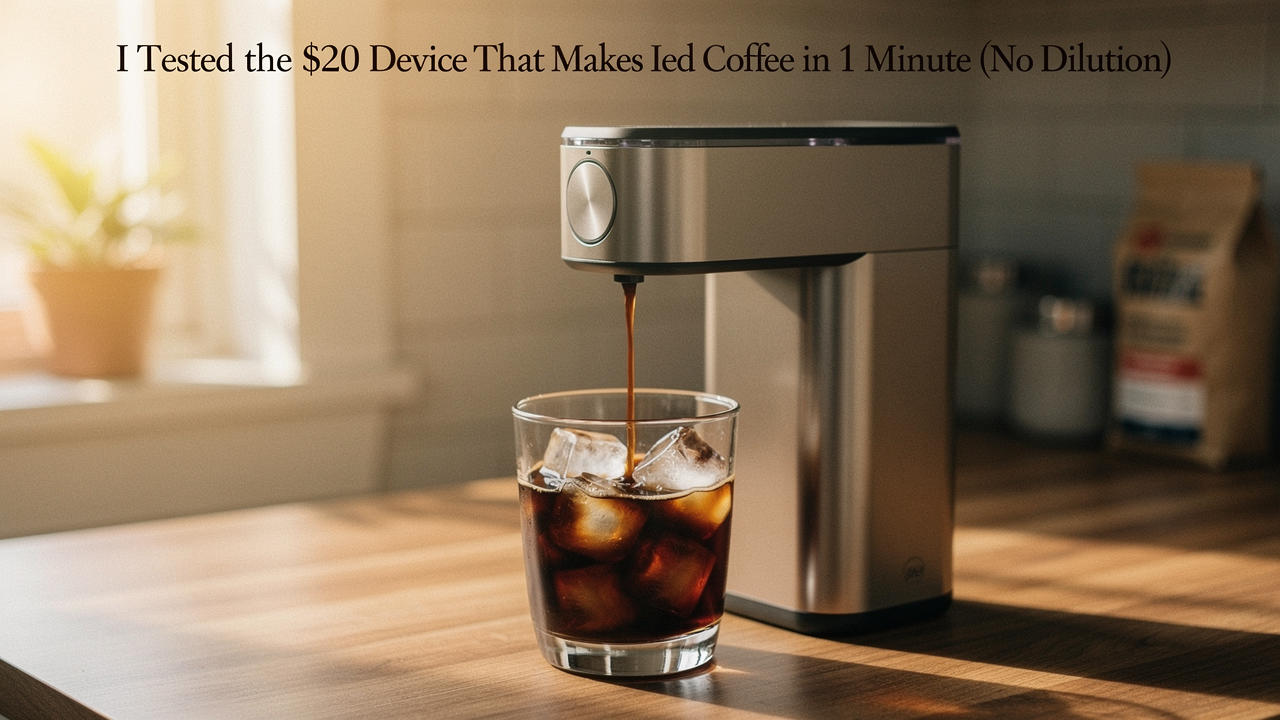
The design is brilliantly simple. It’s essentially a nested system of stainless steel chambers. You fill the outer and innermost sections with water and freeze the whole thing. When you’re ready for coffee, you pour your hot brew into the middle chamber. The coffee is surrounded by ice-cold steel on both sides, but it never actually touches the ice itself.
It’s an affordable coffee gadget that promises to drop the temperature of your drink by over 130 degrees in one minute. Because the coffee remains in a sealed environment, zero dilution occurs.
The 60-Second Test: From Hot Coffee to Ice Cold
To see if this was truly a fast iced coffee solution, I set up a stopwatch. I brewed my favorite Ethiopian light roast at a standard 200°F using a simple pour-over.
The journey from “boiling” to “refreshing” looked like this:
- 0:00: Poured 8oz of hot coffee directly from the carafe into the pre-frozen device.
- 0:30: Gave the device a gentle swirl (agitation helps the heat transfer faster).
- 1:00: Poured the coffee out into a glass.
What surprised me was the temperature. The coffee came out at roughly 38°F. That is “fridge cold” in sixty seconds.
Stopwatch Results: Is It Really 1 Minute?
In my testing, the active “wait time” is exactly 60 seconds. However, if you include the time it takes to brew your coffee (3 minutes for a pour-over or 2 minutes for a pod machine), your total time-to-first-sip is about 4 minutes. Compared to a 12-hour cold brew steep, that’s a massive win for the morning-challenged among us.
Taste Test: Undiluted vs. Traditional Methods
I did a side-by-side comparison between this device and the traditional “hot-over-ice” method. The difference was night and day. The rapid-chilled version maintained the bright, citrusy acidity I love in light roasts. Because it wasn’t watered down, the mouthfeel was syrupy and rich.
Traditional hot-over-ice methods often struggle with flavor stability over a 20-minute drinking window. By the time you reach the bottom of the glass, it’s basically coffee-flavored water. With the rapid chiller, the coffee starts cold, so you only need a few cubes of ice to keep it cold. This ensures no watery iced coffee from the first sip to the last.
The “High Lifestyle ROI” Verdict: Is It Worth It?
Let me be honest: I ignored this category of gadget for years because I thought I could just “hack it” with better recipes. But for $20, the ROI on my morning happiness is incredible.
What sold me:
- The Price: It’s rare to find a genuine game-changer for the price of four lattes.
- The Versatility: It works for tea, wine, or even whiskey if you’re looking to chill a drink without the melt.
- The Durability: It’s mostly stainless steel and BPA-free plastic [3]. It feels like it could survive a move or a dropped lid.
The trade-offs:
- Space: It takes up about the same room as a large protein shaker in your freezer.
- Cleaning: You have to rinse it after every use, and it’s a bit bulky for the top rack of a dishwasher.
Which Coffee Setup Is Your Lifestyle Match?
To help you decide how to optimize your own routine, here are my “Persona Loadouts” for the perfect iced coffee station:
The Minimalist Remote Worker
You want quality without clutter. You prefer a clean desk and a quick ritual between Zoom calls.
- Essential: A stainless steel rapid chiller (the $20 hero)
- Essential: A simple glass pour-over dripper
- Pro Upgrade: A vacuum-insulated tumbler to keep that 1-minute brew cold for hours
The “Sunday Reset” Batch Brewer
You like to plan ahead. You find joy in the process and want the smoothest, lowest-acid flavor profile.
- Essential: A large-capacity glass cold brew pitcher (1.5L+)
- Essential: A fine-mesh stainless steel filter
- Essential: A concentrated iced coffee maker strategy (brewing at a 1:4 ratio)
- Pro Upgrade: Silicone molds for making “coffee ice cubes” using your leftover brew
Common Questions About Fast Iced Coffee
Is a concentrated iced coffee maker better than a chiller?
It depends on your flavor preference. A concentrate maker (like a cold brew system) produces a very low-acid, chocolatey flavor profile. A rapid chiller allows you to keep the complex, bright notes of a hot-brewed coffee. If you love “citrus” or “floral” notes, go with the chiller.
How do I clean and maintain the device?
After every use, I rinse mine with hot soapy water. Since it’s a closed system, you want to make sure no coffee oils build up in the stainless steel chamber, as they can go rancid over time and affect the taste.
Can I pour boiling water directly into it?
Yes! Most of these devices are designed to handle 200°F+ liquids. However, I always recommend checking the manufacturer’s notes to ensure the materials are thermal-shock resistant [3].
Prices may vary based on retailer. This review reflects real-world testing in an Austin, TX home kitchen.
References
- Specialty Coffee Association (2025). Standard: Brewing Ratios and Extraction Yields. SCA Standards Committee.
- Hoffmann, J. (2023). The Physics of Flash-Chilling: Why Temperature Matters. Square Mile Coffee Blog.
- Consumer Reports (2024). Kitchen Gadget Safety: BPA-Free Plastics and Stainless Steel Durability. CR Appliance Labs.
The real win here: Achieving that “first-sip” café feeling in your pajamas without spending $7 or waiting until tomorrow morning.