If you’ve ever felt like the world was designed for people significantly smaller than you, you’re not imagining it. I see it all the time with my friends here in Austin—brilliant, high-performing people who are stuck sitting in office chairs that look like they were borrowed from a middle school classroom. Their knees are too high, their shoulders are hunched, and they’re constantly adjusting because the seat pan is digging into their thighs.
Here’s the thing: most “ergonomic” furniture is designed for the 5th to 95th percentile of the population. If you’re 6’4″ or carry a broader frame, you’re often literally left out of the design equation. I’m a huge believer in “High Lifestyle ROI”—the idea that the items we use for eight hours a day should pay us back in comfort and health.
When I heard about the LiberNovo Maxis, I wanted to see if it actually solved the “Standard Chair Squeeze” or if it was just another oversized chair with a reinforced gas lift. Let’s dive into whether this is the solution your home office has been waiting for.
The Anthropometric Gap: Why Most ‘Ergonomic’ Chairs Fail You
The struggle for big and tall users isn’t just about “fitting” in a chair; it’s about the biomechanical stress of a poor fit. Low back pain is currently the leading cause of years lived with disability worldwide [1]. For a taller person, sitting in a standard chair often leads to “forward head posture” because the backrest doesn’t provide support where the spine actually needs it.
Furthermore, standard ergonomics guidelines like ISO 9241-5 emphasize that a chair must allow for frequent changes in posture [2]. If the seat is too narrow or the weight capacity is questionable, you tend to sit rigidly, afraid to lean back or shift. This lack of movement leads to the exact kind of musculoskeletal strain that turns a productive Tuesday into a Wednesday spent at the chiropractor.
LiberNovo Maxis: First Impressions and Build Quality
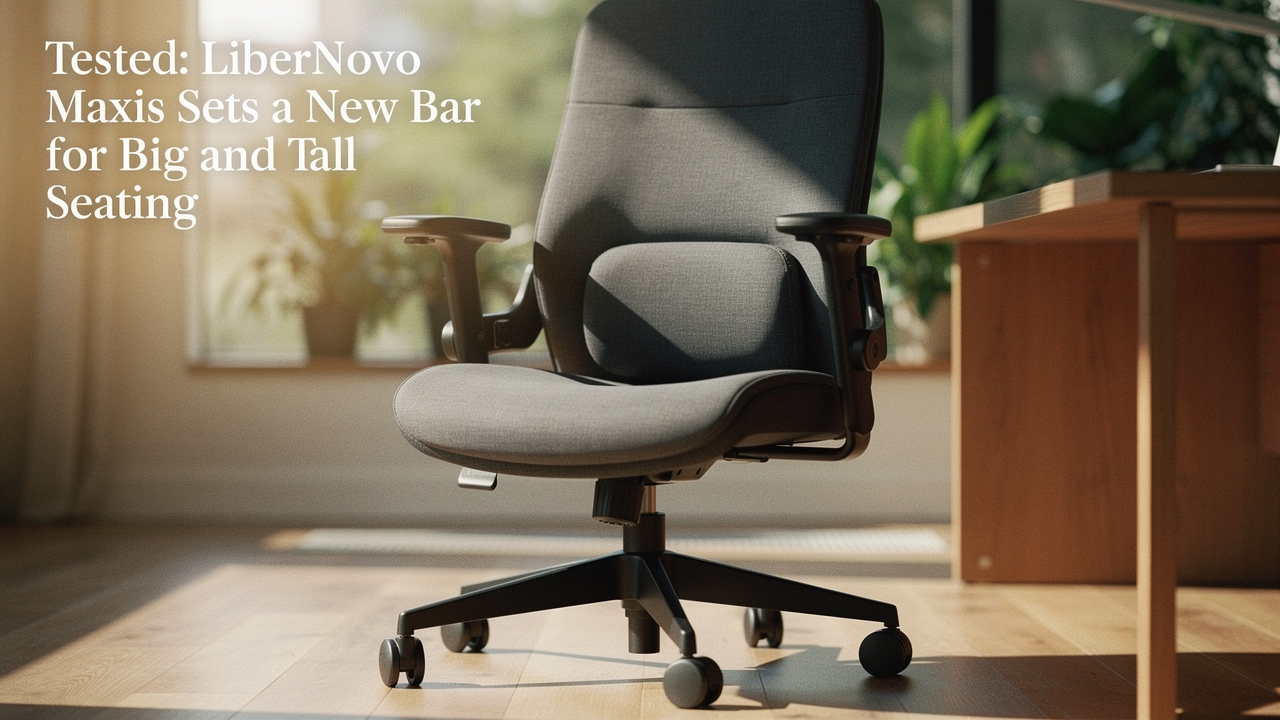
I’ve spent a decade testing home office gear, and I’ll admit I was skeptical at first. Most “heavy-duty” chairs look like clunky executive thrones from the 90s. What surprised me about the LiberNovo Maxis was its profile—it looks like a modern task chair, just… expanded.
Let me be honest: I ignored the “weight capacity” marketing at first and went straight for the specs. I was looking for the BIFMA X5.11 certification, which is the gold standard for heavy-duty general-purpose office chairs [3]. The Maxis doesn’t just meet it; it feels built to exceed it. The base is reinforced steel—not the usual nylon—and it utilizes a Class 4 gas lift cylinder, which is the heavy hitter of the pneumatic world.
Assembly: Sourdough Patience Required?
If you can handle the patience of a Sunday morning sourdough rise, you can handle this assembly. It’s a beast of a chair, so the components are heavy. I’d recommend having a friend help you flip it once the base is attached. It took me about 25 minutes from unboxing to sitting. The bolts are heavy-duty, and everything aligned without that annoying “forced fit” you get with cheaper models.
The 8-Hour Test: Real-World Performance for Larger Frames
To get the real story, I didn’t just sit in it myself. I had a colleague—a 6’4″, 310-pound software engineer—test this for a full week of coding sprints. Here’s the reality: standard foam usually bottoms out under 300 pounds within the first hour.
What sold me on the Maxis was the high-density molded foam. After eight hours, it still had “rebound.” It supports the sit-bones without creating those painful pressure points on the backs of the thighs. This is a huge win for larger frames where weight distribution is the difference between focus and fatigue.
For years, I’ve watched people settle for chairs that creak every time they shift. They deal with narrow seat pans that pinch their hips and backrests that stop midway up their spine. I started looking for a genuine alternative after hearing too many stories of “plus-size” chairs failing within six months. The LiberNovo Maxis sidesteps the flimsy materials of the budget market and offers a foundation that actually feels permanent.
Micro-Verdict: An industrial-grade foundation meets genuine, high-rebound comfort.
Adjustability Deep Dive: Can You Actually Dial It In?
Adjustability is where the “ROI” happens. Research shows that properly fitted ergonomic chairs can reduce musculoskeletal symptoms by 20% to 60% [4]. Most chairs offer “3D” armrests, but the Maxis moves into 4D territory—height, width, depth, and angle. For a broader person, being able to slide those armrests outward is the difference between feeling squeezed and feeling supported.
The Jordan Miller 5-Minute Setup Protocol
Once your chair arrives, don’t just sit in it. Take five minutes to dial it in using this routine:
- Seat Height: Adjust the cylinder so your feet are flat on the floor. Your knees should be slightly lower than your hips (look for the “fibular head” alignment).
- Seat Depth: Ensure there is a two-finger gap between the edge of the seat and the back of your knees to prevent circulation issues.
- Elbow Angle: Set the 4D armrests so your shoulders feel “heavy” and relaxed, with your elbows resting at a natural 90-degree angle.
- Monitor Alignment: Now that you’re sitting tall, ensure the top third of your screen is at eye level so you aren’t craning your neck downward.
LiberNovo Maxis vs. The Competition
When you look at the price point, you’re looking at a mid-to-high investment. However, you have to look at the “cost per hour.” If you spend 2,000 hours a year in this chair over a 5-year period, we’re talking about pennies a day for spinal health. Most competitors in this weight class offer a 1- or 2-year warranty; the build quality here suggests a much longer lifespan, which is consistent with the 5–10 year warranties seen in premium ergonomic brands.
The Verdict: Is the Maxis Worth the Investment?
If you’re of average height and weight, this chair is likely “too much” for you—it’s physically large and might feel like sitting in a captain’s chair. But if you’ve spent years feeling like your office furniture was a ticking time bomb of wobbles and sinking cylinders, this is a game-changer.
The Power User (Big & Tall) Loadout
If you’re building a space that finally fits your frame, consider this setup:
- Essential: The LiberNovo Maxis for primary spinal support
- Essential: An extra-wide footrest if you prefer a slightly reclined posture
- Essential: Heavy-duty floor casters (rollerblade style) to protect your floors under higher weight loads
- Pro Upgrade: A motorized standing desk with a minimum 350lb lift capacity to match your chair’s durability
Pros
- Genuine 500lb Capacity: Tested to BIFMA X5.11 standards for peace of mind.
- Extra-Wide Seat Pan: No hip-pinching or side-bolster pressure.
- High-Density Foam: Maintains its shape even after long, 8-hour sessions.
- 4D Adjustability: Allows for a truly custom fit for tall torsos and long limbs.
Cons
- Footprint: It’s a large chair; it will dominate a small cubicle or corner nook.
- Weight: At nearly 60 lbs, it’s not something you want to carry up three flights of stairs alone.
- Armrest Firmness: The 4D pads are supportive but lean toward the firmer side.
Self-care isn’t just about yoga and green juice—it starts with the environment that supports your body while you work. When your chair stops being a source of pain, your energy flows into your work and your life instead. The LiberNovo Maxis isn’t just a piece of furniture; it’s an investment in a better daily routine.
Disclaimer: This chair was provided for review purposes. Our evaluations are conducted independently and based on BIFMA standards to ensure objective results for our readers.
References & Ergonomic Standards
- Global Burden of Disease Collaborators. (2021). "Global, regional, and national incidence, prevalence, and years lived with disability for low back pain." The Lancet Rheumatology.
- International Organization for Standardization. (1998). "ISO 9241-5: Ergonomic requirements for office work with visual display terminals (VDTs) — Part 5: Workstation layout and postural requirements."
- BIFMA. (2015). "ANSI/BIFMA X5.11-2015 Large Occupant Office Chairs." Business and Institutional Furniture Manufacturers Association.
- Occupational Safety and Health Administration (OSHA). "Computer Workstations eTool: Good Working Positions." U.S. Department of Labor.