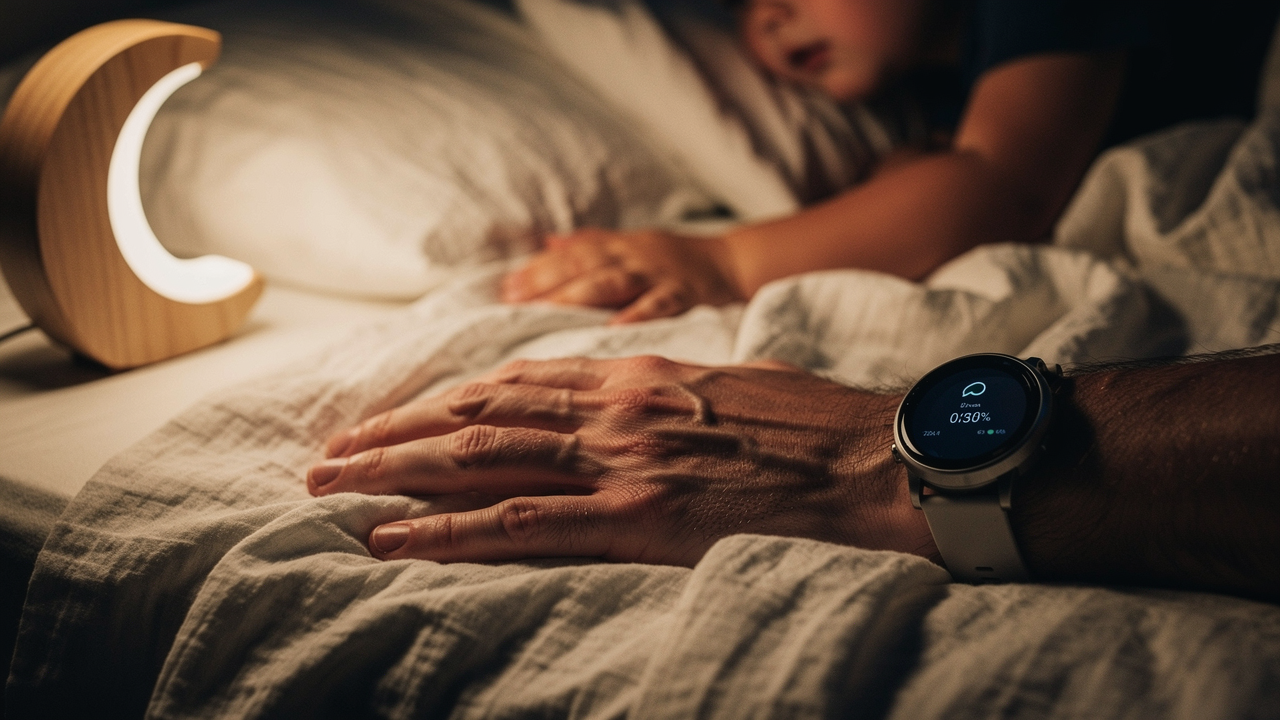
He had spent 11 hours in a blissful, deep-sleep coma while I tossed and turned, ruminating over a work deadline and whether or not I’d remembered to water the ferns on the patio. It’s a humbling moment when you realize a toddler—someone who literally thinks “trousers” are optional—is objectively better at life’s most essential function than you are.
In my world of lifestyle curation, I talk a lot about “High Lifestyle ROI.” There is no higher return on investment than a good night’s sleep. It dictates our mood, our productivity, and how we show up for our families. But as I stared at those two wildly different numbers, I realized that we can’t just track our sleep in a vacuum. We need a family-wide strategy. Today, I’m breaking down why our kids are crushing us on paper, the science of the “parental sleep gap,” and how we can use “toddler logic” to reclaim our own scores.
The Tale of the Tape: Why My Toddler is Crushing Me on Paper
When we look at a sleep score comparison between an adult and a toddler, it’s easy to feel defeated. However, it’s important to understand that we aren’t exactly playing the same game. Most wearable trackers and smart mattresses use proprietary algorithms to “score” our rest. For example, Oura and Eight Sleep look at a combination of total sleep time, efficiency, and heart rate variability (HRV) [1].
For an adult, the National Sleep Foundation generally looks for a sleep efficiency of 85% or higher—meaning you’re actually asleep for at least 85% of the time you’re in bed [2]. My toddler? He hits 95% efficiency without trying. He doesn’t have a “second wind” fueled by a late-night Netflix binge or the lingering cortisol of a stressful email.
Accuracy Check: Are the Sensors Giving My Kid an Unfair Advantage?
Here’s the thing about a wearable sleep tracker: they are incredible for identifying trends, but they aren’t clinical-grade polysomnography. I’ve often wondered if my kid’s high scores were just a result of him being smaller or the sensor being more “generous.”
A PMCID-indexed study titled “Accuracy of 11 Wearable, Nearable, and Airable Consumer Sleep Technologies” actually looked into this. It found that while devices like the Apple Watch 8 and Oura Ring 3 are surprisingly good at detecting macro sleep stages, they can vary significantly in accuracy depending on the metric [3]. For example, some devices are better at detecting deep sleep, while others excel at tracking REM.
What I’ve found in my own “home lab” is that the data is most useful when you stop looking at the raw number and start looking at the delta—the change over time. My toddler’s high score is a reflection of his biological consistency, something we adults tend to trade away for “productivity.”
Why Does My Toddler Sleep Better Than Me? (It’s Not Just Youth)
Let’s be honest: I used to blame it all on “youthful resilience.” But the truth is more scientific. Toddler sleep architecture is fundamentally different from ours. According to the American Academy of Pediatrics (AAP), toddlers need between 11 and 14 hours of total sleep per 24 hours [4]. Their cycles are shorter (~60 minutes compared to our 90 minutes), but they spend a massive chunk of that time in growth-heavy deep sleep.
But the real secret sauce? The routine. A massive 14-country study involving over 10,000 mothers found that children with a consistent bedtime routine slept over an hour longer per night than those without one [5].
What surprised me was how much I had let my own routine slide while I was hyper-focused on his. We ensure our kids have:
- The Environment: Blackout curtains, a cool room (60–67°F), and white noise [2].
- The Wind-Down: No screens 60 minutes before bed, a warm bath, and a predictable story.
- The Consistency: They go to bed at the exact same time every single night.
Meanwhile, I was checking my phone at 10:30 PM and wondering why my “Deep Sleep” metric was in the red. We’ve created “uneven sleep patterns” for ourselves while curating “perfect” ones for them.
The Parent’s Dilemma: Sleep Deprivation and ‘Orthosomnia’
I struggled with this for years. I’d wake up, see a “Fair” score on my ring, and immediately feel more tired than I actually was. This is what researchers are now calling orthosomnia—an unhealthy obsession with achieving “perfect” sleep data.
We are a nation of the “walking tired.” The Cleveland Clinic notes that 50 to 70 million U.S. adults suffer from some form of sleep deprivation [6]. For parents, this is often a “double hit.” We have the biological stress of caregiving combined with the metabolic harm of chronic sleep restriction. MedlinePlus research highlights that this isn’t just about being grumpy; it’s linked to serious metabolic issues and long-term health risks [7].
The irony? Tracking our poor adult sleep can sometimes make it worse. If looking at your data makes you anxious, you’re spiking your cortisol right when you need it to drop. I had to learn to look at my data with “curiosity, not judgment.”
How to Improve Your Adult Sleep Score: The ‘Toddler Logic’ Protocol
If we want to close the gap, we have to start stealing some of that nursery magic. Here is my “High Lifestyle ROI” protocol for sleep optimization.
Step 1: The ‘Hard Cut-Off’ for Stimulants and Screens
My toddler doesn’t have a double espresso at 3 PM or scroll TikTok at 9 PM. Here’s the reality: Caffeine’s effects can linger for 4 to 6 hours [2]. I implemented a “Toddler Cut-Off”: no caffeine after 2 PM and no blue light after 8:30 PM.
Step 2: Stabilizing the Circadian Midpoint
Here’s the thing about “catching up” on weekends: it doesn’t work. An NIH-supported study found that “recovery” sleep on weekends doesn’t reverse the metabolic harm of losing sleep during the week [8]. You’re better off waking up at the same time on Saturday as you do on Tuesday. It keeps your circadian rhythm—your body’s internal clock—from getting “social jetlag.”
Building a Family Sleep Ecosystem
If you’re a data-driven family like mine, you want tools that work together without making your home feel like a surveillance state. Research in Nature Scientific Reports shows that family sleep is actually “concordant”—mothers and children often have synchronized sleep patterns [9].
Here is the “Persona Loadout” for a well-rested household:
- The Data-Driven Parent: A subtle wearable that tracks HRV and recovery without being a distraction.
- The Nursery Sentinel: A non-wearable monitor that tracks breathing and room environment.
- The Environment: Smart lighting that mimics the sunset and a high-quality white noise machine.
Best for Parents: Oura Ring Gen 3
I’ll admit it—I was skeptical at first. I didn’t want another “thing” on my wrist. I’d tried the bulky sports watches, but they felt like a piece of tech I was constantly managing. What sold me on the Oura Ring was its discretion. It looks like a simple band, but it’s packing clinical-grade sensors that monitor my heart rate, temperature, and HRV while I sleep. It’s the first device that didn’t feel like “homework.”
Micro-Verdict: The gold standard for parents who want deep insights without the tech-clutter.
Best for the Nursery: Nanit Pro Smart Baby Monitor
Let me be honest: I ignored the “smart monitor” trend for a while, thinking a basic video feed was enough. But after a few nights of worrying about whether the nursery was too cold or why my toddler was stirring, I switched to the Nanit. It doesn’t require a wearable (which I love—less to charge!), but instead uses computer vision to track sleep patterns and breathing. It gives me a “Sleep Score” for him that actually helps me see if a change in his routine—like an earlier dinner—is working.
Micro-Verdict: Peace of mind for data-loving parents who want to optimize the nursery environment.


My toddler might always win on the “Deep Sleep” duration—that’s just biology. But by leveraging their consistency and our own data, we can absolutely close the gap. Sleep isn’t just a luxury; it’s the ultimate productivity hack and the foundation of a “Good Life.”
Let’s make tonight a little better, together.
***
Disclaimer: I am an optimization geek and lifestyle curator, not a medical doctor. Sleep trackers are intended for trend analysis and lifestyle optimization, not for medical diagnosis. If you struggle with chronic insomnia, sleep apnea, or other clinical disorders, please consult a healthcare professional.
References & Scientific Sources
- Oura Health. (2024). How Oura Measures Sleep. Oura Ring Blog. https://ouraring.com/blog/sleep-score/
- National Sleep Foundation. (2023). Sleep Hygiene Guidelines. https://www.thensf.org/sleep-tips/
- Miller, J. et al. (2023). Accuracy of 11 Wearable, Nearable, and Airable Consumer Sleep Technologies. PMCID: PMC10654909. https://pmc.ncbi.nlm.nih.gov/articles/PMC10654909/
- American Academy of Pediatrics. (2020). Healthy Sleep Habits: How Many Hours Does Your Child Need? https://www.healthychildren.org/English/healthy-living/sleep/Pages/healthy-sleep-habits-how-many-hours-does-your-child-need.aspx
- Mindell, J. A., et al. (2015). Bedtime routines, sleep, and adaptation in young children. Sleep. (Cited by AASM). https://aasm.org/study-shows-that-children-sleep-better-when-they-have-a-nightly-bedtime-routine/
- Cleveland Clinic. (2022). Sleep Deprivation: Symptoms, Causes, and Effects. https://my.clevelandclinic.org/health/diseases/23970-sleep-deprivation
- MedlinePlus. (2023). Sleep Disorders and Health. NIH. https://medlineplus.gov/sleepdisorders.html
- National Institutes of Health. (2019). Irregular Sleep Schedules Can Lead to Bigger Health Issues. NIH MedlinePlus Magazine. https://magazine.medlineplus.gov/article/irregular-sleep-schedules-can-lead-to-bigger-health-issues
- Nature Scientific Reports. (2024). Within-family sleep concordance: Mothers, siblings, and adolescents. https://www.nature.com/articles/s41598-024-76597-2