=
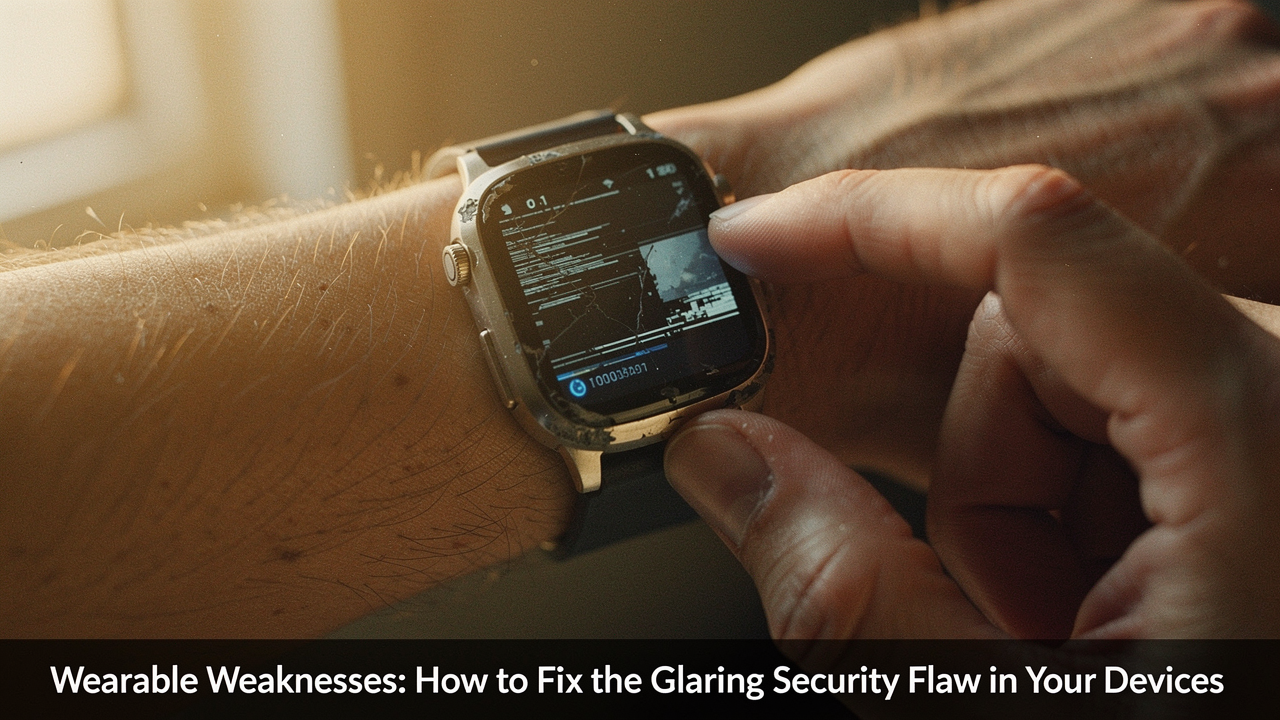
But here is the uncomfortable truth I’ve had to face lately: while these devices are helping us optimize our lives, they are often “leaking” our most intimate details to anyone who knows how to listen. We worry about battery life or whether the screen is bright enough in the Texas sun, but we are ignoring the most glaring weakness of all.
It isn’t a hardware problem. It’s the Invisible Data Lifecycle. From the moment a sensor touches your skin to the second that data hits a server in the cloud, your privacy is on a journey you likely didn’t authorize and can’t easily see.
The Glaring Weakness: Why Your Wearable is an ‘Invisible Snitch’
When we talk about wearable weaknesses, most people think about a shattered Apple Watch screen or a Fitbit that won’t sync. But the real vulnerability is what the Electronic Frontier Foundation (EFF) calls a “digital paper trail” that never ends [5].
The biggest weakness in all wearables is Data Fusion. This is the process where your heart rate, GPS location, and sleep patterns are bundled together and potentially shared with third-party data brokers, advertisers, or even insurance companies. According to the Pew Research Center, between 30% and 50% of us are deeply concerned about how this health data is used, yet we keep the devices strapped to our wrists [4].
We saw the real-world impact of this back in 2018 with the Strava heatmap incident. By simply aggregating public exercise data, the app unintentionally revealed the locations and layouts of secret military bases around the world [4]. If it can expose a secure base, imagine what it says about your daily coffee run or the exact time you leave your house empty every morning.
Understanding Wearable Security and Privacy Risks
Here’s the thing: most of us treat our smartwatches like jewelry, but they are actually powerful IoT (Internet of Things) nodes with massive attack surfaces.
National Institute of Standards and Technology (NIST) guidelines point out that the connection between your watch and your phone is often the weakest link [1]. Bluetooth Low Energy (BLE), while efficient for battery life, can be “sniffed” by hackers in close proximity to intercept data packets. Furthermore, many wearable apps have insecure APIs—basically “digital doors” that aren’t locked properly—allowing savvy actors to bypass your phone’s security entirely.
There is also a massive regulatory gap. In the U.S., HIPAA protects your data at the doctor’s office, but consumer-grade fitness trackers are generally not covered by these privacy laws. The FDA provides guidance for medical-grade devices, but for your standard fitness tracker? It’s often the Wild West [2].
The Accuracy Gap: Can You Trust the Data?
Beyond security, there is a fundamental “wearable device problem” regarding reliability. Studies published in JMIR mHealth and uHealth have shown that step counts can have an error rate of 10–20% depending on your movement style [4]. Even more concerning is heart rate accuracy; optical sensors often struggle during high-intensity intervals, sometimes reporting errors exceeding 10 beats per minute compared to medical-grade ECGs [4].
If you’re making major health decisions based purely on a $50 tracker, you might be optimizing for the wrong metrics.
How to Fix Wearable Device Vulnerabilities (The 5-Step Hardening Guide)
I’ll be honest: I ignored these settings for years because I just wanted to get out the door and run. But once I realized how much data I was broadcasting, I did a “security reset.” Here is how you can protect yourself without losing the benefits of your tech.
1. Harden Your Digital Perimeter (Account Security)
Your wearable is only as secure as the app it talks to. Most “hacks” aren’t sophisticated code-breaking; they are simply someone guessing a reused password.
- Essential: Enable Two-Factor Authentication (2FA) on your Garmin, Fitbit, or Apple account immediately.
- Essential: Use a unique, complex password generated by a manager—never use your social media login to “Quick Sign-In.”
- Pro Upgrade: Use a masked email address (like Apple’s “Hide My Email”) so your primary inbox isn’t linked to your fitness data.
2. Audit Your Permissions & Data Sharing
Let me be real—does your weather app really need “Always On” access to your GPS through your watch? Probably not.
I spent twenty minutes last Sunday digging through my privacy dashboards. I found three old “fitness challenge” apps that still had permission to see my location 24/7. I revoked them instantly. You should look for “Third-Party Integrations” in your settings and prune anything you haven’t used in the last 90 days.
3. Secure the Connection (Bluetooth & Syncing)
Bluetooth is a “chatty” protocol. To minimize risk:
- Action: Turn off Bluetooth on your phone if you aren’t wearing your watch or using it.
- Action: Never sync your wearable data over public Wi-Fi (like at a coffee shop). Wait until you’re on a secure home network or use your cellular data.
- Action: Keep your firmware updated. These updates aren’t just for new emoji; they contain critical security patches that fix vulnerabilities discovered by researchers [2].
Buyer’s Guide: Choosing a Wearable with ‘Security First’ Design
If you are in the market for a new device, you need to look beyond the “Best For” lists and look at the “Security First” posture.
I’ll admit, I was skeptical of the “big brand” ecosystems for a while—I liked the scrappy underdogs. But after researching the security whitepapers from major players vs. budget generic brands I found on Amazon, the difference is staggering.
Many budget trackers have no encryption at all, meaning your heart rate and location are sent in “plain text” through the air. What sold me on sticking with high-end ecosystems was the commitment to on-device processing.
The High-Security Athlete Loadout:
- The Device: A flagship model from a company that publishes regular security audits (e.g., Apple or Garmin).
- The Accessory: A high-quality tech pouch to keep your charging cables and spare bands organized, preventing the loss of small components that might contain local data.
- The Protocol: A monthly “Privacy Reset” on your calendar to check app permissions.
I used to feel a bit exposed wearing a device that knew my pulse better than my partner did. I tried a few budget trackers, but I constantly felt “watched” when ads for knee braces started appearing on my phone after a particularly grueling run. What finally clicked for me was switching to a platform that prioritizes encrypted, on-device processing.
The real win here: You get the life-optimizing data you crave without feeling like you’ve invited a corporate spy into your bedroom.
Bottom Line: Choosing Better Over Having More
Living a “Good Life” in Austin (or anywhere!) means making intentional choices. We don’t have to give up the magic of wearables, but we do have to stop treating them like simple toys.
By taking ten minutes to audit your permissions and choosing devices built on “Security by Design” (like those adhering to ISO/IEC 27001 standards), you reclaim the ROI of your lifestyle tech. Your data is part of your “space”—keep it calm, intentional, and most importantly, yours.
Disclaimer: This guide provides security best practices but cannot guarantee 100% protection against zero-day exploits. Always consult your device manufacturer for the latest security patches.
References & Further Reading
- NIST (2022). Cybersecurity for the Internet of Things (IoT): Baseline Capabilities for Personal Devices. National Institute of Standards and Technology. https://csrc.nist.gov/projects/iot
- FDA (2023). Cybersecurity in Medical Devices: Quality System Considerations and Content of Premarket Submissions. U.S. Food and Drug Administration. https://www.fda.gov/medical-devices
- JMIR mHealth and uHealth (2021). Accuracy of Consumer Wearable Devices for Heart Rate and Step Count. Journal of Medical Internet Research. https://mhealth.jmir.org
- Pew Research Center (2020). Americans and Privacy: Concerned, Confused and Feeling Lack of Control Over Their Personal Information. https://www.pewresearch.org
- EFF (2023). The Privacy Risks of Fitness Trackers. Electronic Frontier Foundation. https://www.eff.org/issues/privacy